

- How to Take Smart Notes by Sonke Ahrens
- Pages: 178
- Published: February 24, 2017
- Read: 1/27/2024 – 2/26/2024
- Rating: 5/5 Stars
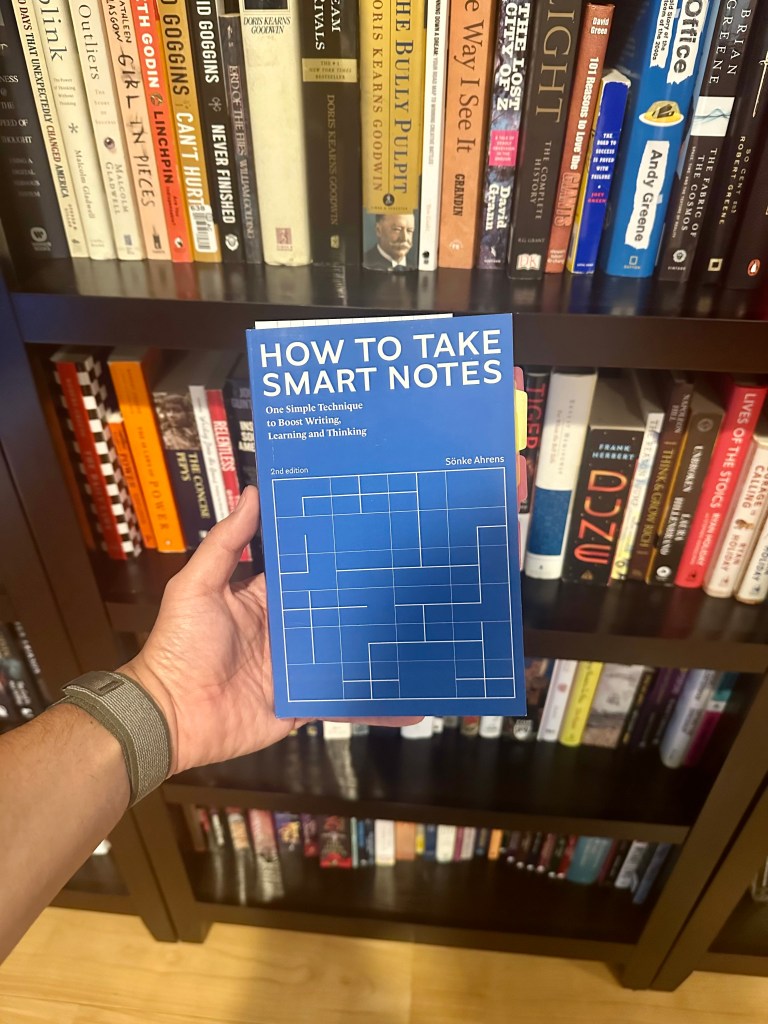
How do you remember what you read? What is the best note-taking app or program out there? What is the best way to take notes? These are all questions that are iterated across countless blog posts and YouTube videos and usually, you end up more lost than when you started. Finding the perfect note-taking system has been the topic I have read the most about in the past few years and like many others, I was on the quest for the perfect system. After wasting countless hours switching between note-taking apps and systems, I realized that the system that frees up your brain to do creative thinking and takes the least amount of time to keep running is best.
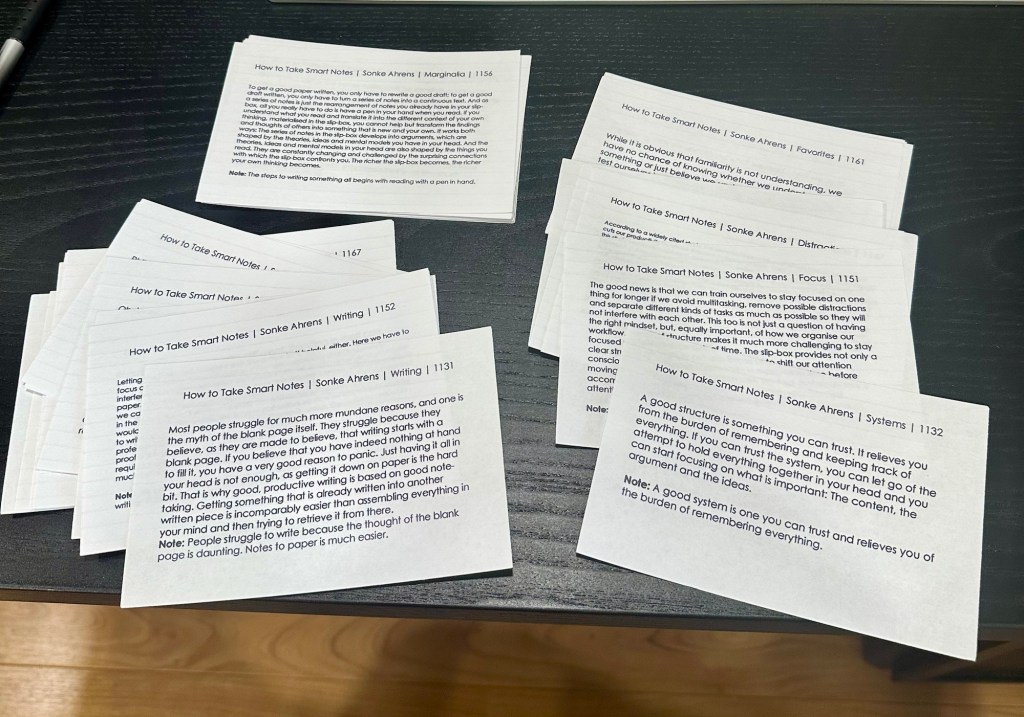
I had heard of the Zettlekasten method many times throughout this journey, but I always believed it to be an outdated system people would use when we didn’t have access to these sophisticated apps, yet here I am, years later, carrying a commonplace book, taking handwritten notes, writing in the margins of physical books, and using physical note cards to save my ideas. The Zettlekasten method (Slip Box Method in English) was a system the great author Niklas Luhmann (1927-1998) made popular. I won’t go in-depth on how the Zettlekasten works in this post, there’s plenty of content out that explains it better than I could, including this book. In short, Luhmann would create fleeting notes which were things you would jot down throughout the day, and literature notes which were notes he would take from his reading. Every day he would distill these notes and create permanent notes which would go onto a notecard. These notecards created the Zettlekasten and would be organized by connections rather than themes. The Zettlekasten would grow organically and become an idea generator for Luhmann’s writing. Like all my other lessons learned posts, this is more than a book review, it is the lessons that I took from the book. For “How to Take Smart Notes” most of the lessons revolve around reading, note-taking, and writing things down. I hope you enjoy it. Here are my lessons learned from How to Take Smart Notes by Sonke Ahrens.
The Importance of Note-Taking
As technology continues to evolve, the number of tools and resources you have at your disposal for information recall and data storage continues to grow. Outside of the basics, your brain doesn’t need to memorize everything anymore, computers can do a much better job at it. The thing your brain is optimized for is deep thinking, and the more resources you can free up for your brain to think, the better results you will get from any creative endeavor you are working on.
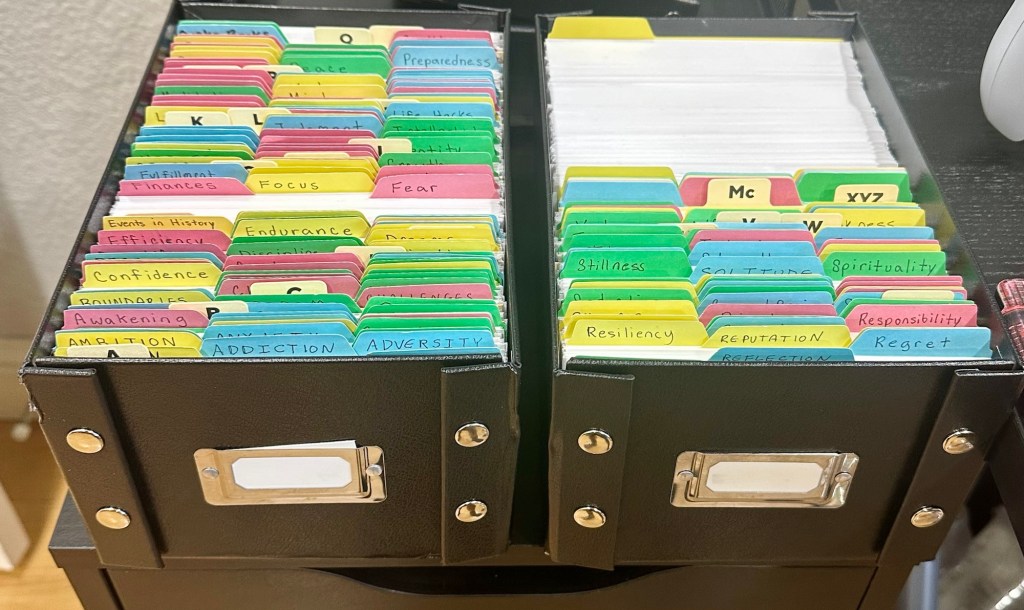
Proper note-taking is the first step to freeing up resources for your brain. One of the most daunting tasks as a creator is getting started, especially as a writer, the blank page staring at you has made many a writer quit. Ahrens explains that proper note-taking is half the work, and when you begin to create a database of notes, you aren’t starting from scratch.
“Most people struggle for much more mundane reasons, and one is the myth of the blank page itself. They struggle because they believe, as they are made to believe, that writing starts with a blank page. If you believe that you have indeed nothing at hand to fill it, you have a very good reason to panic. Just having it all in your head is not enough, as getting it down on paper is the hard bit. That is why good, productive writing is based on good note-taking. Getting something that is already written into another written piece is incomparably easier than assembling everything in your mind and then trying to retrieve it from there.”
Sonke Ahrens
As important as proper note-taking is to free up resources for your brain, a proper system is also essential. The key is to get things out of your brain into a reliable system that you can access to retrieve the information later. The quicker we can remove the burden of memorization from our brain the more resources our brain will have to do the work it was designed for. This system can be a notebook you carry with you to jot things down or a notes app on your phone. There are hundreds of systems out there, don’t go down the rabbit hole trying to figure out which one is best, just pick one that is reliable and run with it.
Niklas Luhmann, one of the best-known users of the Zettlekasten method talked about the importance of writing things down if you want to learn, but for understanding, you must translate it into your own words.
“If you want to learn something for the long run, you have to write it down. If you want to really understand something, you have to translate it into your own words. Thinking takes place as much on paper as in your own head.”
Niklas Luhmann
A good practice to bring value from your reading is not to just highlight anything that resonates with you and leave it at that. You need to either put the passage you saved into your own words or add commentary on why it’s important or how you can use it in your writing. There must be a reason why you are saving the passage and putting it into your own words will help you understand it. Many of Luhmann’s associates were surprised by how effortless he made his writing seem. The quality was outstanding, yet Luhmann wasn’t killing himself to create his work, he was having fun, he would go on to say that the Slip Box was doing most of the work for him, he just had to get it on paper. For Luhmann the Zettlekasten freed up resources for his brain to create great writing, he wasn’t using up valuable resources to memorize quotes or ideas, the Zettlekasten did that for him.
Ahrens emphasizes again that the goal of any tool or system is the capability of giving you an undistracted brain.
“That is pretty much it. To have an undistracted brain to think with and a reliable collection of notes to think in is pretty much all we need. Everything else is just clutter.”
Sonke Ahrens
To summarize the lesson, there is great value in note-taking if done correctly. The combination of the way you consume content, take notes, and store information are all a part of a system, regardless of which one you use, you need to remember that the goal is to free up resources for your brain.
“The slip-box takes care of storing facts and information. Thinking and understanding is what it can’t take off your shoulders, which is why it makes sense to focus on this part of the work. That it facilitates learning as well is a nice side effect.”
Sonke Ahrens
Always Have a Way to Capture Your Ideas
I am a big believer in the commonplace book and the more I read about the great thinkers in history they all had something in common: they loved to read, and they wrote things down. Just like the note-taking system, the way that you write things down doesn’t matter if you are getting the ideas out of your brain.

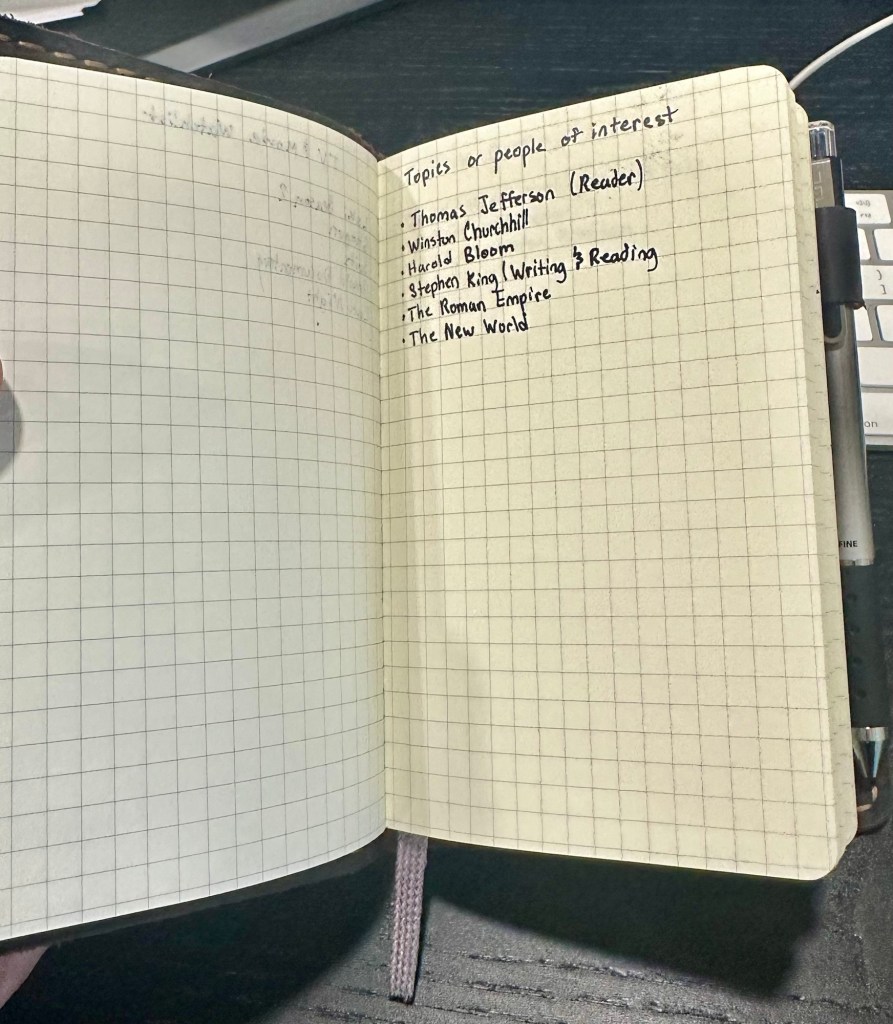
“You need something to capture ideas whenever and wherever they pop into your head. Whatever you use, it should not require any thoughts, attention or multiple steps to write it down. It can be a notebook, a napkin, an app on your phone or iPad.”
Sonke Ahrens
For people who work in an office, it may be more convenient to have a text document open for always jotting down ideas or a notepad on your desk. For people on the go, it may be easier to carry a pocket notebook or use the notes app on your phone. Luhmann called these “fleeting notes” which were thoughts or ideas we jotted down throughout the day and could eventually become permanent notes which were the actual note cards that would go in the Zettlekasten.
“I recommend having pen and paper with you at all times. It is really hard to beat a notebook in its simplicity. If you use other tools, make sure everything ends up in one place, a central inbox or something like that, where you can process it soon, ideally within a day.”
Sonke Ahrens
Regardless of the tool you use, the information that comes in needs to be in a central location that can be distilled either daily, weekly, or monthly, depending on how many things you are saving. For myself I have an inbox notebook on Evernote that everything digital gets sent to throughout the week, on Sunday afternoon I go through and turn some of them into permanent notes and discard the rest. The same goes for my everyday carry pocket notebook which stores all my ideas that come to me throughout the day. I distill this one once it fills up and create perhaps ten permanent notes for every notebook I fill up. It may seem like a lot I write down goes to waste but in reality, I am just constantly offloading things to the notebook, so my brain has as many resources as possible to think.
Always Be Learning
In this blog, I constantly preach taking action. Don’t be a collector of information and do something with all the reading you’re doing. On the other side of this argument, you can take the idea of taking action too far and completely stop researching. There needs to be a fine balance and you need to treat research as a slow burn that constantly runs in the background. For myself, scheduling a 30-minute reading session every day keeps that steady flow of information coming into my system while I continue to dedicate the majority of my time to taking action (writing for me) in my craft. Ahrens has a great quote talking about the importance of focusing on your work but continuing to learn.
“Working as if nothing else counts than writing does not mean spending more time writing at the expense of everything else. Only if we compartmentalize our work into different, isolated tasks will it seem like focusing on writing reduces the time we spend on other tasks. But it does not mean to read less, for this is the main source of the writing material. It doesn’t mean to attend fewer lectures or seminars, because they provide you with the ideas to write about and questions worth answering.”
Sonke Ahrens
One of the most embarrassing situations as a reader is when you are talking about a book and people start to ask you questions about it and you are completely stumped. That’s why it’s a good idea to put notes you save from a book into your own words and revisit those notes every so often. It’s been proven that active recall and using your own words are essential to learning. If you go back and your notes make no sense to you, most likely you didn’t put them in your own words.
This may seem like a lot of work, but you must ask yourself what am I doing all of this for? Is it to become smarter and learn or am I just wanting to show off how smart I look by displaying the number of books I’ve read, even if I didn’t learn anything from them? Ahrens tells us that there comes a moment when we must make a choice.
“Now we are faced with a clear choice: We have to choose between feeling smarter or becoming smarter. And while writing down an idea feels like a detour, extra time spent, not writing it down is the real waste of time, as it renders most of what we read as ineffectual.”
Sonke Ahrens
Do you want to feel smarter or actually become smarter?
Stop Multitasking
I believe that multitasking is only successful if you are doing activities that don’t require brain power. Yes, you can fold laundry while watching TV or listen to a podcast while mowing the lawn, because one of these activities uses very little brain power. On the other hand, context switching between activities that require critical thinking will diminish the quality and increase the time they take to complete. My own experience with this lesson was after reading Deep Work by Cal Newport, Cal would emphasize that 1 hour of undistracted deep work is the equivalent of 4 hours of distracted work. I tested this out myself when I went back to college in my 30s and after I locked myself in my office for 1 hour at a time, not bringing my phone with me, I miraculously began to understand all the coursework easily and passed the rest of my classes without spending hours cramming for every test.
The problem with focus is that it’s a skill that can be unlearned, and the easiest way to unlearn is it to never allow yourself to be bored. By being bored, I mean never allowing your mind to wander and think. At every hint of boredom, you go to grab your phone or do something to distract yourself. Next time you’re in line at the supermarket or are waiting for the server to bring your food, look around and let your mind wander, it will be concerning how many people are glued to their phones, filling their brains with constant distraction. This rears its ugly head when you need to focus on something that requires deep thinking, your mind is constantly making you desire that quick fix of distraction from your phone, causing you to produce low-quality work for a longer period. Focus can be retrained by giving yourself short sessions throughout the day to just be bored, this may seem counterproductive until you think of it as a training activity to regain your ability to focus. These sessions can start small, like once a week commuting to work with nothing playing through the radio, letting your mind wander, and observing your surroundings. Going on walks without your phone is also a great way to regain your focus. Another added benefit is that walking has been proven to improve your thinking and is great for your health. Many of the greatest thinkers in history give credit to a long walk for their moments of enlightenment.
Allow yourself to be bored every once in a while and watch how much your concentration improves when faced with a difficult task.
Final Thoughts
How to Take Smart Notes was one of the most difficult books I’ve had to summarize because the book has no fluff. Every page is filled with knowledge. I created 42 permanent notes from a book that is only 178 pages long. I strongly encourage you to read this book whether you create a Zettlekasten or use your own system, it brings great value if you are looking for ways to improve your learning and creativity.
If you enjoyed this content, please sign up for our newsletter below, share this post with a friend, or read some of our other blog posts. Thanks for stopping by.
Disclosure: Some of the links in this post are affiliate links. This means that, at zero cost to you, I will earn an affiliate commission if you click through the link and finalize a purchase.

 Book Ponder
Leave a comment