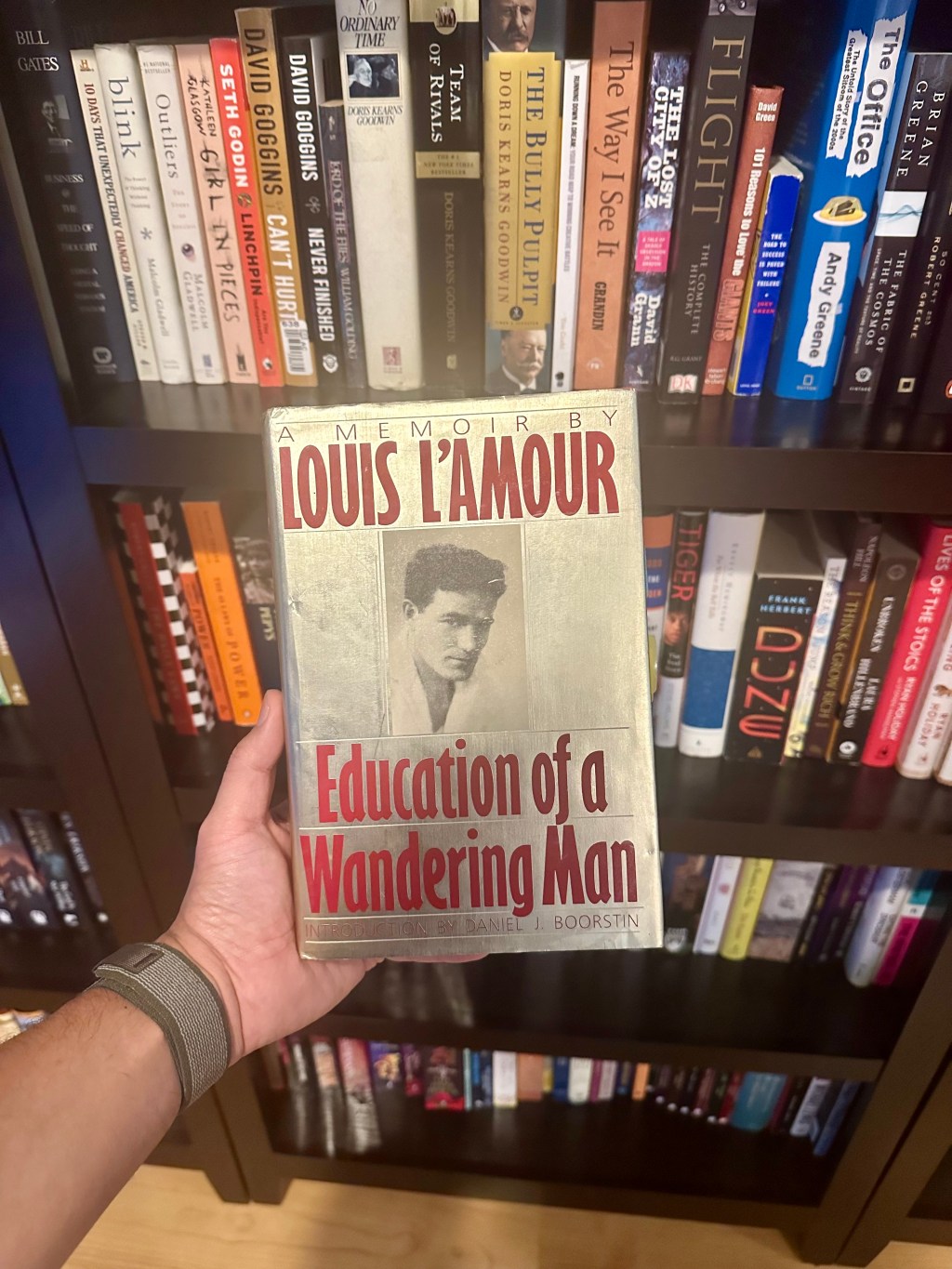
- Education of a Wandering Man by Louis L’Amour
- Pages: 272
- Published: November 1, 1989
- Read: 1/31/2024 – 2/11/2024
- Rating: 5/5 Stars
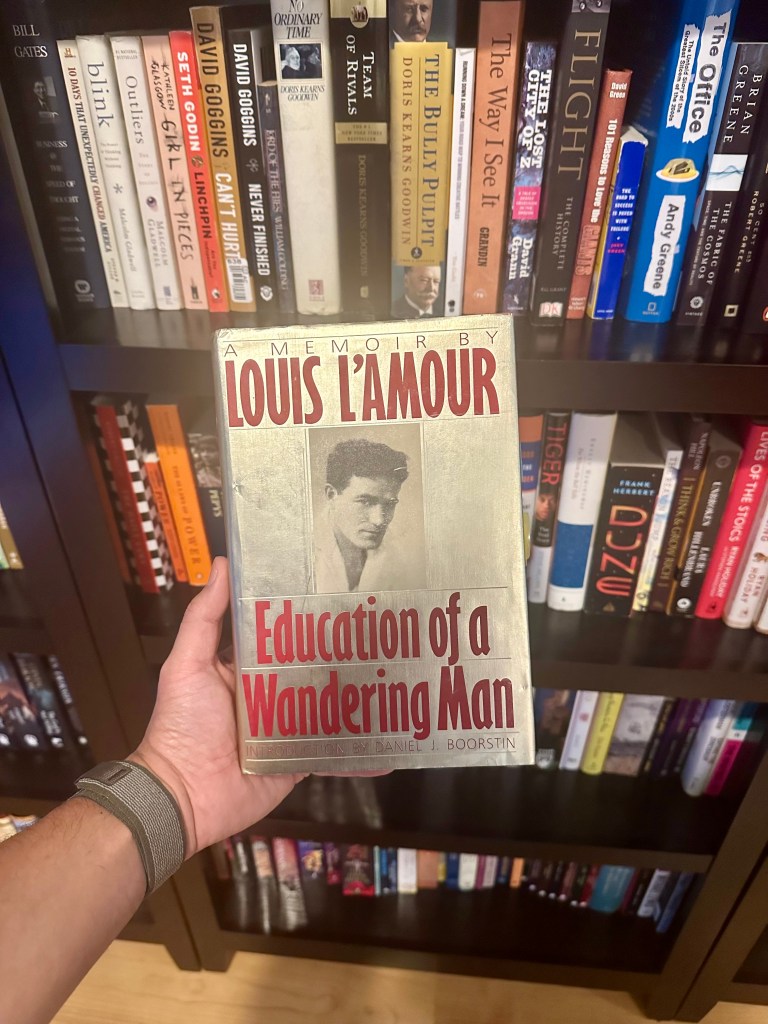
The Education of a Wandering Man is a memoir of the famous author Louis L’Amour, born in 1908, he went on to write over 100 works, mostly westerns. This book focuses on his life growing up during the great depression when he came to heavily rely on books, travel, and self-education to become the man he ended up being. Here are the lessons I learned.
You Can Find Time to Read
The most common excuse people use for not being able to do something is that they do not have enough time. While I’m not questioning how busy your life is, you will be surprised by how many moments of free time you have that end up being filled by scrolling on your phone. Even before iPhones and Netflix, people were using the same excuse.
“Often I hear people say they do not have time to read. That’s absolute nonsense. In the one year during which I kept that kind of record, I read twenty-five books while waiting for people. In offices, applying for jobs, waiting to see a dentist, waiting in a restaurant for friends, many such places. I read on buses, trains, and planes. If one really wants to learn, one has to decide what is important. Spending an evening on the town? Attending a ball game? Or learning something that can be with you your life long?”
(L’Amour, 1990)
It takes being aware of lost reading opportunities during short breaks or leisure time throughout the day and making sacrifices to make more time to read. At first, reading may seem like a hobby but once you become an advanced reader and read to learn, it becomes a tool for life.
Starting in 1919 a Kansas publishing company started creating “Little Blue Books” which could easily fit in your pocket and became popular for having something to always read. L’Amour would stuff his pockets with these little books to never let small reading opportunities go to waste.
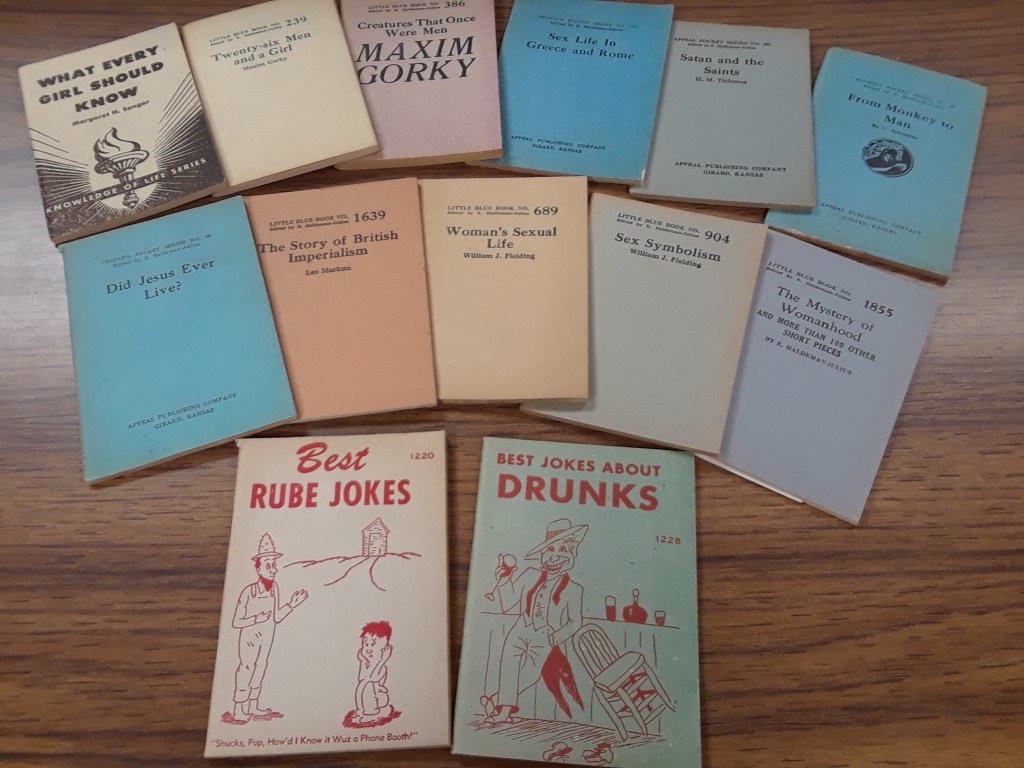
“The Little Blue Books were a godsend to wandering men and no doubt to many others. Published in Girard, Kansas, by Haldeman-Julius, they were slight larger than a playing card and had sky-blue paper covers with heavy black print titles. I believe there were something more than three thousand titles in all and they were sold on newsstands for 5 or 10 cents each. Often in the years following, I carried ten or fifteen of them in my pockets, reading when I could.”
(L’Amour, 1990)
Granted that we have more things fighting for our attention today than in the early 1900’s we also have many more tools to fight against it. The same device that vies for our attention can be curated to be an awesome learning tool and can allow us to learn by watching, listening, or reading at any given moment.
They even made Kindle readers that can fit in our pocket, you can carry thousands of books with you at all times, Louis knew how important reading was to his life and would make sacrifices to read any chance he got, even if he didn’t own a Kindle.
I was never without a book, carrying one with me wherever I went and reading at every opportunity. Often I would eat alone in restaurants, arriving after the rush period and spending a good bit of time over coffee, reading, taking notes on books I expected to write, or thinking about what I was reading.
(L’Amour, 1990)
Have you ever found yourself scrolling through Netflix not finding anything good to watch, or endlessly scrolling through social media even though it’s not entertaining anymore? This is a burnout from the constant dopamine hits that short-form entertainment gives us because the gratification has no delay. Even watching a movie is a better form of leisure because we must follow along for 1-2 hours and we get rewarded by finding out what happens at the end. The same goes for reading, picking up and reading a book for a few minutes will feel like a monumental task after our dopamine rewards system has been fried from constant gratification every few seconds. We will feel boredom set in quickly and the desire to check our phones will quickly overcome us. In his books “Deep Work” and “Digital Minimalism” Cal Newport talks about the similarities between being able to be bored and being able to focus and how they go hand in hand. Someone who never allows themselves to be bored and pulls out their smartphone at even the slightest hint of boredom will have a hard time focusing on things like reading. Once you can regain the relationship with delayed gratification and begin to consume more long-form content you will see how many great books are out there and you will never run out of adventures to go on or things to learn about.
“Looking back over my years of reading, I am amazed at how much really wonderful stuff there is out there, and it is a pity that anyone should deprive himself of the chance to read it, yet many do. Ours is not a leisurely time, and our readers prefer page-turners, stories or other books that lead one eagerly from page to page. It is also important, to those for whom reading is difficult, to have books that demand one read on, and on.“
(L’Amour, 1990)
When you find something truly important to you like books were for L’Amour you begin to make sacrifices for it. You’re thing might not be writing and reading like it was for Louis but whatever your goals are, you will have to make sacrifices along the way like Louis did.
“Each book gave me much to think about, and on my long bus rides I frequently went over what I had read. For a while during this period I lived on one sandwich a day so I could save the money to buy three books of which I had read reviews. They were Marriage and Morals by Bertrand Russell, Liberty Under the Soviets by Roger Baldwin, and Men and Machines by Stuart Chase.“
(L’Amour, 1990)
The great thing about books is the level of friction to begin reading is extremely low. L’Amour puts it best, “A book can be carried away and read at leisure. It needs nothing but an eye, a brain, and the ability to read.” With the recent rise of audiobooks, the friction for reading is at an all-time low, you can pop an audiobook while most passive activities. Doing yard work has never been better when I can listen to my favorite books at the same time.
In conclusion to this lesson, the time to read is there you just have to look for it, and in some cases, you have to make some sacrifices to find it. Reading may not be your thing right now but if it’s something you’re interested in then reading what you love until you love to read, still stands true today. Don’t jump into the most difficult books because they are on a list of “books to read before you die”, instead read something you enjoy, building that love for reading first.
“For those who have not been readers, my advice is to read what entertains you. Reading is fun. Reading is adventure. It is not important what you read at first, only that you read.“
(L’Amour, 1990)
Don’t Remain Uneducated
Louis L’Amour believed there was no reason for anyone to remain uneducated if they had the desire and persistence to learn.
“There is no reason why anyone cannot get an education if he or she wants it badly enough and is persistent. Most cities have libraries, and often state libraries will mail books to a reader. Books are available on every conceivable subject and there are many very good “how to” books from which one can learn the basics of a trade.“
(L’Amour, 1990)
If Louis believed we had the resources back then, imagine what he would think now. Just the internet alone is enough to fill your free time with learning anything you can think of, now you even have that access with you in your pocket or purse at all times, yet we rather spend it mindlessly scrolling for entertainment purposes. You can have the greatest tools on earth but until you have the discipline to use them correctly you will let it go to waste.
This stems from the question, “What about formal education?” L’Amour always believed in formal education as a road map or outline on how or what to study for a certain career but it didn’t do well in guiding you to find what you love.
“No matter how much I admire our schools, I know that no university exists that can provide an education; what a university can provide is an outline, to give the learner a direction and guidance. The rest one has to do for oneself.”
(L’Amour, 1990)
Many parents and students believe that education should do all the work for you, that’s what you’re paying them for right? A university can give you the road map, but we must educate ourselves, especially after our formal education years are over. Many of you believe that our education ends once we have a job in our field and have graduated from college, but that’s when our education should be prioritized even more, now we have the freedom to learn about anything we want on our own time.
The reason the majority of great people in history were voracious readers was because they knew the superpower of reading. Books give you the knowledge it took someone a lifetime to acquire, in a couple hundred pages. Think about that for a moment, whatever problem you may be facing in your life right now, someone in history went through the same problem, overcame it, and wrote about it. Is there anything more valuable than that?
“It is often said that one has but one life to live, but that is nonsense. For one who reads, there is no limit to the number of lives that may be lived, for fiction, biography, and history offer an inexhaustible number of lives in many parts of the world, in all periods of time. So it was with me. I saved myself much hardship by learning from the experiences of others, learning what to expect and what to avoid. I have no doubt that my vicarious experience saved me from mistakes I might otherwise have made—not to say I did not make many along the way.“
(L’Amour, 1990)
As you go off on the journey of self-education it is important to find what kind of learning resonates with you. This can vary from location, medium, and timing. For the early rises reading a good book before the start of your day can be your own thing, for the night owls, staying up into the morning watching YouTube videos on how to program may be your thing. That’s the great thing about becoming an autodidact, is the freedom to learn however way we want.
“My way was suited to me. I have never been very good at taking instruction. I enjoy lectures, and have attended many, but mostly I prefer the quiet of a library and the freedom to go off in any direction that pleases me.”
(L’Amour, 1990)
According to L’Amour, the greatest gift you can give another is the desire to know. Even if the feeling is short-lived, doesn’t it feel great when we become curious about something? Those initial moments of hearing about it for the first time and you just want to rush home and watch some videos about it and then read some books. I find many of these when reading books and the author will mention a related work, topic, or person I had never heard about. Desire is the key, but we must put ourselves in situations where we are open to receiving the spark to start that fire. Louis has a great quote about the desire to learn that was one of my favorites in the entire book.
“I think the greatest gift anyone can give to another is the desire to know, to understand. Life is not for simply watching spectator sports, or for taking part in them; it is not for simply living from one working day to the next. Life is for delving, discovering, learning. Today, one can sit in the comfort of his own home and explore any part of the world or even outer space through books. They are all around us, offering such riches as can scarcely be believed. Also, I might add, having done both, it is better to sit in comfort with a cold drink at hand and read the tale than to actually walk out of the Mohave Desert as I did. The armchair adventurer has all the advantages, believe me. As I have said elsewhere, and more than once, I believe adventure is nothing but a romantic name for trouble. What people speak of as adventure is something nobody in his right mind would seek out, and it becomes romantic only when one is safely at home. It is much better to watch someone riding a camel across a desert on a movie screen than it is to be up on the camel’s back, traveling at a pace of two and a half to three miles per hour through a blazing hot day with the sand blowing.”
(L’Amour, 1990)
The second most common excuse after not having enough time that I get from people when I advise them to read and learn more is that their brain is already too full. By too full they believe that they feel overwhelmed with life as it currently is and that there is no way they could fit anything else onto their plate. While it may be true that you are incredibly busy, a lot of the feeling of being overwhelmed may just be a lack of structure and organization. Realistically, there are no limits to the human mind.
“Personally, I do not believe the human mind has any limits but those we impose ourselves. I believe that creativity and inventiveness are there for anybody willing to apply himself. I do not believe that man has even begun to realize who he is or what he can become. So far he has been playing it by ear, following paths of least resistance, getting by—because most others were just getting by too.”
(L’Amour, 1990)
Our mind isn’t what’s holding us back from doing more, when we can make the time, our mind will be ready to serve us.
The third most common excuse people use to not educate themselves is that they do not have the right teacher. While nothing compares to one-on-one mentorship, you forget that books are teachers. L’Amour emphasizes that great people are constantly forgotten about, but the authors of great books are remembered forever and are always there to teach us their lessons.
“Who remembers the millionaires of the past? Who even remembers the popular heroes? But we do remember a poor stonecutter in Athens named Socrates, a thief from the gutters of Paris named Francois Villon, an actor in London called Shakespeare, a poor farmer in Scotland named Robert Burns, and a weaver in Mayilapur who wrote the Kural. Upon the shelves of our libraries, the world’s greatest teachers await our questions.”
(L’Amour, 1990)
While an actual teacher has its advantages, a good book can teach forever.
“Without books we should very likely be a still-primitive people living in the shadow of traditions that faded with years until only a blur remained, and different memories would remember the past in different ways. A parent or a teacher has only his lifetime; a good book can teach forever.”
(L’Amour, 1990)
“BOOKS ARE THE building blocks of civilization, for without the written word, a man knows nothing beyond what occurs during his own brief years and, perhaps, in a few tales his parents tell him. Without books, we would never have known of Julius Caesar, Cleopatra, or Hannibal. George Washington would have been forgotten and Abraham Lincoln a vague memory.”
(L’Amour, 1990)
You now have plenty of reasons to not remain uneducated. Open yourself up to find the desire to learn, and once you do, use all the resources at your disposal, and give it all you’ve got.
You Can Be Lonely While Not Being Alone
Have you ever been surrounded by people but still felt alone, that’s because you aren’t surrounded by the right people. There can be many reasons for this, you may not have anything in common with these people or share any interests with them. L’Amour talks about facing this same dilemma of being surrounded by people but still longing for someone who shares his interests.
“I suppose I was lonely. I know that often I longed for someone with whom I could talk of books, writers, and things of the mind, but that was not to be for a long time, except here and there when I chanced on some other lost literary soul. Loneliness is of many kinds, and the mere presence and companionship of people does not suffice. The people I had been meeting were friendly, pleasant, and the salt of the earth, but they did not speak my language. I enjoyed them, but something in me reached out for more.”
(L’Amour, 1990)
Loneliness can come in different shapes and forms. Sometimes you need to find the right people to surround yourself with, this can be accomplished by hanging around places that host people with similar interests as yours. With social media now that can be easier than ever, there are groups out there for any interest you can think of, it just takes a little bit of effort.
On the opposite end of this idea, you also need to work on not relying on others for your happiness. Relationships need to be considered as a bonus to your happiness, not the sole cause for your happiness. You need to work on being happy by yourself in doing things you love and growing as a person, then when you meet the right friends or partners, they will be a bonus. L’Amour quotes Professor Thomas Davidson in being happy alone.
“Associate with the noblest people you can find; read the best books; live with the mighty. But learn to be happy alone. Rely upon your own energies, and so not wait for, or depend on other people.”
Just Start
While L’Amour’s advice is directed at writers, I believe it can be associated with anyone having a hard time starting something. People complain that they don’t have any ideas, or they don’t know what to read about but Louis believes that nothing will happen if you never start, just like the water does not flow until the faucet is turned on.
“There are so many wonderful stories to be written, and so much material to be used. When I hear people talking of writer’s block, I am amazed. Start writing, no matter about what. The water does not flow until the faucet is turned on. You can sit and look at a page for a long time and nothing will happen. Start writing and it will.”
(L’Amour, 1990)
Whatever you are trying to create, just start with something. Even if it’s putting your ideas on paper, starting anything will get the ball rolling and allow your mind to shift into creator mode. There’s no excuse to not have ideas because there are a million things to write about or create, and the resources for them are out there, you just must find them.
Once you start creating the work you are destined to do, the results don’t matter. While using the results as a guide on adjustments or areas of focus, it shouldn’t be a parameter to start working on the next things. Many authors including L’Amour believe in starting the next thing right away instead of waiting for the results of the thing you just finished. That thing is done, it’s time to start working on the next one.
“My secret was that no sooner did I put something in the mail than I wrote something else and sent it off. Each rejection was cushioned by my expectations for the other manuscripts. Too many writers put their all into one script, and when it is rejected they are devastated.”
(L’Amour, 1990)
While mentorship and finding a great teacher are very important when you are in the process of honing your craft, there comes a time when you must find your way. If you are constantly seeking help with every step of the process, you will never become self-sufficient. Allow yourself to figure things out on your own, allow yourself to fail, and learn from your mistakes. L’Amour took self-education and writing to another level and usually allowed his experiences and failure to guide him to success instead of asking for help.
“Often I am asked if any writer ever helped or advised me. None did. However, I was not asking for help either, and I do not believe one should. If one wishes to write, he or she had better be writing, and there is no real way in which one writer can help another. Each must find his own way, as I was to find mine.”
(L’Amour, 1990)
Each of you must find your own way in writing or anything you want to create.
Another excuse people use to not get work done is not having the right circumstances. People will use every excuse in the book to not do the work, either the weather is off, they don’t have the perfect program, they aren’t in the right mood, it’s not the right time, or they haven’t done enough research. I find myself in this dilemma also but I will justify it by doing something productive when in reality it’s just the “art of productive procrastinating” when you do something that’s considered productive but much less urgent, to avoid doing the real work. As a writer this happens often with having to do more research or read more books, that’s the fun part, sitting down to write is the actual work. Louis also emphasizes that a writer did not need the perfect atmosphere to write, they could do their craft anywhere.
“PPeople are always interested in how a writer works, as if that made a difference. Some imagine a writer must have complete quiet, or some special atmosphere. The fact is, a professional writer can write anywhere, although some environments are undoubtedly more favorable than others. Some excellent writing is done these days by newspaper people working in a bustling, busy newsroom.”
(L’Amour, 1990)
There is an extreme solution that war leaders would use to have their troops go all in and hold nothing back, it was called “burn the boats”. When they landed on an island to fight a battle, burning the boats behind them gave them no other way of escape besides winning the war, in extreme cases, you must burn the boats to go all in on what you want to become. Today that would translate to something like quitting your job to go all in on your passion. This advice needs to be taken with caution, especially when others rely on your well-being like family. I still wanted to put it out there because if you have nothing to lose. Why not burn the boats? Louis L’Amour felt this way about his writing, he knew he had no other choice.
“For me there was no choice. Whatever else I did, I had to make a living from my writing, and that meant work and lots of it.“
(L’Amour, 1990)
The Power of Stories
Stories are ideas. When we feel like there isn’t anything to write about or are bored with the same things, realize how rich and wonderful our world is. Learn about it and experience it.
“There were places and people to be seen and remembered, there were stories to be heard, and I was hungry for them all. Ours is a rich and wonderful world, and there are stories everywhere. Nobody should ever try to second-guess history; the facts are fantastic enough.”
(L’Amour, 1990)
The only downside to history is that the farther we go back the more biased it becomes because writing was an art, and for most of history that art was excluded to the elites. We didn’t hear much about the farmers and laborers until writing and reading began to become accessible to all. That’s why being literate is so important regardless of what your status is.
“THERE IS A tendency, I believe, sometimes to judge the life-style of a whole people by what we know of a group. Writers and artists are inclined to life-styles different from those of artisans or farmers, merchants or soldiers. Most of what history we have was written by people who did not labor for their bread, or if they did, like Socrates, they often courted or associated with a different kind of people from their fellow workmen. We know all too little of how work was done in times past, as such things were deemed beneath notice, a matter for slaves or other laborers. Most of our pictures of ancient life are offered us by an elite group, concerned with themselves and their way of life.”
(L’Amour, 1990)
That’s why books that were written by non-elites sometimes become classics because it was so rare to get a view of day to day life of regular people. A great example of this is the book “12 Years a Slave”. It sat in obscurity for nearly 100 years before being rediscovered and brought to mass media. We got an inside view of what it was like to be a slave in the 1800s instead of reading about it from the point of view of someone who never experienced it. A lot of the history of regular people is lost because, in the old days, they weren’t the ones doing the writing.
This has led to much of American history being untold. L’Amour believed that a great amount of history that claims to be the first to have done something, is usually incorrect and there was most likely someone that already did it before them. A great example is that many believe Lewis and Clark were the first to trek across North America, yet many came before them, this was just the first documented account.
“As I delved deeper into the background of America, I became tantalized by the unwritten chapters, most of which we will never know because the information simply is not there. Of course, there is always the chance that in old records in England, France, or Spain we may turn up stories now unknown. The records we have are those of known explorations, but what of the many that were unknown? In doing research one stumbles upon tantalizing tidbits, mentions of white men living with Indians in areas where no white men were known to be, mentions of boatloads of Carolina adventurers at the mouth of the Ohio a hundred years before Daniel Boone was born, of that party of French people who went west from Illinois to Washington before Lewis and Clark’s trek over almost the same route. In almost every instance where somebody was supposed to be first, we find there was somebody already there.”
(L’Amour, 1990)
History is a great resource, and we should continue to learn from it, but moving forward everyone should make a habit of writing things down and writing their own story so moving forward history continues to become more accurate.
The Book Collector
Ask any bibliophile what the first thing they look for when they go into someone’s home for the first time is, and they will say “I look for the bookshelves”. We hope every home has at least one, and once you find it, you can almost judge a person by the books they collect. You can almost see what season of their life they are going through based on what they are reading and collecting. If you walked into my home 15 years ago, you would find four cheap Walmart bookshelves crammed with mass-market science fiction and fantasy novels. Today, you will find beautiful bookshelves made of real wood, with books that have greatly impacted my life, mostly history, philosophy, biographies, and the occasional fiction book. They are two completely different phases of my life, yet each one was very important to me. The phase 15 years ago was just as important because I was learning to love reading, if I jumped into Aristotle 15 years ago, I would’ve hated reading, I wasn’t ready. That’s why I’ll repeat the quote from earlier, read what you love until you love to read.
I’ll conclude this lesson with L’Amour’s belief that your library says a lot about who you are and that we should choose quality over quantity when collecting books.
“My library is not simply an accumulation of books. Each book has its reason for being there, and there is no deadwood on those shelves. Those I have are what I believe to be the best in their field, and if not that, they at least have something of value to offer. I have no book I could not read again with profit, and most of them require rereading. Occasionally, when not too pressed to get on with a story, I will go along the shelves, take down a half-dozen books, and just browse through them.”
(L’Amour, 1990)
Final Thoughts
Education of a Wandering Man has been my favorite book I have read in the past couple of years because I resonated with it greatly. I truly believe that If I lived 100 years ago, I would have lived a life very similar to Louis L’Amour’s. Louis encourages the importance of being an avid reader and continuing to self-educate yourself for the entirety of your life, that’s advice that will never get old. I strongly recommend this one.
If you enjoyed this content, please sign up for our newsletter below, share this post with a friend, or read some of our other blog posts. Thanks for stopping by.
Disclosure: Some of the links in this post are affiliate links. This means that, at zero cost to you, I will earn an affiliate commission if you click through the link and finalize a purchase.
 Book Ponder
Leave a comment