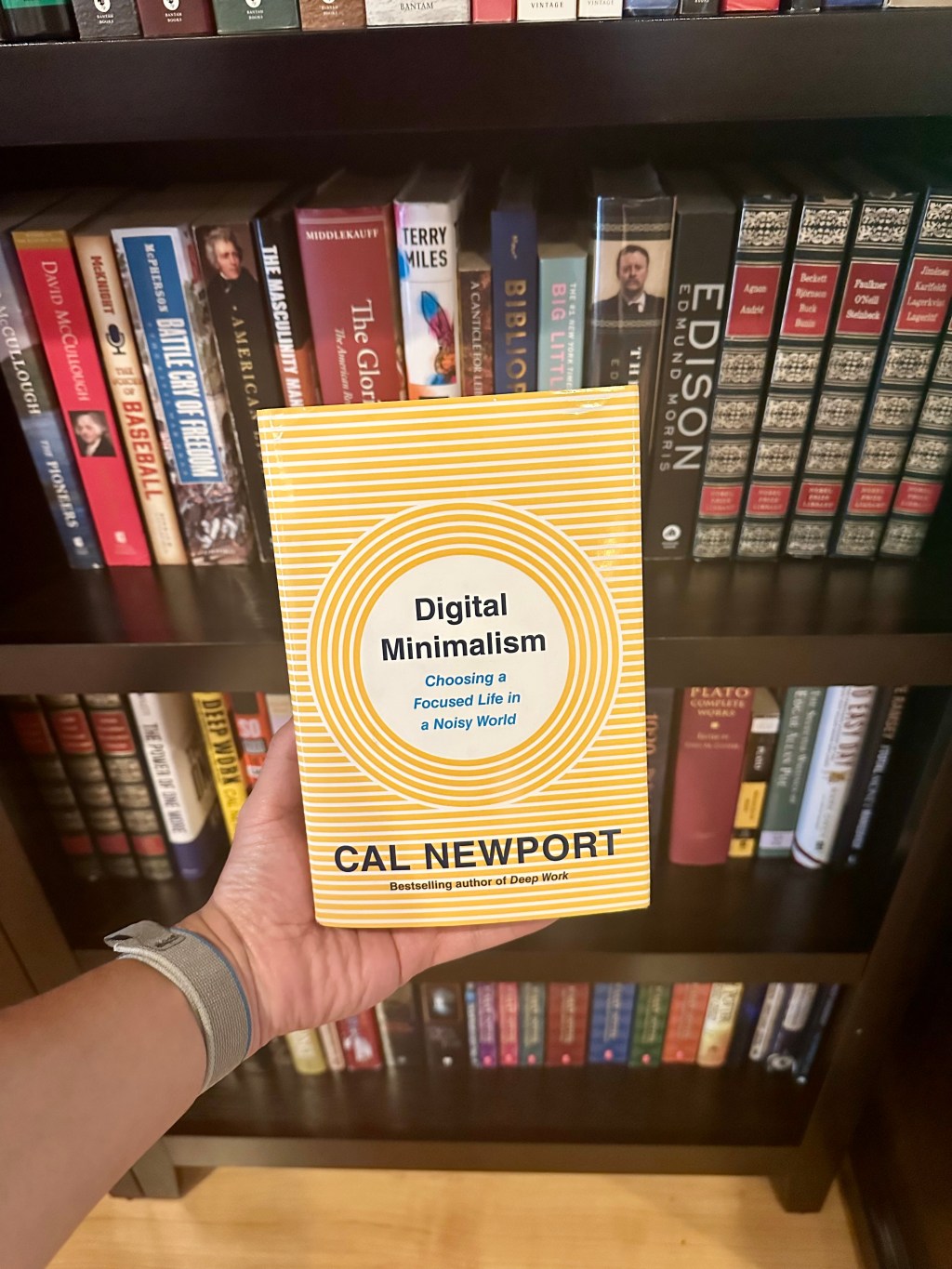
· Digital Minimalism by Cal Newport
· Published: January 1, 2019
· Pages: 302
· Rating: 5/5 Stars
· Read: 10/18/2020 – 12/17/2020. 1/23/2023 – 2/7/2023
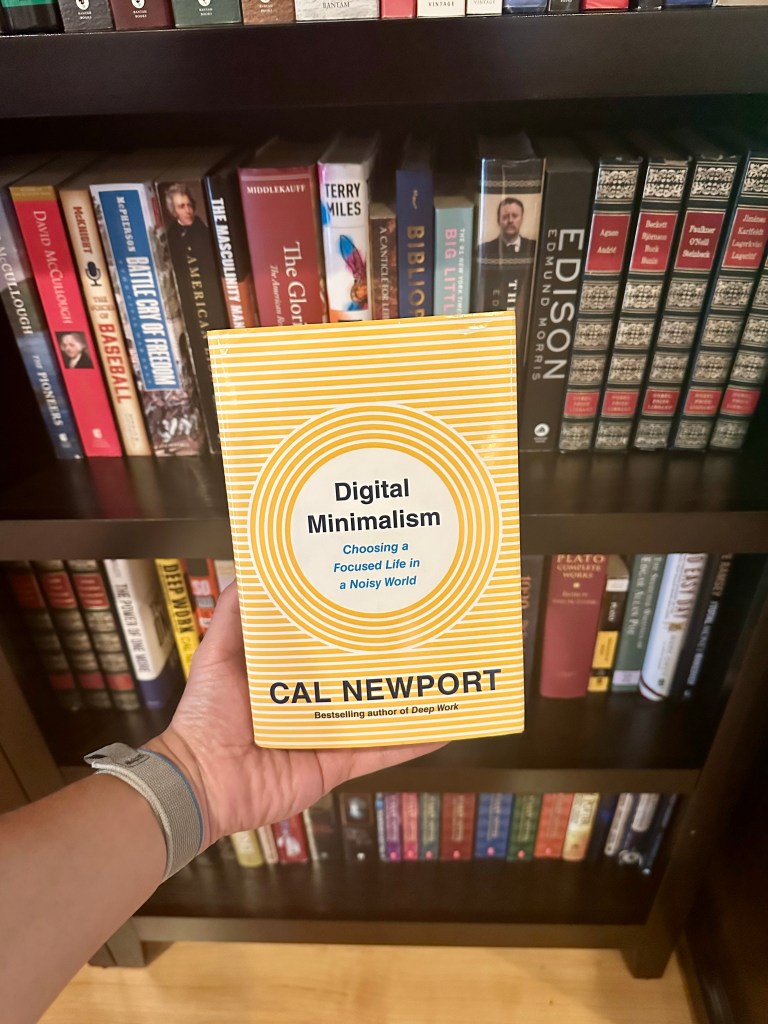
I was first introduced to Cal Newport’s work when he was on the Impact Theory podcast as the anti-social media guy. He had some interesting concepts but the thing I found most fascinating was his emphasis on the power of giving one task your full attention. In the current state where people are constantly distracted with messages and multitasking, Cal believed that focusing on one thing was an even bigger advantage than before. His book Deep Work dived into that concept but knowing the power of deep work was not enough. Cal began to realize that people were so distracted by their smartphones that they could not even achieve a distraction-free moment to begin practicing deep work. This is where his book Digital Minimalism comes in and it gives us strategies on how to use technology as a tool instead of companies using technology to make money from our time.
The Quick Glance
As technology has advanced the moments of solitude which Newport believes are essential to our well-being, began to dwindle. The final straw to eliminate all moments of solitude was what he calls the “quick glance”. Having less solitude was already a problem but now we may have lost solitude completely. Even at moments when we are not consciously using our phones, the device is bringing our attention back to It through notifications. The phone is so advanced now that you do not even have to unlock the screen to get a quick dopamine hit from it. People will begin to suffer solitude deprivation.
“The smartphone provided a new technique to banish these remaining slivers of solitude: the quick glance. At the slightest hint of boredom, you can now surreptitiously glance at any number of apps or mobile-adapted websites that have been optimized to provide you with an immediate and satisfying dose of input from other minds.It’s now possible to completely banish solitude from your life. Thoreau and Storr worried about people enjoying less solitude. We must now wonder if people might forget this state of being altogether.
Solitude Deprivation A state in which you spend close to zero time alone with your thoughts and free from input from other minds.”
Cal Newport
The Power of Walking
Outside of the obvious health benefits, going on long walks without distraction is also beneficial for our minds. How many times do we just allow ourselves to think without being distracted by our devices, in today’s age boredom has become a skill, back before the internet being bored was a part of everyday life and everyone knew how to do it. Now we see people get massive anxiety when they can’t be distracted during a moment of boredom.
“Regularly, go for long walks, preferably somewhere scenic. Take these walks alone, which means not just by yourself, but also, if possible, without your phone. If you’re wearing headphones, monitoring a text message chain, or, God forbid, narrating the stroll on Instagram-you’re not really walking, and therefore you’re not going to experience this practice’s greatest benefits. If you cannot abandon your phone for logistical reasons, then put it at the bottom of a backpack so you can use it in an emergency but cannot easily extract it at the first hint of boredom.”
Cal Newport
Create a True Social Circle
Once we begin to cut back or eliminate social media apps and go back to the old ways of maintaining friendships through phone calls or in-person interactions we will notice our social circle gets smaller. At first, this may be alarming, but a smaller social circle is also a way to remove interactions with people who were just distractions and don’t add real value to your life. Once your social circle shrinks you will be left with real relationships with people that want to do more than receive likes from you on their latest selfie.
“To be clear, conversation-centric communication requires sacrifices. If you adopt this philosophy, you’ll almost certainly reduce the number of people with whom you have an active relationship. A real conversation takes time, and the total number of people for which you can uphold this standard will be significantly less than the total number of people you can follow, retweet, “like,” and occasionally leave a comment for on social media, or ping with the occasional text. Once you no longer count the latter activities as meaningful interaction, your social circle will seem at first to contract.”
Cal Newport
The Digital Declutter
Once we are convinced that cutting back on digital distractions, focusing on building better relationships, and freeing up time to do deep work, we can begin a practice that Cal calls “The Digital Declutter”. In this practice, Cal advises you to spend 30 days doing a digital detox. In this detox, we aim to minimize our digital footprint and remove any apps from our phones that are not essential or that make money from our time. This includes apps like social media and games. Once our phone has been sufficiently dumb-downed, we go through the 30 days of detoxing ourselves from our digital addictions, like ending any bad habits the first days will be hard and you will find yourself reflexively unlocking your phone to open certain apps in moments of boredom. Since the apps are not there you will be forced to get used to being bored and in solitude. As the days go by you will slowly begin to cherish these times of boredom, by the time the 30 days are over you will lose the pull to open apps or doom scroll whenever you have downtime. Now the main key point Cal preaches is that after 30 days we do not install all our old apps back onto our phones and go back to our old ways, we build a filtering system that every app must go through to earn the right to be on our phones. If the app passes the tests they make it back to the phone, after a few days you will realize you were doing well with the dumb-downed phone and that perhaps only a few certain apps were put back on your phone but the addiction towards them isn’t as bad as they previously were.
My Digital Declutter
When I went through my digital declutter in 2020, I was baffled by how often I reflexively went back to open apps that weren’t there. After my 30 days, I did put YouTube, Netflix, and one game back on my phone, but I scheduled their use to leisure time I set aside for myself every day with strict rules on their use. I would only watch videos when I was eating my lunch at work, and I would limit myself to 30 minutes of guilt-free gaming time each day on my phone. With these rules in place, I was able to have a healthy relationship with my phone while also being able to implement leisure activities on it with rules. The Digital Declutter can also be used more than once and I recently did it again in 2022 after I felt myself drifting back to my old ways. I would recommend you give it a shot.
Further Reading
If you enjoyed this content, you could help me out by signing up for the newsletter below, sharing with a friend, reading some of my other blog posts, or purchasing any of the books mentioned through our affiliate links. Thanks for stopping by.

 Book Ponder
Leave a reply to How Digital Minimalism Can Supercharge Your Focus in 2024 | Chikara Realms Cancel reply