
- Rich Dad Poor Dad by Robert T. Kiyosaki
- Published: April 8, 1997
- Pages: 195
- Read: June 25, 2023 – July 1, 2023
- Rating: 4/5 Stars
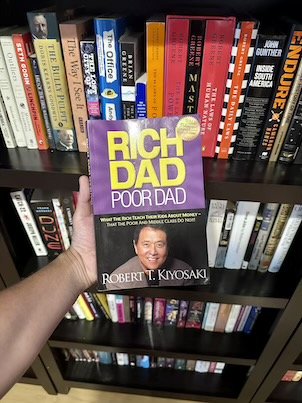
Rich Dad Poor Dad tells Robert T. Kiyosaki’s story of growing up with two dads (not literally). His college-educated real dad (poor dad) and his best friend’s uneducated dad (rich dad) and how their different skills and views on money shaped who they are. I have two requirements for a self-help book: do not add fluff to make your book longer and make the book readable. Rich Dad Poor Dad covers both those bases with the book being under 200 pages and avoiding any fluff while also making it an interesting story to read about. These are my lessons learned.
The Golden Handcuffs
The biggest mistake I see people make and one that I currently struggling with right now is when you allow a company to shackle you with golden handcuffs. The term golden handcuffs means that a company pays you well enough and provides you with sufficient benefits so that you raise your lifestyle to match it and you can no longer leave the job for fear of losing your current lifestyle. When you live below your means and do not need every single dollar your employer pays you, then you still have the freedom to take risks or seek other employment if you are unhappy. The author has a great quote on this dilemma,
“Just know that it’s fear that keeps most people working at a job: the fear of not paying their bills, the fear of being fired, the fear of not having enough money, and the fear of starting over. That’s the price of studying to learn a profession or trade, and then working for money. Most people become a slave to money—and then get angry at their boss.”
Robert T. Kiyosaki
Once the golden handcuffs are on, they are harder than a prison sentence to remove but there are small steps you can take to achieve it. First, you must start living below your means. If you are handcuffed most likely you are also in debt so making a budget that allows you to live below your means and following programs like Dave Ramsey’s baby steps will help you along the path to financial freedom. Once you win your freedom back and don’t feel shackled to an employer over a paycheck you will have an easier time finding fulfillment in your life.
Assets vs. Liabilities
“You must know the difference between an asset and a liability and buy assets. If you want to be rich, this is all you need to know. It is rule number one. It is the only rule. This may sound absurdly simple, but most people have no idea how profound this rule is. Most people struggle financially because they do not know the difference between an asset and a liability. ‘Rich people acquire assets. The poor and middle class acquire liabilities that they think are assets,’ said the rich dad.”
Robert T. Kiyosaki
We will always be poor if we don’t find a way to gain assets. The author emphasizes how people think they are acquiring assets but, they are liabilities that are costing them money instead of money working for them. You may be wondering what exactly is an asset?
“An asset is something that puts money in my pocket. A liability is something that takes money out of my pocket. This is all you need to know. If you want to be rich, simply spend your life buying assets. If you want to be poor or middle class, spend your life buying liabilities.”
Robert T. Kiyosaki
Poor people will buy a shiny new truck or sports car and think it’s an asset but, it is a huge liability. It may assist you in commuting to and from work, but this can also be done with a more economical vehicle. Now that you know an asset is something that puts money in your pocket, you may be wondering what some examples of these assets are.
“So what kind of assets am I suggesting that you or your children acquire? In my world, real assets fall into the following categories:
• Businesses that do not require my presence I own them, but they are managed or run by other people. If I have to work there, it’s not a business. It becomes my job.
• Stocks
• Bonds
• Income-generating real estate
• Notes (IOUs)
• Royalties from intellectual property such as music, scripts, and patents
• Anything else that has value, produces income or appreciates, and has a ready market…”
Robert T. Kiyosaki
Earlier I mentioned that I was dealing with the golden handcuffs in my personal life and the asset I am currently working on which is creating value and providing a service to people by writing about and reviewing books is this website. There may be an easier option on the asset list, but I am passionate about this one, so I am more likely to stick with it. The author also reminds us that we do not have to quit our day job to collect assets, we can still be great employees at our companies, but we need to make our off-time count and still find a way to begin collecting assets.
“When I say mind your own business, I mean to build and keep your asset column strong. Once a dollar goes into it, never let it come out. Think of it this way: Once a dollar goes into your asset column, it becomes your employee. The best thing about money is that it works 24 hours a day and can work for generations. Keep your day job, be a great hardworking employee, but keep building that asset column.”
Robert T. Kiyosaki
This is one of the fears people get when they get financial freedom advice from others. They think that the situation they are in makes it impossible to build strong assets. This isn’t necessarily true. Building strong assets can be done with smaller items while keeping your day job. It’s a snowball effect where you just need to get the ball rolling and the more you do, no matter how small, will cause the snowball to continue to grow and speed up.
The Hedonic Treadmill
In our previous review of The Joys of Compounding by Gautam Baid, we talked about the hedonic treadmill. Baid had described it best, “It’s called the ‘hedonic treadmill,’ and its function is to continually move the goalpost of your financial dreams, completely extinguishing the joy you thought you would get from having more money once you attain it. People are constantly running on the hedonic treadmill; as they make more money, their expectations and desires rise in tandem, which results in no permanent gain in happiness.”
Gautam Baid
This topic is revisited in Rich Dad Poor Dad when Kiyosaki talks about the dangers of people believing more money will solve all their problems.
“But more money will often not solve the problem. In fact, it may compound the problem. Money often makes obvious our tragic human flaws, putting a spotlight on what we don’t know. That is why, all too often, a person who comes into a sudden windfall of cash—let’s say an inheritance, a pay raise, or lottery winnings—soon returns to the same financial mess, if not worse, than the mess they were in before. Money only accentuates the cash-flow pattern running in your head. If your pattern is to spend everything you get, most likely an increase in cash will just result in an increase in spending. Thus, the saying, ‘A fool and his money is one big party.’ “
Robert T. Kiyosaki
These are two separate authors revisiting the same subject: money will not help your financial struggles if you are financially illiterate. In my life, I remember a time when I was making near minimum wage, my finances were tight, but I never felt handcuffed to my job if there were greater opportunities out there. Now over a decade later I find myself making over five times more money and yet I feel like I am going 100mph on the hedonic treadmill. My financial situation is tighter than ever, and I do not know if I can risk looking for another job at this current moment. We all may find ourselves in situations where we hopped on the hedonic treadmill without knowing yet, but the first step is recognizing that we are on it so we can begin the process of putting a stop to that treadmill and walking our own path.
We Are All Capable
“I have been teaching professionally since 1984. It has been a great experience and a rewarding one. It is also a disturbing profession, for I have taught thousands of individuals and I see one thing in common in all of us, me included. We all have tremendous potential, and we all are blessed with gifts. Yet the one thing that holds all of us back is some degree of self-doubt. It is not so much the lack of technical information that holds us back, but more the lack of self-confidence. Some are more affected than others.”
Robert T. Kiyosaki
Having self-doubt is a part of human nature but it doesn’t have to dictate our lives if we are mindful of our potential. It is natural for us to have doubt when trying to do something we have never done before, we might make up other reasons like not having enough time or not being skilled enough to do it, but every single person has been at this crossroads, and at some point, you got to just try the thing, even failure is better than not acting.
Are You Really Busy?
“If they aren’t busy at work or with the kids, they’re often busy watching TV, fishing, playing golf, or shopping. Yet deep down they know they are avoiding something important. That’s the most common form of laziness: laziness by staying busy.”
Robert T. Kiyosaki
Constantly doing things does not mean you aren’t lazy, especially if the things we are spending our time on aren’t moving us toward our goal. We see people like this all the time that talk about how busy they are but, they are just doing things most responsible adults do, like spending time with kids, grocery shopping, working, cleaning the house, etc. Yes, these things may make us seem like we are busy, but we also need to start tracking the time we spend doing unproductive things. Are you reading a book or watching TV while eating lunch? Listening to audiobooks or listening to music while driving? Scrolling social media or reading articles while lying in bed? There are many small opportunities we can take advantage of to allow us to get more out of our time. In a recent episode of Cal Newport’s podcast “Deep Questions,” he had Laura Vanderkam as a guest. Laura talked about working with extremely busy individuals that needed to find slivers of time to work on their research or do some other kind of deep work. They were looking for slivers of time! The clients would be ecstatic when Laura would find the extra 20 or 30 minutes in their busy schedule, yet we call ourselves too busy. It made me realize that my life wasn’t as busy as I thought and if I added all the time I wasted on unproductive things, I could dedicate much more time to my craft.
Invest First in Education
As Zig Ziglar says, “Rich people have small TVs and big libraries. Poor people have small libraries and big TVs.”
“Invest first in education. The only real asset you have is your mind, the most powerful tool we have dominion over. Each of us has the choice of what we put in our brains once we’re old enough. You can watch TV, read golf magazines, or go to a ceramics class or a class on financial planning. You choose. Most people simply buy investments rather than first investing in learning about investing. A friend of mine recently had her apartment burglarized. The thieves took her electronics and left all the books. And we all have that same choice. 90 percent of the population buys TV sets, and only about 10 percent buy business books.”
Robert T. Kiyosaki
My proudest achievement is looking at the furniture in my home today, compared to 15 years ago. In 2008 if you walked into my home, you would find an entertainment center in the living room filled with DVDs and PlayStation games. In the 2023 version of me, you will see a living room entertainment center containing 5 full-size bookshelves with over 300 books I’ve read, filled with highlights and notes. You would find a spare bedroom as a dedicated “deep work” room where most of my writing is done. The change was that I learned the value of education and that it’s the most important thing I could invest in. Educating myself with books helps me be a better father while also learning skills to live a better and more honorable life. If I could give you any advice that resonated with me from this book, is to begin to schedule your leisure activities to gain the skills to build assets. I’m not asking you to never watch a movie or TV show again but to plan these activities for certain hours and days and be intentional when doing them. For example, you can say I will only play video games for a maximum of one hour a day and exclusively with my kids as a family activity. No going in the spare bedroom and blocking out the world for 5 hours at a time. The same for movies and TV shows, schedule the time to do them and perhaps make an activity you do with your kids or spouse. Be intentional about everything you do in life, don’t just coast.
If you enjoyed this content, please sign up for our newsletter below, share this post with a friend, or read some of our other blog posts. Thanks for stopping by.
Disclosure: Some of the links in this post are affiliate links. This means that, at zero cost to you, I will earn an affiliate commission if you click through the link and finalize a purchase.
 Book Ponder
Leave a reply to Pai Rico, Pai Pobre: lições práticas de Pai Rico, Pai Pobre para você cara pálida – Escola Católica Stella Matutina de Ensino Fundamental em Campo Grande-MS Cancel reply