The Lessons Learned series is different than standard book reviews. There are hundreds of great book reviews for Atomic Habits, and I would be wasting your time creating another one. Instead, I strive to give you the lessons I was able to extract from the book to improve my life and yours.
Control What You Can Control
When life gets hard, and you feel overwhelmed, the most important thing you can do is control what you can control. Start with something small like tidying up your room, combing your hair, and making yourself look presentable to face the day. This will give you control over your life and start you off in the right direction when facing your day. If you try to face all of life’s difficulties while rolling out of bed late, rushing through breakfast, and speeding to work, your mind will already be in panic mode instead of finding peace in your morning routine to face the day with calmness.
How To Make Progress With Your Habits
Don’t Always Be Preparing
James Clear talks about the dangers of always preparing to do something or work that feels productive but isn’t moving you closer to your goals. As an aspiring writer, I deal with this dilemma by constantly feeling like I need more research. Reading books is easy and fun, but sitting down to brainstorm my ideas, build an outline, and publish a new post is the work. Don’t trick yourself into thinking you’re being productive when, in reality, you are only preparing to be productive.
Don’t Only Do It When Motivated
Another flaw in human nature is relying on motivation to get things done. It feels great when you are inspired after a good night’s sleep, life is going your way, and all the circumstances are perfect for you to be productive. What about when you are running on 3 hours of sleep, work is a mess, and your kids are sick? That’s the flaw in relying on motivation; in those moments of despair, the motivation by your side earlier is nowhere to be found. This is when discipline steps up and supports you during difficult times. Motivation is excellent, and there’s nothing wrong with bathing in it when it’s around, but don’t rely on it entirely because it won’t always be there.
Crossing A Critical Threshold
You are no longer always preparing and are doing the work required to reach your goals; you’re also disciplined enough to power through the hard times when motivation is no longer around, but what will you do when you have been at it for weeks and you see no progress? It’s when one of the most challenging things to continue when you see no progress, you begin to second guess yourself if it’s all worth it or if you are doing the right thing. These are the moments you need to be patient. As James Clear says, “Small changes often appear to make no difference until you cross a critical threshold. The most powerful outcomes of any compounding process are delayed. You need to be patient.” It’s hard to be patient, but always remember that everybody would do it if it were easy.
Results Over Long Periods
Advice varies from person to person on being patient and having a sense of urgency. One person will tell you life is short and you have to go; another will tell you life is long and to be patient. While both are valid, they can be helpful or harmful depending on the situation in which you apply them. When dealing with procrastination and having difficulty starting a task, applying urgency is essential. When building habits that last, patience is critical. If you lack patience, you will give up when you don’t see instant results; building habits relies on delayed gratification. Be patient; the results will come if you are consistent for long periods.
The Plateau of Latent Potential
James Clear describes the plateau of latent potential as similar to melting an ice cube. When it’s at 25-31 degrees, you think there is no progress, but once it passes that 32-degree threshold, you see all the progress at once. The same happens when you make positive changes in your life and build good habits. When you pass that plateau, everyone will think you were an overnight success, but they don’t see all the work you put in before that wasn’t showing any results. Remember to keep chipping away at your goal; you will break through the plateau at some point, and your results will come pouring in.
Get started on your goals, stay disciplined even when unmotivated, and be patient; the work will pay off.
Surround Yourself With the Right People
Join A Culture
One of the critical components to success is surrounding yourself with people with the same goals or habits as you. If you want to identify yourself as someone who takes care of their health and works out regularly, then surrounding yourself with people who feel the same way will go a long way to helping you stick with your habits. Staying on the couch when your buddies go to the gym will be hard. On the other hand, if you are hanging around people with bad habits, such as sitting around watching TV all day, drinking beer, and eating junk food, do you think they will encourage you to eat healthy or go to the gym? They will likely try to convince you to take it easy and hang out. More than willpower alone is needed; you need to build systems to help you achieve your goals, and one of those systems is surrounding yourself with people that will assist you in your progress, not bring you down to their level.
Surround Yourself With Things That Encourage Your Good Habits
Don’t limit yourself to surrounding yourself with the right people; include surrounding yourself with the right things. James Clear emphasizes the importance of having the things that encourage you to stick to your habits within reach.
“Want to draw more? Put your pencils, pens, notebooks, and drawing tools on your desk, within easy reach. Want to exercise? Set out your workout clothes, shoes, gym bag, and water bottle beforehand. Want to improve your diet? Chop up a ton of fruits and vegetables on weekends and pack them in containers, so you have easy access to healthy, ready-to-eat options during the week.”
James Clear
Surrounding yourself with tools related to your goals will be constant reminders throughout the day of what you want to improve.
Optimize Your Brain
Free Up Resources For Your Mind
The human brain is the most powerful tool for what it thrives at. Before modern technology, the brain may have been the best tool for memorization. With so many tools today that function as much better memorizers, we can free up resources to allow our brains to think deeply, solve complex problems, and generate new ideas. A way habits can free up resources is that when a task becomes a habit, we can do it passively. If the basics of life are a constant struggle, you need to muster up your willpower to achieve them, and then your brain is using up valuable resources to help you overcome these tasks. If your habits are dialed in and the basics of life are taken care of, your brain can focus on the next set of challenges.
Knowledge Compounds
Saving $5 today won’t make you wealthy; living a life committed to financial responsibility will. The same goes for knowledge acquisition.
“Knowledge compounds. Learning one new idea won’t make you a genius, but a commitment to lifelong learning can be transformative.”
James Clear
Be the person who dedicates time every day to working on your goals. The compound interest of working at something every day over long periods of time will be transformative.
The Goldilocks Rule
Finding the balance between too complex and too easy is difficult, but when you see that sweet spot, you enter the coveted flow state and experience peak motivation. This feeling is called “The Goldilocks Rule”.
“The Goldilocks Rule states that humans experience peak motivation when working on tasks that are right on the edge of their current abilities. Not too hard. Not too easy. Just right.”
James Clear
This doesn’t mean we should only work on things that are in this perfect state, but it should be a reminder if something is too difficult or too easy.
Find Your Identity
Make Your Habits Part of Your Identity
Practicing good habits every day helps you identify as a person who practices those good habits. If you keep your home and workplace tidy, you begin to identify as an organized person. If you go to the gym every day and watch what you eat, you identify as healthy. Embodying the identity of what you want to become helps you accomplish these new habits more easily because you are that person, not trying to be that person.
Shifting Your Perspective
It feels like you are going against human nature when you try to look at the bright side of a negative situation; shifting your perspective can facilitate this. This is similar to the popular podcaster Jocko Willink’s strategy of saying “good” to anything bad that happens to you. Your business proposal was rejected? Good, now you know what you can improve on. You failed to reach your weightlifting goals? Good, now you know what muscles need extra work. James Clear talks about a similar story about a man confined to his wheelchair.
“I once heard a story about a man who uses a wheelchair. When asked if it was difficult being confined, he responded, ‘I’m not confined to my wheelchair—I am liberated by it. If it wasn’t for my wheelchair, I would be bed-bound and never able to leave my house.’ This shift in perspective completely transformed how he lived each day.”
James Clear
This is one of the most difficult practices to implement because when life gets hard, the last thing your brain thinks about is looking at the bright side. Shifting your perspective can help you feel optimistic and encourage you to continue working on your goals and maintaining good habits.
Become What You Want To Be
Many individuals make the mistake of labeling their goal as an action rather than an identity. If you want to get better at running, make your goal “I want to be a runner,” not “I want to go running more.” I had the same shift when I was dedicating my free time to improving my reading and writing. I started telling myself, “The goal is not to read a book; the goal is to become a reader.”
“The goal is not to write; the goal is to become a writer.”
Final Thoughts
I most likely don’t have to emphasize how good Atomic Habits is because it’s been the most popular self-improvement book for a couple of years now. I hope this post summarizes the lessons I extracted from the book. If you decide to read it, I would love to hear what you learned.
If you enjoyed this content, please sign up for my newsletter below, share this post with a friend, or read some of my other blog posts. Thanks for stopping by.
Processing…
Success! You're on the list.
Whoops! There was an error and we couldn't process your subscription. Please reload the page and try again.
Disclosure: Some of the links in this post are affiliate links. This means that, at zero cost to you, I will earn an affiliate commission if you click through the link and finalize a purchase.
Do you know what good habits you want to implement in your life but can’t find time to do them? Individuals face this common problem when trying to make positive life changes. I will use reading as an example of a habit that people want to implement in their lives because they keep hearing how beneficial it is for them.
Prioritize Your Habits
The mistake you are making is not prioritizing the habits you want to do. Life will always find a way to take up all of your time, unexpected circumstances will prolong certain activities, and the unpredictability of life in general will always have you wanting for more time. For the most part, you are still accomplishing your essential tasks though, like going to work, eating, spending time with family, etc. The key is to implement your reading habits into this list of essentials.
Make Reading Essential
If you make reading a part of the activities you do every day then you will stop relying on leftover time to do it. This is easier said than done because you feel that on most days all the time is booked up to your already pressing activities. This is when you need to sit down and scrutinize your day to see where exactly your time is going.
Track Your Time
Since smartphones are the most common form of distraction, it’s a great way to start when looking for any time we can free up. An easy way is to install some sort of screen time app that tracks your usage on your devices. After a few days inspect how much time is going to what and I can almost guarantee you that at least 30 minutes of your day are going to apps that aren’t making you more productive and aren’t essential to your day. Once you can pinpoint these windows of opportunity you can begin to schedule your reading time.
Schedule Your Reading Time
The best way to become a great reader is to schedule a set amount of time each day to read. This can mean getting up 30 minutes earlier and having a reading session before starting your day. Another alternative is to elect to read a book instead of watching TV or scrolling on your phone when on your lunch break, this can both be implemented at home or work. Switching to reading instead of using my phone at work has been the biggest game changer in increasing my reading time. On an average 12-hour shift I get 90 minutes of break, and outside of eating and using the restroom, I get a solid hour of reading done every day I’m there. I know everyone’s job is different and perhaps this isn’t an option for you, but this is just an example of opportunities you can find to implement reading by tracking your time. Many of us are on the go from the moment we wake up and our only option may be to read before bed, this is great opportunity to schedule your reading and also a more beneficial bedtime routine instead of watching TV or being on your phone.
Listening To Audiobooks
Another way to get more reading done even though I don’t think it’s as efficient as sitting down and giving a book your full undivided attention is listening to audiobooks. The great thing about audiobooks is that they can be listened to while doing other passive activities at the same time. Mowing the lawn, driving, and folding laundry are great examples of moments that can be spent listening to an audiobook.
When beginning to use audiobooks try it on novels or easier books first because it’s likely to get distracted and lose your place when first consuming books via audio. Over time you can get better at them and find yourself able to stay focused on the book without getting distracted. I exclusively use audiobooks for “fun” reads or rereads. Whatever path you decide to take, the important part is that you are spending more time reading, the choice is yours.
Final Thoughts
These are a few simple tricks that can increase your reading time and make it a part of your everyday life. I will leave you with one of my favorite quotes on reading by Naval Ravikant,
“Read what you love until you love to read.”
Processing…
Success! You're on the list.
Whoops! There was an error and we couldn't process your subscription. Please reload the page and try again.
The Lessons Learned series is different than normal book reviews. There are hundreds of great book reviews for Deep Work and I would be wasting your time creating another one. Instead, I strive to give you the lessons I was able to extract from the book to improve my life and yours.
What Is Deep Work?
Do you ever find yourself trying to focus intently on one important task and your mind keeps tugging at you for a short distraction to get your mind off the difficult task? The basis of deep work is the ability to push through this and concentrate deeply on a task.
Cal Newport better defines it as, “Professional activities performed in a state of distraction-free concentration that push your cognitive capabilities to their limit. These efforts create new value, improve your skill, and are hard to replicate.”
With an entire industry focused on keeping you distracted with social media apps and games, the advantages of deep work are more valuable than ever. If you can practice deep work today, it will give you a huge advantage over your competition.
You Can’t Rely Solely on Willpower
Many individuals will read that something is good for them and try to apply it with no strategy, and rely solely on willpower. While this may be effective in the beginning, studies have shown that willpower is finite. To truly make a change you need a strategy and systems in place to help you achieve a change. Don’t forget that there are engineers out there whose sole purpose is to keep you distracted and doom scrolling on their apps.
“The key to developing a deep work habit is to move beyond good intentions and add routines and rituals to your working life designed to minimize the amount of your limited willpower necessary to transition into and maintain a state of unbroken concentration.”
Cal Newport
How to Get Better at Deep Work
There are many strategies out there to improve your ability to focus and it depends on what your main source of distraction is. For now, we will focus on the most common one: smartphones. Smartphones are an incredible tool if used correctly, but can also be the bane of your existence if allowed to run amok in your life.
The Digital Detox
The next book after Deep Work by Cal Newport is “Digital Minimalism.” It talks about a strategy of detoxing yourself from your smartphone addiction by removing all apps from your phone that make money off of your time. After the 30-day detox, you methodically allow some of these apps back onto your phone when they fulfill a useful purpose or have limits that can be followed. For example, your favorite game or the Netflix app can make its way back onto your phone if you have the correct systems and guidelines in place to only use these apps with intention and not every time you feel bored. An example of intention can be scheduling a 30-minute block every other day where you can watch Netflix or play your game guilt-free, but once that time is up you don’t use that app again. When boredom hits throughout the day you don’t allow these apps to work their way into your life as a distraction device.
Being Bored Is Okay
The next step to improve your ability to practice deep work is to regain the skill of being bored. A common theme in my writing is that boredom and the ability to focus are the same skill and if you never allow yourself to be bored, then you are losing the ability to focus. Have you ever tried to complete a difficult task if you can’t focus? It will either take much longer than intended or the quality will be lackluster. Cal Newport recommends implementing short sessions of boredom throughout your day with one longer session once a week. These short sessions can be waiting in line at the grocery store without reaching for a form of distraction or driving to work without anything on the radio. The longer weekly session can be going on a 30-minute walk without any devices. This leads to our next lesson and the incredible benefits of walking.
The Power of Walking
The more biographies I read the more I realize that many great individuals in history had many of the same habits. The three that are always recurring are the benefits of walking, writing things down, and surrounding yourself with the right people.
Many great artists, leaders, authors, and businessmen credit their ability to solve difficult problems or come up with new ideas to walking. As Nietzsche said, “It is only ideas gained from walking that have any worth.”
Productive Meditation
Long undistracted walks are a great way to regain your ability to focus, but if this feels like too much, you can try practicing a strategy that Newport introduces called “Productive Meditation”.
“The goal of productive meditation is to take a period in which you’re occupied physically but not mentally—walking, jogging, driving, showering—and focus your attention on a single well-defined professional problem. Depending on your profession, this problem might be outlining an article, writing a talk, making progress on a proof, or attempting to sharpen a business strategy. As in mindfulness meditation, you must continue to bring your attention back to the problem at hand when it wanders or stalls.”
Cal Newport
Implementing productive meditation into your “boredom sessions” can make them feel more productive and an easier transition from constantly being distracted to allowing yourself to practice complete boredom.
The next time you go on your weekly “boredom session” try bringing a problem you are trying to solve and keep your mind focused on that task during the entire session. Over time practicing these small boredom sessions every day and a longer productive meditation session throughout the week will give you a noticeable improvement in your ability to focus the next time you sit down to do meaningful work.
What Do You Focus On?
Let’s say you have regained your ability to focus for long periods and are ready to implement this skill back into your life. You may ask yourself, does every task require deep work? Do you implement deep work when mowing the lawn? The answer is to focus on your most important goals.
Deep Work Has Limits
The longer you practice deep work the longer you can do it, but even the most agile minds find that there is a limit to deep work. Cal Newport puts this number at 4 hours of pure deep work before your focus resources are depleted and for novices in deep work, perhaps only one hour of deep concentration seems to be the limit, if we were to implement deep work to everything, we would be toast by noon.
Not every task requires deep work, narrowing it down to a small number of extremely important goals and directing your deep work skills to those goals is ideal. Once you have chosen a task to perform deep work on, try your best to have a least a one-hour block for deep work, because any distraction that causes a context switch while trying to focus starts the process all over again as you have to ramp up that full focus mode again. It’s not just a switch we can turn on and off, concentrating on a task deeply requires build-up.
Doing Meaningful Work Brings Us Joy
What is all of this for? Why is this so important if life is just about happiness? Cal Newport says that studies have shown that human beings are most satisfied with life when immersed deeply in something challenging. How good does a well-deserved dopamine rush feel when you create something or complete a difficult task? Lounging around doing nothing may seem like it makes us happy, but being in the flow state doing meaningful work, brings us joy. That’s why it’s important to find some sort of fulfillment in whatever you are doing.
Give Whatever You Are Doing Your Full Attention
Once you have regained your ability to focus again and found something to work on that brings you fulfillment or joy, give whatever you are doing your full attention. Better yet, imitate the actions of one of the most decorated deep work advocates in history.
“Like Roosevelt at Harvard, attack the task with every free neuron until it gives way under your unwavering barrage of concentration.”
Cal Newport
Final Thoughts
Deep Work by Cal Newport is what I consider a “quake book”, a book that shook me to my core and changed the way I view the world. The first time I read it, I was struggling to balance returning to school for my Bachelor’s degree and working full-time, while being a husband and father. After implementing the strategies in the book and regaining my ability to focus I was able to easily pass the rest of my classes by practicing one hour of deep work on my days off to study. That’s all it took, you will be surprised how much more you can get done with one hour of deep work compared to hours of distracted work.
If you enjoyed this content, please sign up for my newsletter below, share this post with a friend, or read some of my other blog posts. Thanks for stopping by.
Processing…
Success! You're on the list.
Whoops! There was an error and we couldn't process your subscription. Please reload the page and try again.
Disclosure: Some of the links in this post are affiliate links. This means that, at zero cost to you, I will earn an affiliate commission if you click through the link and finalize a purchase.
The Lessons Learned series is different than normal book reviews. There are hundreds of great book reviews for Titan by Ron Chernow and I would be wasting your time creating another one. Instead, I strive to give you the lessons I was able to extract from the book to improve my life and yours.
Surround Yourself With What You Want to Be or Who You Want to Become
A common theme when reading about individuals who have become wildly successful is that they knew the importance of surrounding themselves with the right people, John D. Rockefeller was no exception. He credited a large portion of his success to being able to read people and finding out who was trustworthy or not. He surrounded himself with these people when starting his life as a businessman and it helped him build great partnerships and an advantage over his rivals. This theme can also be extended to large groups of people like the incorporated village of Owego where Rockefeller grew up.
“The incorporated village of Owego had an imposing courthouse, a well-stocked library, a renowned school, and other nascent hints of culture. For a country town of seventy-two hundred people, it also boasted a disproportionate number of resident writers and artists.”
Ron Chernow
Surrounding yourself with the right people, communities, and even towns can go a long way to improving your growth. Even if we are unaware of it, we subconsciously start having similar characteristics to the people we are around most. Be wary of who you associate with and always strive to be around like-minded people or individuals who are where you want to be.
Build Your Future With Relentless Effort and Determination
My favorite part of all biographies is the journey, how regular people like you and I found a way to do incredible things. Rockefeller was no exception to this and it shows in his journey to get his first job. This was our first glimpse into Rockefeller’s intense ambition and sense of urgency to get what he wanted. Following the constant abandonment of his father and his subsequent withdrawal from supporting John’s dream of going to college, he realized that he was going to have to become the man of the house and find a source of income.
Each morning Rockefeller would leave his home and 8 AM and make his rounds to Cleveland firms offering his services for bookkeeping work. In the middle of summer, he made this trek six days a week for six consecutive weeks. The thought of going back to the country and relying on his father for his livelihood gave him the strength to carry on. As described in this biography, failure was never an option and he would restart his trek from the beginning over and over again when all businesses had turned him down.
“When he exhausted his list, he simply started over from the top and visited several firms two or three times. Another boy might have been crestfallen, but Rockefeller was the sort of stubborn person who only grew more determined with rejection.”
Ron Chernow
Rockefeller’s perseverance finally paid off as he got a bookkeeping job at the firm Hewitt and Tuttle, and this started the rollercoaster journey to becoming the wealthiest man alive. The importance of this day was never forgotten and Rockefeller cherished “Job Day” as the most important day of his life.
“For the rest of his life, he would honor September 26 as ‘Job Day’ and celebrate it with more genuine brio than his birthday. One is tempted to say that his real life began on that day.”
Ron Chernow
Imagine if Rockefeller had just given up and admitted defeat. We need to have the same passion and determination that Rockefeller implemented when we are pursuing our dreams.
Write Things Down
Like Abraham Lincoln, Teddy Roosevelt, and Ralph Waldo Emerson before him, Rockefeller had the habit of writing things down in a commonplace book or what he called “Ledger A”.
“In his pocket, he carried a little red notebook in which he jotted suggestions for improvements and always followed up on them.”
Ron Chernow
Ledger A was the most sacred relic in Rockefeller’s life and he cherished it for the rest of his life. It shows his passion for numbers as he kept a meticulous log of all his expenditures even into old age in future versions of his ledger.
“For the remainder of his life, Rockefeller treated Ledger A as his most sacred relic. Producing it before Bible classes more than fifty years later, he became almost tearful and trembled as he thumbed its pages, so potent were the emotions it evoked.”
Ron Chernow
It may seem strange or dramatic for us when someone has this type of reaction to just a notebook, but many people in history gave credit to their commonplace books as the main reason for their success. The commonplace book was there to externalize great ideas, remember important information, and a resource to clear the mind. They are all used differently by all users but they share the same benefit of getting important things off your mind to free up resources to generate new ideas.
If you haven’t started your commonplace book, don’t wait any longer to start. It can be on a notes app, a fancy bullet journal, or just a basic notepad, the important part is externalizing the things that cross your mind throughout the day.
Never Judge a Book by Its Cover
How often do you judge someone before getting to know them, perhaps by the way they dress or their demeanor? There’s nothing wrong with following your intuition but you should work on holding off passing judgment on others until you have gotten to know them. I would have missed out on many great friendships in my life if I had judged people by my first impression. This leads to a comical story in Titan when a young Rockefeller starts seeing a woman but is turned away by her parents because they don’t think he is good enough for their daughter.
“In one of the less prophetic judgments in parent history, they argued that they didn’t want their daughter to throw herself away on a young man with such poor prospects.”
Ron Chernow
These parents judged Rockefeller without getting to know him and believed that the eventual wealthiest man in the world had poor prospects. To add insult to injury, Rockefeller went on to become an even better father and husband than a businessman.
The Power of Walking
How often do you go on walks? Better yet how often do you go on walks without distractions? On top of all the excellent health benefits of walking, it’s also an incredible idea generator. Combining walking with writing things down is a guaranteed way to think through difficult problems and generate new ideas. Being bored without reaching for a source of distraction goes hand in hand with the ability to focus on a difficult task for long periods, but many people have a hard time implementing “boredom” sessions throughout their day as it feels like a huge waste of time. A better alternative is going on undistracted walks, this means no phone, no music, no podcasts, just your thoughts. At first, the desire to reach for a distraction will be unbearable but over time you can slowly begin to retrain your brain to be okay without constant dopamine hits. Over time you will look forward to these moments as they will become stress relieving and a great way to think through things.
Rockefeller credited much of his success to walking for his business partner Henry Flagler and himself.
“We met and walked to the office together, walked home to luncheon, back after luncheon, and home again at night. On these walks, when we were away from the office interruptions, we did our thinking, talking, and planning together.”
John D. Rockefeller, Sr.
Aside from the benefits of going on walks alone, walking as a social interaction is also a great activity and I can credit it to some of the best conversations I’ve had with my family when we’ve gone on device-free walks after dinner.
Learn From Your Mistakes Instead of Repeating Them
How often do you see kids go through traumatic childhoods and then put their own families through the same things when they grow up? You would think that if you went through something you hated you would never put your own family through the same thing, but this dilemma is more common than you think. We learn by example, even if it’s negative.
Every so often we get individuals who learn from their mistakes and go above and beyond to never repeat the mistakes of their parents. This was the case for Rockefeller. As he began to raise his own family he was always conscious of the shortcomings of his father and made great efforts to not follow in the same footsteps. The most admiral trait that I learned from reading this biography is that even though Rockefeller was considered to be the greatest businessman of his time, he was an even better father and husband. This is the true redemption story, when your childhood sets you up for failure but you become great at the thing everyone expected you to fail at. His father was a terrible role model, yet Rockefeller used this as a lesson on what not to do instead of following his father’s footsteps.
The greatest compliment Rockefeller could receive was from his biggest critic Ida Tardbell who almost single-handedly dismantled the Standard Oil empire. After working together with Rockefeller Jr. she went on to say that even though she disdained Rockefeller’s business practices, no one can question his excellence in parenting.
This goes to show you, that just because life dealt you a bad hand, doesn’t mean you can’t learn from those mistakes and not repeat them.
The Importance of Concentration
With the rise of technology, the skill to focus on a single task for long periods is becoming less common and more valuable. Being able to focus almost seems like a superpower now. Always ahead of his time, Rockefeller knew how valuable this skill was and was always using it to his advantage.
“He once asked rhetorically, ‘Do not many of us who fail to achieve big things . . . fail because we lack concentration—the art of concentrating the mind on the thing to be done at the proper time and to the exclusion of everything else?’”
John D. Rockefeller, Sr.
Prioritize not relying on your phone as a constant source of distraction and pick up a book or write in your commonplace book when you have moments of downtime. This will benefit you when it’s time to sit down and focus on a difficult task. You won’t be constantly fighting the urge to check your phone as a source of distraction.
Focus on Your Strengths, Delegate Your Weaknesses
The most valuable part of your time is to spend the majority of your time doing the things you are good at and delegating the rest. If you are a great writer but a terrible website designer, don’t waste countless hours working on your website when it could be spent writing. Find which one of your skills has value and delegate the others if possible. Rockefeller used this same strategy when dealing with business, he knew what he thrived at and delegated the rest to others who thrived at those skills.
“I never felt the need of scientific knowledge, have never felt it. A young man who wants to succeed in business does not require chemistry or physics. He can always hire scientists.”
John D. Rockefeller, Sr.
Stay Accountable to Your Commitments
Being a good person is a fine balance and many of the greatest businessmen in history have terrible children who have been coddled or raised by nonpresent parents. Rockefeller’s greatest achievement was his parenting of Junior. Like mentioned before, when your biggest critic, compliments your parenting, you must be doing something right.
We can use this as a reminder that just because you are chasing your dreams, doesn’t mean that you can let your other responsibilities fall by the wayside.
Final Thoughts
Titan by Ron Chernow is one of my favorite biographies I have read in the last few years. Most of us have heard the story of the oil giant “Standard Oil” and the subsequent movement by the U.S. Government to put rules in place to control monopolies. Chernow does a great job of showing us who Rockefeller was as a human being, not just a businessman. I strongly recommend checking out this biography, don’t be intimidated by its size, like all Ron Chernow biographies, the flow is amazing and it’s an entertaining read.
If you enjoyed this content, please sign up for my newsletter below, share this post with a friend, or read some of my other blog posts. Thanks for stopping by.
Disclosure: Some of the links in this post are affiliate links. This means that, at zero cost to you, I will earn an affiliate commission if you click through the link and finalize a purchase.
Processing…
Success! You're on the list.
Whoops! There was an error and we couldn't process your subscription. Please reload the page and try again.
You see it all the time, a baseball player is in a slump and no matter what he does he just can’t snap out of it, it seems like the world is against him because line drives are being hit directly at defenders and the next guy up is getting a bloop hit single. Does this sound familiar to you when trying to get your life in order? You are finally saving some money and your car breaks down. You are being consistent with your workouts and you get the flu. Circumstances outside of your control are making you feel like a failure. The baseball player on a slump also feels like a failure even though he is doing all the right things. It’s human nature to want to hit a home run every time you come up to bat to break the slump. Yet you continue to fail over and over again. Batting coaches give batters the same advice that we can use in our own lives, “narrow it down to small victories”.
Narrow It Down
Coaches will tell the batters to narrow it down to individual at-bats and even individual pitches. Take a ball, take a good swing, and even if you don’t get a hit, narrowing it down to individual pitches can give you small victories that will lead to the right mindset and big victories in the future. If you can’t get any wins then you can’t stop feeling like a failure. You can implement this same strategy in your life, if you make small progress every day in all facets of life you can consistently be crushing your goals and breaking out of slumps. Get up early, skip dessert after dinner, or take a 15-minute walk. These are all small victories we can get in the bleakest of times. Next time you feel like a failure, try narrowing it down and taking pride in the small victories throughout the day.
If you enjoyed this content, please sign up for my newsletter below, share this post with a friend, or read some of my other blog posts. Thanks for stopping by.
Processing…
Success! You're on the list.
Whoops! There was an error and we couldn't process your subscription. Please reload the page and try again.
The Lessons Learned series is different than normal book reviews. There are hundreds of great book reviews for Discipline is Destiny and I feel like I would be wasting your time creating another one. Instead, I strive to give you the lessons I was able to extract from the book to improve my life and perhaps yours.
Time Waits for No One
We tend to neglect “the thing” we want to accomplish until we have enough time, or when the time is right. This could be finally getting around to getting in shape, writing the book we keep talking about or starting the business that you’ve always dreamed of, but that’s all it is…just a dream. Don’t be an empty dreamer, if you truly want to accomplish all your goals, then you must make time for them, not wait for time to magically show up. As Ryan Holiday says,
“You have to do your best while you still have the chance. Life is short. You never know when the game, when your body, will be taken away from you. Don’t waste it!”
Ryan Holiday
Even though telling you to slow down sounds counterproductive to the point I am making, it’s also important to find balance in whatever you are doing. Reading the previous quote and getting motivated is good, but many people go full speed from there, end up getting burned out, and make less progress than before.
This is commonly seen in people trying to get in shape, they get a good workout plan from a friend, or they watch a motivational video that inspires them to hit the gym. After two weeks when they see their progress slow, or their bodies break down, they stop going altogether which puts them even further behind than when they started.
Every activity for every goal needs to be sustainable for long periods. It feels good to get out there and go above and beyond when motivated, but long-term sustainability requires discipline. The motivation won’t be there when you’re tired from lack of sleep, stressed out from work, or dealing with an illness. These are the moments when we rely on our discipline to do what we are supposed to do regardless of how we feel.
Once we acknowledge that life is short and we need to find a balance to achieve our goals, we run into the third dilemma of always “getting ready” to do the work. There will always be one more thing you need to do before you can start, you need the weather to clear up a bit before you can start to work out, you need a better setup before you can start your writing, you need things to slow down at work so you can start your side hustle. There will always be one more thing we can do before we start, but we can always start right now. It doesn’t matter how unprepared you feel, it’s still better to just start. The perfect circumstances won’t magically show up at your doorstep and if that perfect situation does present itself to you, you will end up chasing that moment forever and rely on it to do any work. Start today, stop making excuses, every day that you wait is time that you will never get back. As Ryan Holiday says, sometimes the work will feel like torture, but it will be worth it.
“Today, we’re more apt to talk about work than lose ourselves in it. We like to make a big show of it on social media. We spend a lot of money acquiring the right tools or setting up a fancy office. Getting down to it? Every day? That sounds like torture. Sometimes it is torture!”
Ryan Holiday
The Power of Simplicity
Today more than ever, the world is filled with distractions. The perfect productivity app just came out, the perfect notebook is on its way, and the perfect course for my passion just became available. Nothing will do the work for you. Looking for the perfect system that will make the work not feel like work doesn’t exist, at best a good system will give you a small boost in productivity, but nothing beats putting in the time and doing the work. Keep it simple, start the work, and then figure out tools to help you along the way. Don’t do it in the opposite order or else you will be stuck on an endless quest to find the perfect system and never start.
“The less you desire, the richer you are, the freer you are, the more powerful you are. It’s that simple.”
Ryan Holiday
Focus on What You Can Control
Our lives can be unpredictable. Everything can seem fine until our A/C breaks down in the middle of the summer and we can’t afford to fix it. We get test results that tell us our health isn’t as great as we thought. We find out our kids are struggling in school, and we aren’t sure how to fix it. In these moments when chaos seems to be whirling around us, we must remember to only focus on the things we can control.
The easiest thing to make us feel in control in a chaotic situation is to take care of ourselves. Like Ryan Holiday says,
“While the world is unpredictable, one thing we do control is how we take care of ourselves. Making our bed, tucking in our shirt, running a comb through our hair, these are little things we can always do, practices that instill order and cleanliness in a messy situation.”
Ryan Holiday
Next time life feels overwhelming, take a moment to tidy up yourself and your space to gain some control when facing the uncontrollable.
Never Lose Control of Your Emotions
Never lose control of your emotions and if you happen to, try your hardest to not make any decisions or be around others while feeling this way. It’s not easy to master your emotions but when things are outside of your control, you can still control how you respond to those things. The best way to respond is to distance yourself from everything until you can regain control of your emotions. This is easier said than done and I understand that certain situations don’t allow you to get away. If you don’t have control over your emotions the second-best option is to be self-aware enough to acknowledge when you are in these situations so you can make better decisions.
Ryan Holiday tells us that most mistakes, regrets, and embarrassing moments can be credited to emotional decision-making.
“Nearly every regret, every mistake, every embarrassing moment—whether it be personal or professional or historical—have one thing in common: Somebody lost control of their emotions. Somebody got carried away. Somebody was scared, or defensive. Somebody wasn’t thinking beyond the next few seconds.”
Ryan Holiday
Make Some Kind of Progress Everyday
Just be better than you were yesterday, and if you failed today, get up and try again tomorrow. Acknowledging that you failed is still progress. Everyone gives young people advice to start saving for retirement early because compound interest will make you rich by the time you retire. The same goes for self-improvement, small wins every day will equal major victories in the long term. It’s hard to see the point in skipping dessert today when the scale doesn’t move the following morning, but what do you think the effects of skipping dessert for 3 months will be? The scale probably moved a few pounds, your sugar levels are down, you’re sleeping better, and you generally feel better. That’s a huge victory when many small victories are accomplished over a long period.
“The Japanese word for this is kaizen. Continual improvement. Always finding something to work on, to make a little progress on. Never being satisfied, always looking to grow.”
Ryan Holiday
It’s common for baseball players to go through slumps during their careers. It’s human nature to want to hit a home run every time you come up to bat and break the slump with one big act, but you find yourself continuing to fail. Batting coaches use the same small progress every day analogy. They tell the batters to narrow it down to individual at-bats and even individual pitches. Take a ball, make contact, and have a good swing, even if you didn’t get a hit, it’s a small victory to get you making progress to getting hits again. We need to take this strategy in our lives, if we make small progress every day in all facets of life, we will consistently be crushing our goals.
“It’s the journey of a lifetime. In fact, that’s the way to think about all of this: How much progress could you make if you made just a little each day over the course of an entire life? What might this journey look like, where might it lead, if each bit of progress you made presented both the opportunity and the obligation to make a little more progress, and you seized those opportunities, you lived up to those obligations, each and every time?”
When your goals feel overwhelming and unachievable narrow it down to a single action and gain small victories every day. Just be better than the previous day, the previous hour, or the previous minute.
Keep yourself valuable by always having a purpose in your life. It doesn’t have to be big, it can be small hobbies like learning about something new and reading some books about it. Ryan Holiday talks about the most powerful man in the world Marcus Aurelius who could have had everything he wanted at his fingertips, still studying and learning because he knew that was the key to growing old.
“He understood the second we stop trying to get better is the moment we start gradually getting worse. After the passing of Antoninus, he maintained his lifelong study of philosophy, humbly gathering up his tablets and going to school even as an old man. He never wanted to stop learning, never wanted to stop getting better.”
Ryan Holiday
If one of the most powerful men in history never stopped trying to make progress every day, then so can you.
Strict With Yourself, Tolerant With Others
When you get to a place where you feel like you have your life in order physically, mentally, and spiritually it’s a great place that many times is short-lived and even fewer people ever attain. When you are in that moment, doing things that don’t move you closer to your goals makes no sense, and it’s hard to fathom why others are doing them. It’s human nature for us to judge others and give unsolicited advice. We start to develop a God complex and think of ourselves as better than others. This is one of the nastiest side effects of self-improvement and one we need to be wary of.
This is when I learned the most valuable lesson from Discipline is Destiny, “Strict with yourself, tolerant with others.”
It’s hard to get others to get on board when you are making positive changes in your life, but each person’s life is their own. Unless they ask, the most we should do is let others know we are there for them if they want help or advice and leave it at that. We don’t know what phase of their journey they’re on. Ryan Holiday reminds us that Marcus Aurelius, the most powerful man in the world, would be the one person who should be giving unsolicited advice, and yet he was tolerant of others and strict with himself.
“It was said that the true majesty of Marcus Aurelius was that his exactingness was directed only at himself. He did not “go around expecting Plato’s Republic.” People were people, he understood they were not perfect. He found a way to work with flawed people, putting them to service for the good of the empire, searching them for virtues that he celebrated and accepting their vices, which he knew were not in his control.”
Ryan Holiday
The most difficult part is watching people you care about make bad decisions, but Ryan Holiday reminds us that as hard as it is, it’s their life and not yours to control. Not everyone signed up for the kind of life you live.
“The only person you get to be truly hard on is you. It will take every ounce of your self-control to enforce that—not because it’s hard to be hard on yourself, but because it’s so hard to let people get away with things you’d never allow in yourself. To let them do things you know are bad for them, to let them slack off when you see so much more in them. But you have to. Because their life is not in your control.”
Ryan Holiday
It’s hard enough to get your own life in order, focus on doing what’s best for you, and be open to helping others when that help is warranted.
Final Thoughts
Discipline is Destiny is the best of Ryan Holiday’s books, which is an honor because most of Ryan’s books receive high praise. Discipline is where it all starts, discipline is the first building block to creating a great life. Discipline is doing what you’re supposed to do even when you don’t feel like it. I hope this article and possibly this book help you discover the importance of discipline and help you implement it into your life.
If you enjoyed this content, please sign up for my newsletter below, share this post with a friend, or read some of my other blog posts. Thanks for stopping by.
Disclosure: Some of the links in this post are affiliate links. This means that, at zero cost to you, I will earn an affiliate commission if you click through the link and finalize a purchase.
Processing…
Success! You're on the list.
Whoops! There was an error and we couldn't process your subscription. Please reload the page and try again.
Richardson Jr. brings us the gold standard in Ralph Waldo Emerson biographies. The book is easy to read and goes in-depth on the more important aspects of Emerson’s life. Emerson is looked back fondly as one of the greatest intellectuals in history and is remembered for his speeches, essays, and books. Any aspiring writer, thinker, or pursuer of knowledge should study Emerson and apply many of his practices as their own.
The Lessons Learned series is different than normal book reviews. There are hundreds of great book reviews for Emerson: The Mind on Fire and I feel like I would be wasting your time creating another one. Instead, I strive to give you the lessons I was able to extract from the book to improve my life and perhaps yours.
Prioritize Good Habits
Prioritizing good habits is a good starting point for any life well lived. A common theme among great people in history is that they prioritize what is important to them, even at a young age. Emerson was no different in this regard.
“His extracurricular reading was at least three times as extensive as his reading for courses, and he was already in the habit of getting up at 4:30 or 5 in the morning to tend his correspondence and write in his journals.”
(Richardson, 1995)
The earlier the better, but regardless of your age, prioritizing the actions that you know will move you closer to your goals is essential. This is easier if you have clarity and are very specific on what you want.
The Power of the Commonplace Book
The most common theme from all the histories and biographies I’ve read is the importance of writing things down. Even though the commonplace book today may look much different than it did in Emerson’s day, it still brings the same value. Our brain is arguably the most powerful tool in the world, don’t waste its resources on menial tasks like memorization. That’s what tools are for. You should always carry something with you to jot down ideas, things to remember, or your thoughts.
Emerson began to use a commonplace book in 1819 at 16 years old and credits it as one of the staples to his success. By 1822 he was filling up almost a notebook a month. This is a great insight on how reading was one of the most common leisure activities of the time and it has slowly dwindled over the years as technology advances. Now the value of reading is more prevalent than ever since fewer, and fewer people do it.
The key to a functional commonplace book is to not overthink what goes in it. Emerson used it as a jack of all trades for writing things down.
“Emerson’s organized, persistent, purposeful journal keeping is one of the most striking aspects of his early intellectual life. He wrote constantly, he wrote about everything, he covered hundreds of pages. When he had nothing to say, he wrote about having nothing to say. He read and indexed and reread what he had written. He copied letters into his journals and prose from his journals into his letters.”
(Richardson, 1995)
As the years went along Emerson’s notebook collection continued to grow and it evolved as a great writing tool while also giving peace to a mind that was on fire. Emerson never let an idea go to waste and was one of the few people that I believe exhausted all his creative resources by the end of his life. In his own words, he said by the end of his life, his creative moments came at longer intervals and that is also displayed in his journal entries when they went from daily entries to almost an entire year without any entry. View the commonplace book as the ultimate tool to allow your brain to create ideas, not merely remember them.
For Emerson, the commonplace book was a lifelong companion that stood by his side as he accumulated knowledge throughout his life. By the end, Emerson’s notebooks surpassed 200 volumes and assisted him in his lectures and writing. With today’s technology, there is no reason we shouldn’t have our own knowledge database like Emerson. One of his biggest fears was losing all his hard work and he almost did when his home caught on fire on July 24, 1872. It shows you how important the notebooks were to Emerson that while the home was still accessible, he began to throw his notebooks out the window so they wouldn’t burn. With the ability to digitize our notes and back them up, our chances of losing our notebooks are slim to none.
Originally Emerson had a journal-style notebook in which he would write about his day, and separate notebooks for his reading and lecture writing. Eventually, he switched to an all-purpose commonplace book that would hold any idea that came to him on any subject. Later, he would distill these notebooks and organize them, realizing that all his thoughts were ready when it was time to write.
This shows how ahead of his time Emerson was because that’s one of the foundations of current-day note-taking. Capture anything that resonates with you now, distill it, and organize it later. This commonplace book idea is reiterated by his friend Elizabeth Peabody when she was advised by Emerson to start her own commonplace book.
“He advised me,” she recalled,to keep a manuscript book—and to write down every train of thought which arose on any interesting subject with the imagery in which it first came into my mind. This manuscript was to be perfectly informal and allow of skipping from one subject to another with only a black line between. After it was written I could run a heading of subjects over the top—and when I wanted to make up an article—there were all my thoughts ready.”
(Richardson, 1995)
Once Emerson’s notebooks began to be filled with thoughts and ideas from all walks of life, connections began to be formed. Things he read connected with thoughts he wrote down. Conversations with friends connected with prompts for lectures. Getting everything out of your brain onto the page and revisiting it when some time has passed allows us to make connections from a variety of different sources.
The commonplace book became so powerful for Emerson that he would passionately encourage his friends to start one. This was part of his great mentorship as Henry David Thoreau would later recall,
“Shortly after graduation late in summer of 1837, about the time he began a short-lived teaching job with the Concord public schools, Thoreau also began a journal, evidently at Emerson’s urging.”
(Richardson, 1995)
This is how we ended up with Walden. Thoreau wasn’t the only one who benefited from Emerson’s encouragement of the commonplace book. Elizabeth Peabody, Margaret Fuller, and Edward Channing all spoke of Emerson’s encouragement to start a commonplace book or to continue using one.
If you feel encouraged to start your own commonplace book, don’t overthink it, just start. It doesn’t have to be pretty or perfect, it only needs to be a tool to put your thoughts and ideas on paper. Don’t worry about how unorganized or haphazard it is, that’s why we distill it later and extract the most important parts. This is a practice that Emerson also went on to implement in his own notebooks.
“Finding that this plan did not work, he shifted to another, whereby he used the journals to record his thoughts and impressions as they first struck him, and he assigned the thoughts to categories later on.”
(Richardson, 1995)
Whether it’s the notes app on your phone, a notepad, journal, or notebook, start your commonplace book today to never lose another great idea while freeing up resources for your brain to create ideas.
What Kind of Reader Are You?
One of the foundations of an advanced reader is to shift your levels of reading according to what you are reading. Let’s get the myth out of your system that you must read everything from cover to cover. There’s too much bad (and good) writing out there and life is too short to be spent on bad writing. The first level of reading is one we don’t want to spend too much time in, in this elementary level of reading, we have only learned how to read and don’t extract anything from what we read. Shifting to the second level, we understand and remember what we read, but it’s not something important, and usually read for enjoyment. This can be any kind of fiction we are reading for entertainment. Moving on to the third level, a level where we skim through the book and only stop and read sections that are relevant to us. This is useful for books that contain the information we need in certain sections of the book, and we do not need to read it from cover to cover. The highest level of reading comes from quake books that can be read cover to cover, always producing valuable wisdom. These books can be read and re-read always providing us with new insights. As we master the art of reading, we can shift in and out of these levels of reading, slowing down, and re-reading when needed to gain the most value possible.
Emerson had a similar style, he characterized it as different kinds of readers.
“Coleridge notes that there are four kinds of readers: the hourglass, the sponge, the jelly bag, and the Golconda. In the first everything that runs in runs right out again. The sponge gives out all it took in, only a little dirtier. The jelly bag keeps only the refuse. The Golconda runs everything through a sieve and keeps only the diamonds. Emerson was not a systematic reader, but he had a genius for skimming and a comprehensive system for taking notes. Most of the time he was the pure Golconda, what miners call a high-grader, working his way rapidly through vast mines of material and pocketing the richest bits. He read rapidly, looking for what he could use. Certain books, among them Plutarch and Montaigne, were particularly rich for him and could bear endless rereading.”
(Richardson, 1995)
Which type of reader will you be?
At some point, you must distinguish reading for entertainment and reading for knowledge. Reading for knowledge can be reading to gain advancement in your career, reading for self-improvement, reading for ideas, and much more. Emerson was a great writer and lecturer; he attributed a large part of his success to his voracious reading habit throughout his life. Yet the author clarifies that just reading wasn’t enough and it’s how we read that matters.
“Anyone can amass an impressive amount of reading. But the active filtration and the tight focus of constant intention which convert that reading into real life experience and then into adequate expression, these are the exclusive properties of the great writer.”
(Richardson, 1995)
This is why our reading needs to be focused and with intention. Emerson advises to gain a better understanding while reading history and biographies. He says to put yourself in the person’s shoes and feel what they would be feeling if you were living in that moment. It’s difficult for us to associate with things from the past when we are comparing them to the way life is today.
“The past cannot be ignored. Emerson read as much history as anyone. But the past can be understood only if we imagine each moment of it as present, with ourselves as the actors in it. Not knowledge of the past but sympathy with it is what matters. “
(Richardson, 1995)
Next time you pick up a history book read it as if you are experiencing it.
Journey Over Destination
The best part about biographies is the journey of how the person got to where they are, usually, it’s filled with trials and tribulations which make them stronger. Like Arnold Schwarzenegger’s escape from Austria to join a bodybuilding competition as a teenager, Ulysses Grant being dirt poor with no hope in sight, and Abraham Lincoln reading trial records while taking notes on trees because he couldn’t afford law books or notebooks. The journey is the best part and the most relatable if that’s the part of your journey you are on. If you’re in the middle of the struggle you don’t want to read about someone’s life once they made it, you want to read about the struggles they faced and how they overcame them.
Emerson had a list of mentors that he looked up to for inspiration. They could be colleagues or famous authors, but he always focused on how the great figures did their work. This is what he could apply to his own life.
“Emerson was as much interested in the achievers as the achievements. He was most interested at the moment in how the great figures had done their work. “
(Richardson, 1995)
Make your own list of mentors or heroes and use the experiences from their journeys to inspire and guide you.
Build Your System
As I mentioned earlier with technology there is no excuse to not have a commonplace book that you can back up digitally. The same goes for building your system for your life. There are thousands of apps and programs with powerful computing that take care of every aspect of your life from calendars, to-do apps, and note-taking apps there is no excuse to not have a system working for you, freeing you up to do the real work.
From a young age, Emerson began to keep journals in notebooks, as they grew, he built indexes on indexes to keep track of his notes. He could have stopped here but as his notebook collection continued to grow, he was always finding ways to improve his system. By 1843 his index grew into a 400-page notebook which allowed him to locate any piece of information he required. Notetaking apps today save us all that time by allowing us to search for anything we need. This is why you need to build your own system that allows you to save and create ideas and not allow your hard work to go to waste. A popular system today is called “The Second Brain” which means having another brain usually on a note-taking program that works side by side with your real brain to manage memorization, organization, and storage, to allow your real brain to work at full capacity. It’s satisfying to see how ahead of his time Emerson was by implementing similar systems before they were mainstream. Richardson Jr. describes it best when he speaks of Emerson’s “external memory”.
“His own memory was excellent. He was able when pressed to call up all of Milton’s “Lycidas.” He knew a great deal of Wordsworth by heart; he recited poetry to his children on their walks. Yet he set no great store on memory, and his work habits did not require much use of memory. His vast system of notebooks and indexes functioned as an external equivalent—a replacement really—of memory.”
(Richardson, 1995)
The biggest downfall today with systems is that people spend too much time trying to perfect them rather than using them as a tool to improve their productivity. Find the tool that has the least amount of friction, and you are most comfortable with and just go.
Stop Waiting for the Perfect Time, Act Now
Emerson had a good head on his shoulders from an early start. In college, he was already a voracious reader who would avoid parties and stay away from any activities that didn’t move him closer to his goals. From the start, he realized that you would never have time to do the things you wanted to accomplish unless you made the time. If you wait until you’re done with all your responsibilities before you do the “thing”, then you will never get around to it. There will always be something else that needs to be done. After the truly important responsibilities are done, do the thing and urgency will allow you to finish the rest later. A common one is people saying they don’t have enough time to read. That’s because they leave it as something they do if time allows it, instead, schedule and prioritize it into your day.
If You’re Going to Do Something, Do It All the Way
If you’re going to do something, do it all the way, or don’t do it at all. Those resources are better spent elsewhere, rather than doing something at half effort. Emerson wrote, “The one good in life is concentration; the one evil is dissipation.” The most precious resource that money can’t buy back is time, squandering it is a disrespect to all who have come before us to give us the life we have today. Pick something…anything…and do it all the way.
Allow Your Intuition to Guide You
That moment when something clicks, when you get excited about a thing, some may call it the “aha” moment, or the “light bulb” moment. These are the moments when you need to drop everything and allow whatever is causing this feeling to guide you. It could be reading a topic that is resonating with you, or creating something that gives you an unmatched feeling of excitement. These are the tiny moments that bring you closer to finding your passion, they can’t be ignored. Your mind can almost sense that you’re on the verge of something great. It feels like a higher level than the flow state and usually something great or unique comes from it.
When Emerson returned from Europe, he had a similar feeling where all his ideas and insights came together as one to create something great. Richardson Jr. describes the moment for Emerson.
“A whole series of ideas, impressions, insights, convictions, and readings all ran together like a series of streams into a river. The process was a confluence because it was not so much a change of direction as an augmentation.”
(Richardson, 1995)
Many of these moments are lost to us if we are constantly in a state of distraction. Great ideas came to people when they were going on walks, waiting in line at the grocery store, or just sitting outside enjoying nature. Sadly, these moments are far and few between. At the slightest hint of boredom, you go for your smartphone to give you a dopamine hit, instead of sitting in boredom. The word boredom has a bad reputation, but it’s a skill that allows us to focus on one thing for long periods. If you can sit with your thoughts with no distractions for long periods, you will find that you can also focus on a task for long periods, they are the same skill. Practice allowing yourself to be bored every once in a while.
Emerson’s many moments where he felt reinspired to carry on with his work, came from moments where he was alone with his thoughts for long periods. He tells of the story of his friend Jones Very who gained encouragement from a train ride.
“In August of 1837, Very was riding a B & M train from Boston to Lowell when he was suddenly struck by a sense of terror at how fast he was moving through the countryside. The terror subsided when he realized that he habitually stood “amid movements far more worthy of alarm yet with perfect safety.” Exalted now by the sense of being in God’s care and by a simultaneous “sense of man’s power and gifts,” he felt himself “borne along by a divine engine and undertaking his life-journey.” The trip “passed on for a while as without time.” When he returned from the trip he felt purged, exhilarated, and encouraged in his seeking.”
(Richardson, 1995)
James Very would never have had this moment of enlightenment if he spent the entire train ride doom scrolling on his phone or watching a movie. I’m not saying to be bored all the time but give yourself a few moments every day and one longer session once a week. The benefits will pay off when it’s time to focus on something important.
Richardson Jr. would go on to emphasize that Emerson believed moments not events were the turning points in a life. Your moment will come, just try not to miss it because you’re distracted by something else.
Set Rules for Yourself
Prioritize yourself so that you are the one person you don’t want to disappoint. We always worry about what others think and go above and beyond to not disappoint them but what about us? People have their own lives and priorities; they care about what you are doing much less than you think. Emerson prioritized what he thought of himself when no one else was around as the leading indicator that he was living the life he wanted to live. This came to light when he realized that the burdens and responsibilities of others were bringing him down. He resolved to live a simpler life where he prioritized himself. With this, he proposed a rule he would follow for the rest of his life.
“In a burst of enthusiasm he proposed to himself a rule of life, a sort of answer to Bartleby: ‘I will no longer confer, differ, refer, defer, prefer, or suffer. I renounce the whole tribe of fero. I embrace absolute life.’”
Ralph Waldo Emerson
Make yourself the main priority in your life, and then set rules for yourself.
Do Your Own Research
The term “do your own research” has gotten a bad reputation lately because it’s become associated with conspiracy theories, confirmation bias, and the spreading of misinformation.
There are positive sides to doing your own research though, Emerson tried his hardest to read everything from the direct source, he was tired of reading books about books. Every step away from the original source opens the door for someone’s opinion to influence the outcome. Emerson wanted to make his own opinion on the works he read and that’s a practice we can implement today and not just in books. Not believing rumors or stories and only taking to heart what we hear directly from the source will help us uncover the truth and not be fooled by lies and gossip.
This practice made Emerson extremely picky about the books he read. Reading a book is a big commitment of your time and you don’t want to waste it reading garbage. There are so many great books out there, that it’s a good idea to set rules on what books you will read. Emerson made three rules for himself when selecting a book.
Never read a book that is not a year old [because only good books survive].
Never read any but famed books [same reason].
Never read any but what you like.
Emerson’s third rule might be the most important one. Reading is important, but if you read books you don’t like, it’s going to become a chore, and you will find yourself reading less and less. Follow the advice of the author Naval Ravikant , “Read what you love until you love to read”.
The Power of Walking
As earlier stated, society is slowly losing the ability to be bored. A great way to force yourself to think and work through your thoughts is to go on walks without any distractions. This means no music, podcasts, or phone usage. Going on walks is great for your health and is one of the most powerful tools that many famous thinkers like Thoreau, Charles Dickens, Friedrich Nietzsche, and Albert Einstein credited for coming up with new ideas or solving difficult problems.
Emerson had his moment of clarity on an October walk near Walden Pond he states, “Amid the many coloured trees I thought what principles I might lay down as the foundation of this course of lectures I shall read to my fellow citizens.” Richardson Jr. accurately describes this moment for Emerson, “This was what Emerson called elsewhere a ‘casting moment.’ A moment in which he saw with unaccustomed force and clarity the cardinal points of what he recognized as both as his own convictions and ‘perennial philosophy.”
As earlier stated, these moments don’t come around very often, and we can’t miss the opportunity to take advantage of them because we don’t give our brains the ability to allow our thoughts to wander. If you feel uninspired and without ideas, try implementing undistracted walks into your lifestyle and even if they don’t bring in new ideas, they are a great tool for destressing and improving your health.
Be Generous
Generosity can come in all shapes and forms. Many individuals blame their inability to be generous because of financial struggles, but generosity isn’t strictly based on money. We can also be generous with our time. Helping a friend move, being there for someone who needs a friend. Next time someone asks for help offer up your time and you will be surprised how useful you can be without spending a penny. When Emerson and friends started a magazine called “The Dial” he relied heavily on acquaintances he had built throughout the years. Emerson had a reputation for being generous and always helped write letters of recommendation, setting up authors with publishers, and opening the doors to his home to those in need. When he was in dire need of contributors for his magazine he relied heavily on these same individuals, and they repaid the favor. Early issues of The Dial are filled with works from Henry David Thoreau, Margaret Fuller, and many others that Emerson had been generous to throughout the years.
On July 24, 1872, Emerson’s home caught on fire. His neighbors rallied together to try to save his notebooks, books, and prized possessions. Late into the night books were being thrown out the second-story window as the firefighters put out the slow-moving fire. Once it was concluded that the house would have to be rebuilt, the community repaid Emerson’s generosity once again.
“The house would have to be rebuilt. Emerson had inadequate resources; he still debated heavily on lecture fees for living expenses. But thousands of dollars were raised now in Boston, Cambridge, and Concord to help the man and his family who had helped so many others.”
(Richardson, 1995)
Emerson’s lifelong generosity was a part of his character, and he never expected anything in return, that was most likely why it was paid back tenfold in his greatest time of need.
Final Thoughts
Richardson Jr. does an amazing job of giving us an in-depth look at Ralph Waldo Emerson’s life. It is an inspiring story of a man’s lifelong pursuit to find the connection between humans and nature. It is inspiring to see his productivity and ambition at a time when the tools we have today were not available.
I like to ask myself, what would great intellectuals from the past be capable of today with all of the world’s knowledge in the palm of their hands? Would Lincoln, who had to take notes on trees, spend his days playing games, or reading? Would Emerson have written more books and lectures with all the books in the world at his fingertips? Or is too much ease of information a negative thing? It makes you think that perhaps the work is what makes us better and making things easier would have harmed individuals like Emerson. That is a battle we fight today whether this advancement in technology has become more of a burden than a tool, and it is our job to be weary of what we consume and do our best to keep moving in the right direction.
Emerson: The Mind on Fire has become a “Quake” book for me, a book that has shaken me to my core and has made me reconsider how I look at life, knowledge, and writing. Like all Quake books, I recommended it to everyone, not just someone wanting to become a writer.
If you enjoyed this content, please sign up for my newsletter below, share this post with a friend, or read some of my other blog posts. Thanks for stopping by.
Disclosure: Some of the links in this post are affiliate links. This means that, at zero cost to you, I will earn an affiliate commission if you click through the link and finalize a purchase.
Processing…
Success! You're on the list.
Whoops! There was an error and we couldn't process your subscription. Please reload the page and try again.
Right Thing, Right Now by Ryan Holiday is the third book in “The Stoic Virtue Series” preceded by Discipline is Destiny and Courage is Calling. It focuses on “justice” and how it goes hand in hand with discipline which focuses on being good internally while justice focuses on being good externally.
“We keep our word to ourselves— that’s discipline.
We keep our word to others because it’s justice.”
Ryan Holiday
The Lessons Learned series is different than normal book reviews. There are many great book reviews for Right Thing, Right Now and I believe I would be wasting your time creating another one. Instead, I strive to give you the lessons I was able to extract from the book to improve my life and perhaps yours.
Be Good, Even When Nobody Is Watching
It’s easier to do good when it benefits us. Putting in that extra effort at work is easy when our boss is watching and can benefit us in getting that promotion in the future. It’s easy to help an elderly person in need or give up your seat for a pregnant woman when your kids are watching. It shows them a good example of what being a good human being looks like. But what about when no one is watching? That is the true test of character. Ryan Holiday emphasizes the importance of doing what’s right even when it may cost you.
“Care about others.
Treat them as you would wish to be treated.
Not just when it’s convenient or recognized, but especially when it isn’t.
Even when it’s not returned. Even when it costs you.”
A good practice to improve this habit is by using a tool that many religious individuals practice. It says to always act as if God is watching over your shoulder, if you aren’t religious, you can replace God with anyone important to you. Always act as if your kids are watching, or always act as if your parents are watching. This will help give you pause to think and become aware if you are making a bad decision.
Being good when nobody is watching goes hand in hand with being good when the going gets tough. It’s easy to do the right thing when the right thing is easy, and circumstances are perfect. But what about when the going gets tough? What about when the stakes are high, or you don’t feel well? This is when the importance of discipline kicks in and not relying on how you feel to do the right thing. A good practice to improve at this is to take a step back and ask ourselves, “What decision would I make right now if the circumstances weren’t difficult, and I felt great?” The right thing must be done all the time, not just when it’s convenient.
Acting as if the world is watching in everything you do, will impose justice into every aspect of your life. If you act as if your spouse is watching, you won’t step outside of your marriage. If you act as if your friend is watching, you won’t gossip behind their back. Ryan Holiday says that if we are inclined to hide something and would dread for it to become public then it’s probably not the right thing to do.
“Meanwhile, how many of our marriages would survive our spouse looking at our phone? Or our boss seeing what’s in our email? How many reputations would survive a lawsuit that made it to discovery?
If we’re inclined to hide it, we probably shouldn’t do it. If we dread the publicity, maybe we’re not living or doing right.”
Use the Past to Guide Your Future
A common theme you see when reading history and biographies are atrocities people committed because it was a product of that time or back then it was the standard. While we should show leniency to our ancestors in certain areas because it was a product of the time, other actions like slavery or the holocaust are irreprehensible, regardless of the period they were committed in. This leads to a lesson you can apply to your actions. Act with the mindset of, “What will the future think of this decision?” Some things that are a gray area today, will be crystal clear to our grandkids in the future. 100 years ago, people were unsure whether they should support the abolition of slavery, in the moment it was a tough decision with immense financial repercussions, but those who chose not to do the right thing are looked at negatively today. In whatever you support or believe in, try putting yourself in the shoes of people who are directly affected and think of what the history books will say about it in the future. If you are always doing the right thing, you are future-proofing your reputation and will be someone future generations can look up to.
Don’t Become Desensitized to Bad Things
Ryan Holiday talks about how people become desensitized to horrific acts committed in history. Perhaps the first time everyone was horrified but once it became “normal” people became accustomed to acting this way.
“The first time we see it, we’re horrified. New sailors on slave ships reacted with horror. The same goes for executives touring a sweatshop. Or the prison guard. The first taste of illicit money. But the third or the fourth time? After a while on the job? It just becomes part of the job. Our conscience is dulled.”
Ryan Holiday
The first time we do something wrong is the hardest. It gets easier every time after that. Don’t let it get to that point, continue to let bad things make you feel bad by not letting it become a habit. Your conscious is the same as a friend trying to give you advice and they slowly stop because you never listen. That little voice in your head gets quieter and quieter the longer you ignore it until you catch yourself going too far and wishing you would have listened to that voice sooner. That’s what justice is about, not saying “Just this one time” or “It’s okay because no one will notice”, eventually someone will notice and one time will lead to two, that’s why we never put off doing the right thing.
A Life of Integrity Will Cost You
So far, the theme of justice has been doing the right thing regardless of the circumstances. One of the toughest challenges of this mantra is doing the right thing while others are succeeding while doing the wrong thing. In these moments where it’s tough to see the good in doing the right, it’s important to look long-term and at the big picture.
“When we see others pull ahead of us because they have acted without it, when we see them bending the rules or taking bribes, we must remember where that road ultimately ends.”
Ryan Holiday
That road will lead to losing your integrity, and no amount of success can offset it. We see some of the most successful people in the world lose their integrity, their reputation never recovers regardless of all the assets they have. How you feel about yourself when no one is watching is something money can’t buy. When you are sitting alone with your thoughts you know who you truly are and someone who maintains their integrity can feel good about themselves and that goes a long way to being happy rather than having success with no integrity. It’s tough seeing others succeed by taking shortcuts, but there’s a price to pay in the end. Some individuals pay it after their death, when their atrocities come to light, and their descendants have to deal with the fallout.
Virtue Is Practiced Everyday
Doing the right thing is something that is never put off for later. It’s a lifestyle, not something we do when it’s convenient. Ryan Holiday advises us to take Aristotle’s view of virtue and make it a part of our daily habits.
“I’ll do it later. I’ll do it when I’m more secure. I’ll do it when it will really count.
But this violates Aristotle’s view of virtue. It wasn’t a thing you arrived at, it was a daily practice— it was a habit. And in this daily practice, we become who we are.”
To help implement this lesson into your life think of yourself as being a virtuous person which allows you to do the right thing all the time because that’s who you are, not an action that you are trying to accomplish whenever it’s convenient.
Do Not Excuse Your Actions
The easiest way to let wrongdoing run amuck is to stay in your bubble. You tell yourself that it’s not your business or you say it’s someone else’s problem, but that’s what allowed many of the worse moments in history to carry on for much longer than they should have. Too many people turning a blind eye because it didn’t affect them, or acting oblivious because it would be an inconvenience, it’s cowardice if you ask me. Perhaps you aren’t going to save the world but at the bare minimum, you have the power to make yourself a good person.
“The problem is that it’s so easy to stay in our bubbles. To not see what we don’t want to see. We don’t do the math— on what it would be like to live on such a wage, on where all these raw materials are coming from, on where our money is going. We ignore the smell . . . or let people cover it up for us.”
Ryan Holiday
As I mentioned before, put yourself in the shoes of the affected person and then decide what you would do.
The book talked of the famous poem by Martin Niemöller on the effects of showing indifference to suffering until it affects you.
“First they came for the socialists, and I did not speak out—
Because I was not a socialist.
Then they came for the trade unionists, and I did not speak out—
Because I was not a trade unionist.
Then they came for the Jews, and I did not speak out—
Because I was not a Jew.
Then they came for me—and there was no one left to speak for me.”
If you weren’t there in someone else’s time of need then no one will be there in yours. Everyone’s time comes. Step out of your comfort zone and do the right thing. If you read a lot of history, you will understand that life on earth is a big cycle, history consistently repeats itself, and you must look to the past to not make the same mistake again when your time comes.
Another excuse people make is that they don’t want to start small, they try to hit a home run when they’ve never taken a swing before, they want to save the day or do nothing at all. If you want to make a change in any aspect of your life you must start small. No change is possible without that first tiny step, if you are looking to make a change in society start with your local politics instead of running for president.
Blaming the system is an excuse to do nothing. Ryan Holiday talks about how acting like an “outsider” is cool and how blaming the whole system being corrupt excuses you from taking action, but this is another form of cowardice. Perhaps the whole system is corrupt, but that doesn’t excuse you from working on what’s right.
“You can resign in protest. You can call them all bastards. You can damn the whole world as corrupt and broken. Just know that, in so doing, you may put yourself out of the running to be of service to anything but your sense of superiority.”
Ryan Holiday
In the end, it’s all an act to stay in your comfort zone and not do what’s right because it’s difficult. You are just watching from the sidelines and letting everyone else do the work.
Stop making excuses to not do the right thing.
Generosity Everyone Can Afford
You blame your lack of generosity on not having enough money to help. Yet some of the best forms of generosity exist outside of financial assistance. Ryan Holiday talks about kindness being a form of generosity we can always afford.
“It doesn’t matter how much money you have, how much power you have (or how little), nothing is stopping you from being generous in some form or some way. How are you doing? Do you need anything? Great job. I appreciate you. These are expressions of generosity that don’t cost a thing.”
Sometimes you can’t afford to be generous financially, but many types of generosity are free and sometimes just asking someone “how they’re doing” is all the kindness they need. If you feel like you can’t be generous financially, then ask someone if there’s any other way you can be of assistance that isn’t financial. You will be surprised by how helpful you can be to someone without spending a penny.
The 7 Blunders of Humanity
The final lesson isn’t directly from Ryan Holiday but from his excerpt of the great ethicist Mahatma Gandhi. These seven blunders of humanity were passed on to his grandson while Gandhi lay on his deathbed.
“Wealth without work.
Pleasure without conscience.
Knowledge without character.
Commerce without morality.
Science without humanity.
Religion without sacrifice.
Politics without principle.”
If you feel that it’s too difficult to navigate through all the self-help advice out there, simplify it by not committing any of Ghandhi’s seven blunders.
Right Thing, Right Now was another great addition to Ryan Holiday’s stoicism-based self-improvement books. Judgment is an area we certainly lack as most of the self-improvement is based on “self”, and we forget that a big chunk of being a good person is how we deal with others. I would recommend this book and look forward to Ryan’s final installment of his stoic virtue series.
If you enjoyed this content, please sign up for our newsletter below, share this post with a friend, or read some of our other blog posts. Thanks for stopping by.
Disclosure: Some of the links in this post are affiliate links. This means that, at zero cost to you, I will earn an affiliate commission if you click through the link and finalize a purchase.
12 Rules For Life: An Antidote to Chaos by Jordan Peterson is a book that provides lessons on how to be a better person and live a more fulfilling life. Jordan Peterson has been a controversial figure in the past years for his stand on free speech. Whether you agree with Dr. Peterson’s ideas or not, you can never grow as a person by strictly reading and studying things only you agree with. It leaves you susceptible to manipulation and occasionally you need to get out of your comfort zone and read something uncomfortable. I always use the supermarket analogy when reading someone or something you don’t fully agree with. It’s like going grocery shopping and you only put the things in your cart that you want or are beneficial to you and leave the rest behind. I’ve read many authors with opposing viewpoints than mine but still went into it with an open mind and gained lessons I would have missed if I let my pride dictate my actions.
The Lessons Learned series is different than normal book reviews. There are hundreds of great book reviews for 12 Rules for Life, and I feel like I would be wasting your time creating another one. Instead, I strive to give you the lessons I was able to extract from the book to improve my life and perhaps yours.
Failure Is Easy, Success Is Hard
Life isn’t fair, it never has been and never will be. Once you make this clear to yourself, you can begin to shift your mindset to do your best with the hand life has dealt you. You only live this life once, what other choice do you have? Failure is easy, you don’t have to do anything to fail. Succeeding requires hard work and dedication. Many people rather stay at the bottom and complain instead of doing something about it. It may seem harsh, and this is not the case for everyone, but Jordan Peterson has an excellent quote about the reality of this circumstance.
It is far more likely that a given individual has just decided to reject the path upward, because of its difficulty.
Prioritize Yourself First
I am going to create a scenario for you. Have you ever taken care of someone important to you, either through an illness or a rough time in their life? This could be a sick child, grandparent, or friend. The doctor may have prescribed them a lifestyle change or a medication regime and you would be the first person to make sure they were following the doctors’ orders and taking better care of themselves. You would be the first to hold them accountable. What about taking care of yourself? Shouldn’t you prioritize your well-being also?
Jordan Peterson believes that we think other people (especially ones we care about), shouldn’t suffer. In some cases, people take better care of their sick pets than themselves. People put themselves down thinking they don’t deserve the same care or are ashamed to be sick. Your well-being should be your priority and while taking care of people that rely on us is important, how will you be able to do that in the future if you don’t take care of yourself first?
Carry Yourself Well
The way you carry yourself sends signals to your brain that can affect your mood. If you stand up straight with your shoulders back and walk with a purpose, you feel confident, hopeful, and encouraged. The greatest achievements in history were most likely not accomplished by men and women who were slouching around, walking with their heads down, and afraid to make eye contact with anyone. While these actions or skills may not seem as relevant today, our brains are still hard-wired to react to our posture and will adjust our mood and demeanor accordingly to the actions we are doing.
Just like improving at any skill, carrying yourself well with confidence may feel uncomfortable at first, but will improve if you practice it. I see this a lot with younger employees who are new to jobs, they are intimidated by senior employees and aren’t accustomed to others being direct and serious with them. They usually walk around with their head down trying not to make eye contact with anyone to avoid any sort of confrontation. For the most part, even at a young age, you will gain more respect if you carry yourself well while showing confidence and determination, instead of shying away. If you struggle with this start small by attempting to not look down at the ground when walking past others, you don’t have to make eye contact or start a conversation, but it will become noticeable if every time you pass by someone you stare at your feet. If this feels too uncomfortable start by doing it in places where you don’t know anyone personally, like the supermarket, or just doing errands in general. You will be fun to be around and become more respected if you carry yourself well.
Automatize the Simple Things
Your brain is the most powerful tool on earth, yet the valuable resources of the brain are constantly being used by menial tasks that are better delegated to tools and systems. One example is memorization, a simple note-taking app or notebook can do a much better job at remembering things than your brain. Thinking critically and deeply? That’s something your brain excels at, and a notebook doesn’t. The easiest way to automatize your life is to apply it to the things you repeat every day. Your morning routine should be automatized by having your clothes laid out the night before, your shoes in the same spot, your toothbrush, in the same spot, and your keys, wallet, and phone in the same location so that your morning becomes a methodical routine that runs in the background instead of a chaotic rush out the door that starts your day off on the wrong foot. You can’t perform your best work when you’re trying to remember if you put on deodorant before you left the house.
Continue Striving
Our body and mind are designed to always have something you’re working towards. Younger people deal with this less as growing up and starting your life usually keeps you preoccupied enough to be striving towards something. As we get older, and life slows down you begin to lose that purpose in life. I saw this frequently when coworkers would retire and six months later you would hear they passed away. They seemed perfectly fine when they were showing up to work every day, but once they retired with no purpose, they just sat around doing nothing. Human nature is designed for us to continue striving, when we stop having purpose, we begin to perish and decay. No matter what stage in life you are in, remember that with the mind and body, you use it, or you lose it. Stay active and give yourself a purpose mentally and physically.
Be Present with Your Kids
Your kids are constantly giving you opportunities to be involved in their lives. They ask you questions that you may find annoying or repetitive but it’s important to them. They may constantly ask you to throw the ball around or do some activity together but you are always too busy, yet they see you glued to your phone all the time. Then when your kids are teenagers or young adults you are shocked why they don’t come to you for advice or tell you about their problems. When they are starting their own lives, you are offended that they don’t visit more often or bring your grandkids around, but why would they? Think of the friends you had that never responded to text messages or were always too busy to hang out, eventually, you stopped trying right? Your kids will do the same thing with you. You chose other things over them for their entire childhood and made them feel like raising them was a chore. Phone calls, text messages, emails, and errands, will always be there, but their childhood will not. Enjoy it while it lasts, be present whenever possible, and say yes, a little more, it will reap the benefits in the long run. Next time your kid gives you their undivided attention, return yours to them also.
Trust, but Verify
Ronald Reagan’s “trust, but verify” quote is still as effective today because humans are not perfect. Our best friend can have a lapse in judgment and break our trust, your spouse can fall out of love and break a vow. There are many circumstances where people we thought we could trust in our lives can fail us, and that’s because human beings are flawed. Never trust anyone completely. This isn’t saying to never let anyone in your life get close to you, just don’t trust in any one thing completely, and always be cautious. You may trust your best friend, but that doesn’t mean he should have access to your bank account. This is an extreme case, but you get the point. Jordan Petersons quote says it best,
Friendly dogs can still bite. Old and trusted friends can still deceive
Embrace Your Uniqueness
Every person is unique, you must make the decisions that most benefit you, never decide because it’s what everyone else is doing.
Be cautious when you’re comparing yourself to others. You’re a singular being, once you’re an adult. You have your own particular, specific problems—financial, intimate, psychological, and otherwise.
Jordan Peterson
You follow the same workout regime as your neighbor, yet you are seeing different results because you are unique. You and your classmate study just as hard for the same exam yet you are getting A’s and they are getting C’s because you are unique. We all learn, adapt, and face adversity in our way. Don’t compare yourself in every aspect or expect the same result in everything you do. Extract lessons from others but apply them uniquely to your circumstances.
As important as not copying others is, not worrying about what others are doing is just as important. Everyone is on their own journey, and I promise you no one cares about what you are doing as much as you think. They all have their problems and challenges they are facing, once you can embrace this you can begin to make progress in your life.
Make Progress Everyday
I’ve heard it time and time again, especially if you are working towards something you aren’t naturally gifted at. Make progress every day, no matter how small it is, just show up every day and do something that makes you better or moves you closer to your goals. Small wins every day over a long enough timescale, will produce big victories. Many great people in history weren’t naturally good at what they succeeded in, but they learned early on that showing up every day and putting in the work gave them an advantage even against others who were naturally gifted. If you are one of the lucky few who is naturally gifted, then combining it with showing up every day will make you unstoppable. Jordan Peterson says,
Compare yourself to who you were yesterday, not to who someone else today.
We are all on a different part of our journey, and the worst thing you can do is to compare yourself to others. Analyzing others is helpful to gain insights and tips but in the end, this is your journey, and you will have to go about it in your unique way. Your only focus should be trying to be better than you from yesterday.
Comparing yourself to others, especially those who are farther along the path than you, is counterproductive, but we also need to show humility to those who are behind us. Have urgency and ambition in what you are striving for but also maintain modesty and humility.
Making progress every day will feel difficult on the hard days, that’s why when things get tough, we need to make a detailed plan of attack instead of just winging it. A structure can bring peace to the chaos caused by difficulty. Jordan Peterson says,
You must determine where you are going in your life, because you cannot get there unless you move in that direction. Random wandering will not move you forward. It will instead disappoint and frustrate you and make you anxious and unhappy and hard to get along with (and then resentful, and then vengeful, and then worse).
If you have structure and a plan, it will keep you grounded and less affected by outside circumstances.
Clean Up Your Life
Jordan Peterson tells us that sometimes we must follow our gut feeling and that most of the time we know what we are doing is wrong, yet we fail to acknowledge it.
Start to stop doing what you know to be wrong. Start stopping today. Don’t waste time questioning how you know that what you’re doing is wrong, if you are certain that it is. Inopportune questioning can confuse, without enlightening, as well as deflecting you from action. You can know that something is wrong or right without knowing why.
You can read all the self-help books you want, watch all the motivational videos on YouTube, and listen to the best podcasts, but deep down you know it all comes down to you. Perhaps not down to specifics but in general terms, you know what you need to do to change your life. You know the bad habits you must quit; you know the people that bring you down, and you know what you really want, you just have to find the willpower to do it. Jordan Peterson tells his readers to start small when beginning to clean up their lives and to have a tough conversation with themselves.
Consider your circumstances. Start small. Have you taken full advantage of the opportunities offered to you? Are you working hard on your career, or even your job, or are you letting bitterness and resentment hold you back and drag you down? Have you made peace with your brother? Are you treating your spouse and your children with dignity and respect? Do you have habits that are destroying your health and well-being? Are you truly shouldering your responsibilities? Have you said what you need to say to your friends and family members? Are there things that you could do, that you know you could do, that would make things around you better? Have you cleaned up your life?
Some of us have people who care enough about us to tell us the hard truths, but most people won’t do that. That’s why you need to be honest with yourself and tell it how it is so you can begin to truly clean up your life. If you always sugarcoat, and remain afraid of the truth, you will never make the progress you need.
Get Yourself in Order First
I’ve written before on When to Take a Stand and the importance of trusting your judgment once you know you are reliable, but it continues to be a difficult subject. It is important to take a stand in what you believe in but how do you know what you believe in is right? Taking a stand is dangerous when later you realize you were wrong, you can damage your reputation and more. Some lessons I gained from this book on this topic were to get your house in order first before trying to enact judgment on others. It’s easy for us to sit back and judge what everyone else does while ignoring our flaws. Jordan Peterson says,
If you cannot bring peace to your household, how dare you try to rule a city?
Before you are quick to judge others, make sure you have yourself in order first. But how do you know you are reliable enough to trust your judgment? This requires intense self-awareness and an examination of your past decisions. If you are someone that has consistently made bad decisions in your life perhaps it’s time to step back from judgment and continue to work on yourself first. If you feel like you have a good track record and people look to you for mentorship and guidance on decision-making, then most likely you are seen as reliable to others and can make good judgment calls. Don’t go too far in either direction though, just because you’ve made some bad decisions in your life doesn’t mean that all your thoughts and beliefs are wrong, and on the other end if you believe you are reliable, be modest about it, there’s always a chance you might be wrong in the future, and you won’t even know it until it’s too late.
The Negative Snowball Effect
Outside of it already being a bad thing, dishonesty is a compound effect. When we tell one lie, sometime down the line we must tell another lie to cover that one. Before we know it, we have built a web of false stories and lies to uphold our image before it all comes crashing down. This same issue comes up with saying “no”. When you look back at some of the most tragic moments in history like the Holocaust, world wars, and genocides, you wonder how people let it get to that point. When you dig a little deeper into the history books you notice that it’s a chain reaction of people not being able to say no when it needed to be said, and before you know it there was no one to say no when it mattered. Jordan Peterson explains it this way,
If you say no to your boss, or your spouse, or your mother, when it needs to be said, then you transform yourself into someone who can say no when it needs to be said. If you say yes when no needs to be said, however, you transform yourself into someone who can only say yes, even when it is very clearly time to say no. If you ever wonder how perfectly ordinary, decent people could find themselves doing the terrible things the gulag camp guards did, you now have your answer. By the time no seriously needed to be said, there was no one left capable of saying it.
If you can’t say no when the risk is low, then you won’t be able to say it when it truly matters. This is why you need to practice saying no to people. This doesn’t mean being rude and there’s usually a right way to go about it. At work, it helps to be known as a hard and reliable worker, because when you say no people will believe that there is a good reason, not because you are lazy. If you have a reputation for slacking off and doing the bare minimum then when you try to stand your ground and say no, no one will take you seriously.
When people have difficulty saying no it usually is accompanied by lying instead. The lies that are told to cover previous lies will eventually run out of places to hide, and you will either face being exposed to who you are or resort to doing terrible things to keep your lies hidden. This is why honesty and the ability to say no are paramount.
True Wisdom Is in Humility
The reason why people who believe they are always the smartest person in the room stop growing is because they think they have nothing to gain from others. While it may be true that you may be the most knowledgeable person in the room, there is always wisdom to be gained from the least expected places. A personal story of mine on this topic is from an elderly man I ran into while waiting for my junior college class to start. I was surprised to see someone his age wasting his time on a college course and thought he could be doing better things with his time than going to school. I could have discarded the conversation he initiated with me but on that day, being open-minded gave me a life lesson that it may have taken me many more years to obtain. He taught me the value of being a lifelong learner.
Peterson says that humility was one of the reasons Socrates is remembered so fondly.
It is for this reason that the priestess of the Delphic Oracle in ancient Greece spoke most highly of Socrates, who always sought the truth. She described him as the wisest living man, because he knew that what he knew was nothing. Assume that the person you are listening to might know something you don’t.
Next time you find yourself having a conversation with someone, be open-minded that they might know something you don’t. Always be open to learning opportunities from the least expected places.
Be the One People Rely On
Most families have that person who everyone turns to during hard times. Whether it’s for help during a rough financial patch or someone the family rallies to when there’s a death in the family. If you had someone like this growing up, then you know the importance of it and how having a stable presence in the family can go a long way. That’s why it’s important to try to be this person for your own family when you grow up or be the first in your family if it’s lacking this individual. Reiterating some of the statements from before, the characteristics to be this person can be achieved by following many of the previous lessons mentioned, especially cleaning up your life and getting yourself in order. Be strong in the face of death. Prepare and make yourself comfortable around it. Be the one others can rely on in times of suffering.
Face Your Problems Head On
Peterson believes one of the biggest mistakes you can make is shying away from challenges. If you retreat and hide from your problems they won’t get solved and will only be harder to tackle when you have no choice but to face them. If there’s something difficult in your life, face it head-on. Why hide from it while it continues to get stronger? Be the aggressor. There is stability in knowing. Let’s use one of the most common fears people have, the fear of having a disease or illness that alters their lives. They don’t go to the doctor, they try to ignore the symptoms, hoping they will go away on their own, while they are crippled with the anxiety of “what if”. The better course of action would be to face the problem head-on, if you find out nothing is wrong with you, you can move on with your life worry-free. If on the rare occasion, the worst-case scenario is true, at least know you can make a plan of attack to overcome it, or plan to live what life you have left the best way you can. There is no benefit in being in denial.
On the other side of facing your problems head-on, try not to be bitter about life. If we are constantly looking for problems we will find them, try your best to look at the bright side, and have gratitude for the things that are going well in your life. Sometimes all you do is focus on the bad.
What shall I do with the world? Conduct myself as if Being is more valuable than Non-Being. Act so that you are not made bitter and corrupt by the tragedy of existence.
Learn From Your Mistakes So You Don’t Repeat Them
In all the books I have read, one common theme constantly resurfaces itself: the power of writing things down. Whether it be ideas, thoughts, or just things to remember, externalizing these things from your brain, frees up resources for the important things and helps keep our minds at ease. Peterson says,
Note your errors. Articulate them. Strive to correct them. That is how you discover the meaning of your life.
A new practice I’ve added to my commonplace book is to write down my mistakes. It allows me to reflect on them and not repeat them. It’s also a great reminder when you go back to read your old journal entries and see that perhaps something you are dealing with today, you already faced a few years ago, and find strategies to overcome it. I also go back and read the mistakes I made and realize I no longer make them, showing how much I’ve grown as a person. Get in the habit of writing things down.
Be Respectful and Show Gratitude
The final lesson I gained from this book is to be respectful and show gratitude to all those who came before us. Not everyone in history was a great person but they all went through similar, if not greater struggles than we did. Many people in our past made great sacrifices to give us the lives we live today and just because things they did may not fit with the norms of today, we must remember that they did their best in the time and place they were in, and it’s easy to judge from a distance without knowing what it was like to be there in that time. Some of the things done in history were unforgivable and these are not the things I’m speaking of but a couple hundred years in the future perhaps civilization will be perfected in such a way that they will judge all our actions with tooth and comb, but they won’t know what it was like living in our time. So, I just leave you with the message to be grateful and respectful of what we have today. Many people suffered greatly for what we take for granted today. Try to pass it forward and leave this world a better place than how we found it.
Final Thoughts
While Dr. Jordan Peterson is a controversial figure, I don’t think anything in this book is pushing any sort of harmful agenda. Like I said in the introduction to this post, be open to reading out of your comfort zone take what’s valuable, and leave the rest behind. I enjoyed this book and think it’s much stronger than the sequel.
If you enjoyed this content, please sign up for our newsletter below, share this post with a friend, or read some of our other blog posts. Thanks for stopping by.
Disclosure: Some of the links in this post are affiliate links. This means that, at zero cost to you, I will earn an affiliate commission if you click through the link and finalize a purchase.
Processing…
Success! You're on the list.
Whoops! There was an error and we couldn't process your subscription. Please reload the page and try again.
Slow Productivity is the newest book from Cal Newport, it delves into the world of productivity and how we have lost our way on what the main goal of productivity is. The goal of accomplishing quality work has been lost in short-term tasks that make us feel busy but do not produce quality work and end up causing burnout. Slow productivity encourages focused work at a sustainable pace for long-term goals.
The Lessons Learned series is different than normal book reviews. There are dozens of great book reviews for Slow Productivity, and I feel like I would be wasting your time creating another one. Instead, I strive to give you the lessons I was able to extract from the book to improve my life and perhaps yours.
What is Productivity?
For as long as I can remember, productivity always meant working on a given task in order to create a quality product or service. For the most part, our customers or boss would expect a given result in a set amount of time, and it would require us to be productive in order to complete it. Over the years as technology evolved more and more tasks were added to our agenda without any real way of knowing if accomplishing these things made us productive. Now the parameters of productivity have been lost and workers have turned to working as long and as hard as possible to be considered productive without any clear metric in sight. This can cause valuable hours to be lost doing “pseudo-productive tasks” that may feel like we are being productive but actually aren’t moving us any closer to our goals.
Cal Newport defines pseudo-productivity as “The use of visible activity as the primary means of approximating actual productive effort.” In short, it looks like we are doing a lot of work instead of doing a lot of work. The lost art of real productivity has created a generation of workers doing unproductive work in order to look busy and impress their bosses. This leads to companies going through waves of hiring and layoffs once they realize that the problem wasn’t a lack of workforce, it was that the workforce was unproductive. It is a problem that has yet to be solved but Cal Newport’s books emphasize the point of giving workers time to do undistracted focused work to create quality instead of piling on administrative work that doesn’t use the valuable skills they were hired for.
Implementing Slow Productivity
Whether it be in your career or personal life, consistency over a long period will produce greater results. Cal Newport believes you can reach these results by doing fewer things, working at a natural pace, and obsessing over quality. The term slow and productivity seem to be opposites but slowing down allows you to have clarity to be productive on the things that matter.
The first step of slow productivity is to do fewer things, to accomplish this you need to know what tasks bring value to your company or projects. Once these tasks are isolated you need to work on them at a natural pace that is sustainable for long periods to avoid stress and burnout. Both steps contribute to step three which is obsessing over quality. The only way to stand out is to create quality work and that’s impossible if we lack clarity on what tasks are important and are burned out to have the energy and mindset to create quality work.
This sometimes means that the best-paying job isn’t always the best job for your goals. If you lack passion, you will never be dedicated to applying slow productivity to your job or career. Sometimes your passion isn’t your job but what your job allows you to do. Using myself as an example, I have a blue-collar job that is the opposite of my writing career, but the job allows me to listen to audiobooks most of the day which frees up my off time to work on my writing. I may not be passionate about my job, but I am passionate about the opportunity it gives me. The best career allows you to do a job you are passionate about or gives you enough balance and compensation to pursue your passion.
Mastery is the Best Leverage
Many aspiring creators I talk to want to know the secret to success. Anywhere from the perfect system, the right social media strategy, or the best template for a website, but at the end of the day it just comes down to quality. If you create something great, you will be found. That’s why I believe gaining mastery should be your main goal in anything you want to pursue, that’s the only way you will have leverage to implement slow productivity in whatever you desire. The book shares a great story about the artist Jewel and her realization that to control her schedule and to create the music she wanted; she would have to have abilities that could grant her leverage. She became good enough that music labels were willing to work with her demands in order to be associated with her. If you want that kind of autonomy, you need to gain mastery over your skillset.
Don’t Quit Your Day Job Yet
Follow your passion. We hear it all the time. It might be some of the most common advice given, but in the theme of slow productivity, don’t quit your day job until your side hustle can stand on its own two feet. This is especially true if the risks you take affect more than just yourself. It’s important to find a balance between risk-taking and playing it safe. Cal Newport believes in having a balanced strategy in first finding out if people will pay for whatever product or service you provide. Secondly, whatever you had success with, is replicable. If your first project did well, make sure you can replicate it, and it wasn’t just a one-hit wonder. If these two prerequisites can be met, then your side hustle may be ready to be your main thing.
Final Thoughts
Slow Productivity has great advice on long-term sustainability with productivity. Compared to his previous books, “Deep Work” and “Digital Minimalism”, the lessons from “Slow Productivity” felt directed at a more niche knowledge worker audience, instead of the former two which had lessons that could be applied to everyone. Combined with the fact that Cal now has a great podcast that has already covered many of the topics in this book, I would say it is the weaker of the three but still a great read for knowledge workers who aren’t familiar with all of Cal’s podcast episodes. I am looking forward to Cal’s next book centered around the deep life.
If you enjoyed this content, please sign up for our newsletter below, share this post with a friend, or read some of our other blog posts. Thanks for stopping by.
Processing…
Success! You're on the list.
Whoops! There was an error and we couldn't process your subscription. Please reload the page and try again.
Disclosure: Some of the links in this post are affiliate links. This means that, at zero cost to you, I will earn an affiliate commission if you click through the link and finalize a purchase.




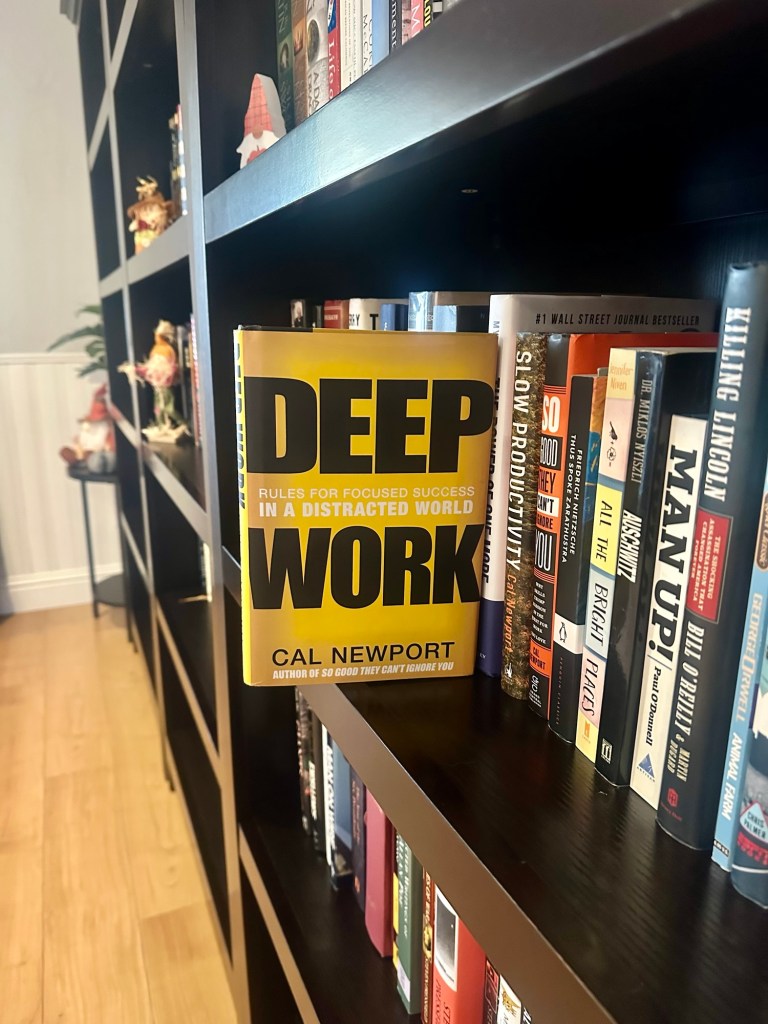

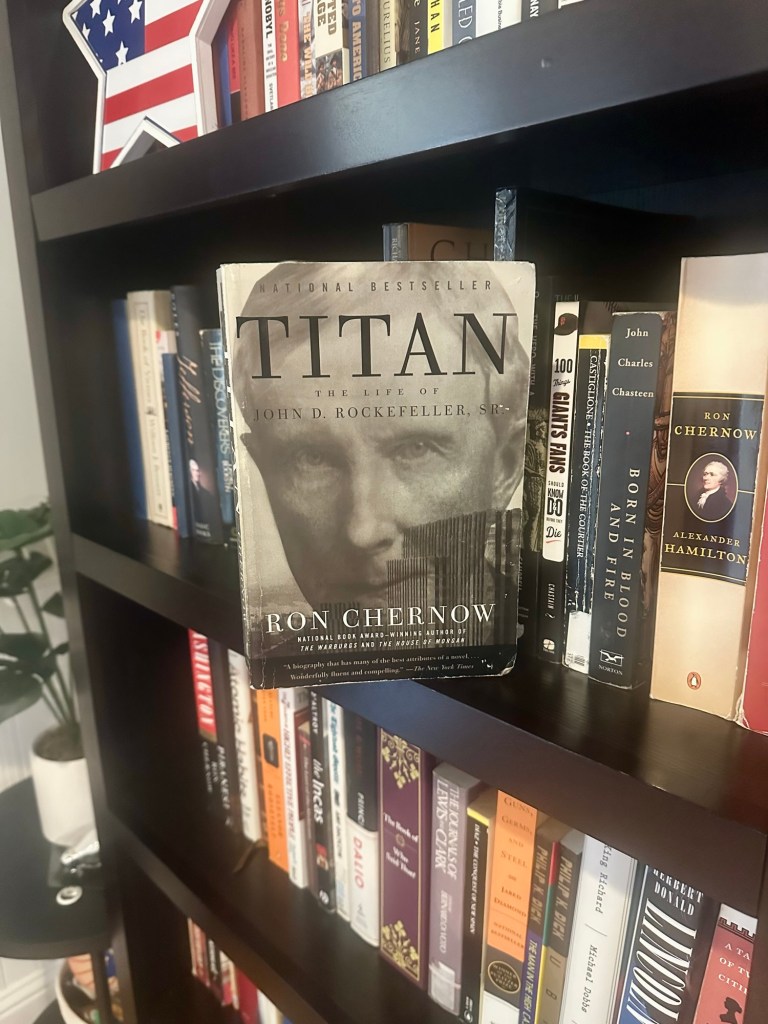



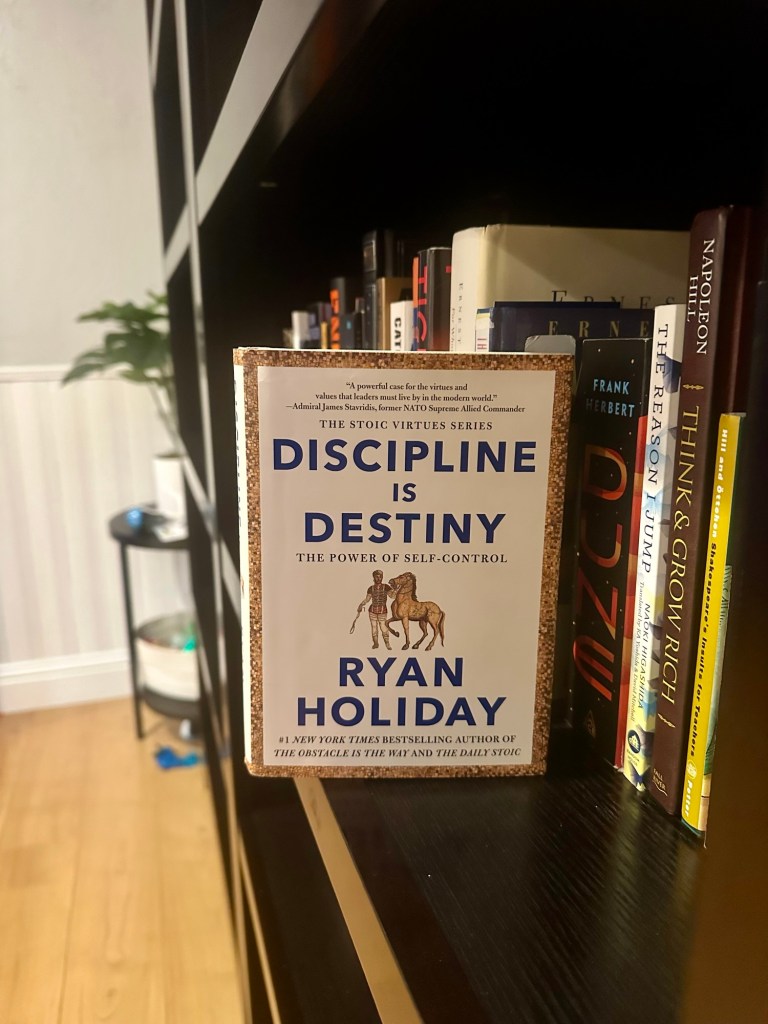









 Book Ponder