
Reading With Purpose
Not all reading is created equal.
Most people think reading is automatically a good thing—that simply finishing a book makes you smarter or more disciplined. But that’s not always true. Reading without focus can be little better than scrolling through your phone: it fills time but leaves you unchanged. The difference lies in how you read. Reading with intention can shape your thinking and actions for the better; reading just to say you’ve “read” something is often wasted time.
As Epictetus said, “I cannot call somebody ‘hard-working’ knowing only that they read. Even if ‘all night long’ is added, I cannot say it—not until I know the focus of all this energy…”

“Far too many good brains,” Seneca said, “have been afflicted by the pointless enthusiasm for useless knowledge.”
Learn to Read Again
Before we can discuss reading with intention, we first need to regain our ability to focus and work our way up to intentional reading.
One of the hardest habits to break as a reader is the urge to finish a book just to say you’ve read it. By this, I mean the dopamine hit to check a book off as “read”. Reading books is the opposite of short-form content because it makes the user earn their dopamine hit. What this leads people to do is rush through the book, taking shortcuts, to say they read a specific number of books and seem well-read in their social circles, but what did we actually get from these books? Reading an entire book is a big time commitment; if we are only consuming them to check off a box, then that time is much better allocated elsewhere. The 40 hours you spend reading a biography are wasted if you don’t gain any lessons or skills you can apply to your life. This is why I always encourage you to actively read with intention, or not to read at all.

Embrace Boredom
If you are taking up reading to do something more productive than endlessly scrolling on your phone, then the transition is going to be difficult in the beginning. Social media has fried our brains with cheap dopamine hits and removed our ability to focus on one thing for long periods of time.
I never understood what boredom had to do with it until I read Cal Newport’s book “Deep Work,” where he explains that the ability to be bored without distracting yourself is the same skill as focusing on one task for an extended period of time.

If you grew up before smartphones, we had moments throughout our day where we just had to be bored without any options to distract ourselves. My only regret is that I wish I had carried a notepad with me at all times because some of your best ideas come when you allow yourself to be bored. With a smartphone in our pocket at all times, those moments of boredom have been completely eradicated from our lives. Whenever boredom creeps in, we instinctively reach for a distraction. That same sensation will hit you when you attempt to take up reading. After a couple of pages, you will begin to space out, and the urge for a quick check on your phone for that cheap dopamine hit overcomes you.
Regaining our ability to be bored and stay focused can be retrained in interval sessions. Let’s start with 10 minutes first, where you do not allow yourself to reach for a distraction when boredom sets in. These short 10-minute sessions can be accomplished in any scenario where pre-smartphone humans were usually bored. In line at the grocery store? Resist the urge to check your phone and allow yourself to be bored. Driving to work? Pick one way to work or on the way home to not listen to anything and drive.
Once you can do 10 minutes, bump it up to 30 minutes. A good one to help your mind and body is to go on undistracted walks. A couple of days a week, go on a 30-minute walk without anything playing through your ears. You’ll survive if you miss one podcast episode or don’t have a constant flow of music going through you.
When you slowly regain the ability to be bored, you will notice your reading sessions will become easier, and you will begin to enjoy reading again without having the constant itch to check your phone. The urge never truly goes away, as we still use our phones for the majority of the day, but our training will outweigh it.
Fall in Love with Reading
Don’t get me wrong, reading is fantastic, but it can still feel tedious if you’re reading the wrong book at the wrong time. Social media has romanticized reading so much that people end up disappointed that it’s not all that these influencers make it out to be. That’s because you’re judging reading through the wrong lens.
Stop viewing reading as if you’re in a comfy chair with coffee, a cat on your lap, your favorite blanket, and a fire in the background. Doing so places an impossible standard on reading. Instead, imagine reading as a mentor who will teach you about anything you’re curious about. A silent mentor that will guide you in many areas of life that apply to you.

Using myself as an example, books taught me how to be a better father, husband, and friend. It taught me how to manage my career and professional relationships. It gave me examples of how great people in history managed adversity. In many instances, books are someone’s life’s work compressed into a few hundred pages that can be consumed in days to weeks. Many books were written so that you can gain the same lessons it took others a lifetime to acquire in a fraction of the time.
If you romanticize reading in this manner, you will come at it in a much more sustainable light and will be ready to read actively.
Another mistake new readers make is jumping into the great books right away. They want to read Plato, Aristotle, and Socrates; they want to deep dive into the Harvard Classics and engross themselves with some of the great thinkers in history. This is an admirable plan, but you will notice very quickly that these books are not easy to read and will suck the joy of reading out of you. That’s why I am terrible at recommending books to people and always give the same advice: read what you love until you love to read. Once you love to read, you will be able to work past the difficulty of some of the great books and find the hidden gems that lie within.
For starters, read something light in a genre you know you love. A good thriller or mystery that you can’t put down will get you replacing reading with doom scrolling in no time. Find an author you resonate with and read some of their best works. Something light and easy in the beginning will get your reading skills up while also granting you a newfound appreciation for reading.
How To Read with Intention
To read attentively-not to be satisfied with “just getting the gist of it.”
Marcus Aurelius
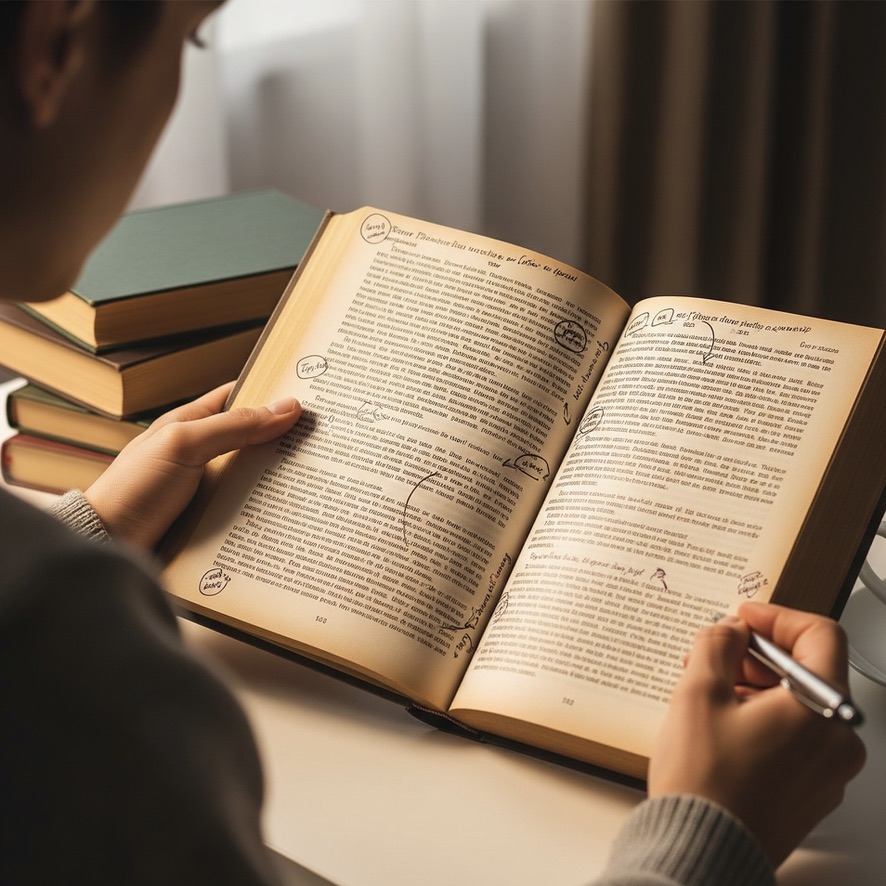
Now that you are finally ready to read with intention, the real value in reading comes to the surface. The most crucial part is that you need to go into every new book with a plan or goal. A goal to extract as much value from the book as possible, remember this is your precious time, get the most bang for your buck. When reading a book for leisure, there’s nothing wrong with lying in bed or on your favorite couch, relaxing. I recommend that when reading a book you intend to gain knowledge from, you treat it seriously and read in an environment that is ideal for learning. If you plan to read physical books, keep something to take notes either in the book or on notecards or a notebook. Take your time, this isn’t a race to check off a box.
Avoid the Elitist Trap
People who read a lot tend to form a superiority complex. They begin to look down on others who don’t read like us. We scoff at people enjoying the latest fantasy novel, thinking to ourselves that they should be reading something more enlightening. Steven Reese from the Read Your Color substack has a great quote about the two kinds of bad readers.
“On the other side of the road is a different kind of trap. The one where only certain books count. Where condescension is the default mode of communication. Where joy is replaced by superiority (grown out of an inferiority complex), and the point of reading is not to grow, but to win. Transformation never happens because it’s not allowed. We aren’t curious; we’re defensive. We already have the “right” taste, the “correct” views. We don’t need books to change us. Why would we? We already know it all! And the joy? Gone. Reading here is grim, obligatory, dry. It’s a weapon. If the Brainrot crowd reads only for pleasure, the Elitist crowd reads only for prestige. Neither is reading for truth. Neither is open to being surprised.”
Steven Reese

We need to find balance. While reading should be used as a self-improvement tool, it’s also perfectly fine as a leisure activity and probably a better one than most. Don’t scoff at the person reading for leisure and be happy that they aren’t doomscrolling on their phone instead. They may be working on developing a love for reading. We were all there at one point.
Find Your Own Reading System
Over the past ten years, during which I began to take writing seriously, I’ve explored various strategies for active reading. I used to be a 100% digital reader, highlighting on my Kindle and using digital note-taking. The only downside is that the ease of saving things digitally made me a hoarder of information. I would finish books with hundreds of highlights and notes that didn’t really resonate with me or seem very important once I was done. Ever since I transitioned to physical books, with writing on the margins and using note cards, I began to rethink whether something was worth saving, as it took time and effort to save it. Anything I highlight or underline in the book has to have my own note that goes along with it. I don’t just highlight something because it sounds interesting; there has to be a reason, and I need to be able to explain that reason on the spot.

Turning Reading into Action
Reading is an investment of your most valuable resource—time. Don’t waste it on skimming or racing through books to say you’ve read them. Instead, slow down, take notes, reflect, and allow the best ideas to shape your thinking and actions. If you do, reading stops being a pastime and becomes a lifelong tool for growth.
If you enjoyed this content, please sign up for my newsletter below, share this post with a friend, or read some of my other blog posts. Thanks for stopping by.
Disclosure: Some of the links in this post are affiliate links. This means that, at zero cost to you, I will earn an affiliate commission if you click through the link and finalize a purchase.
Book Ponder focuses on the incredible power of reading, and even though stand-alone articles like these are unique ideas, I like to credit any books that inspired or gave me the resources for the idea.

 Book Ponder
Leave a comment