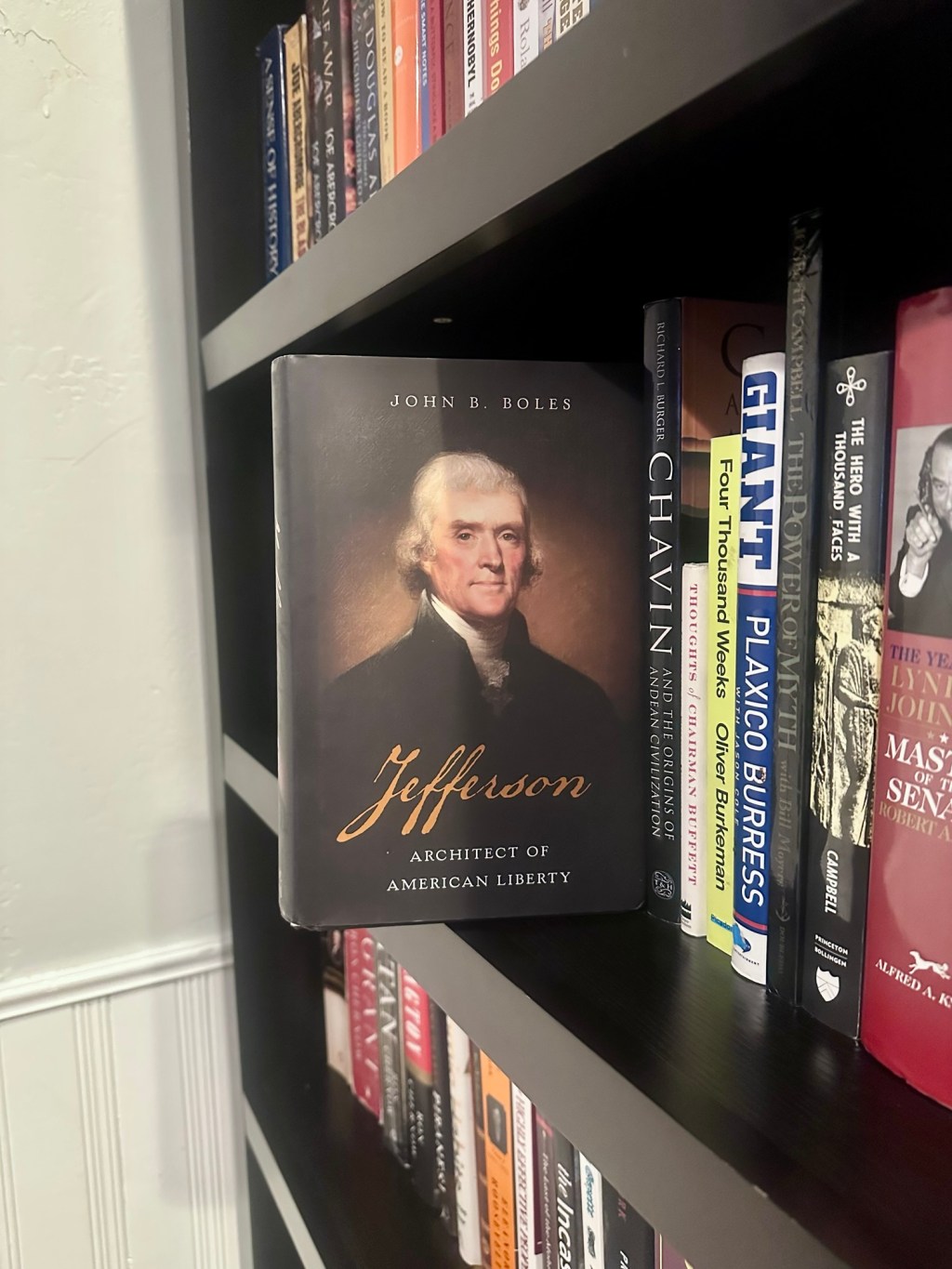
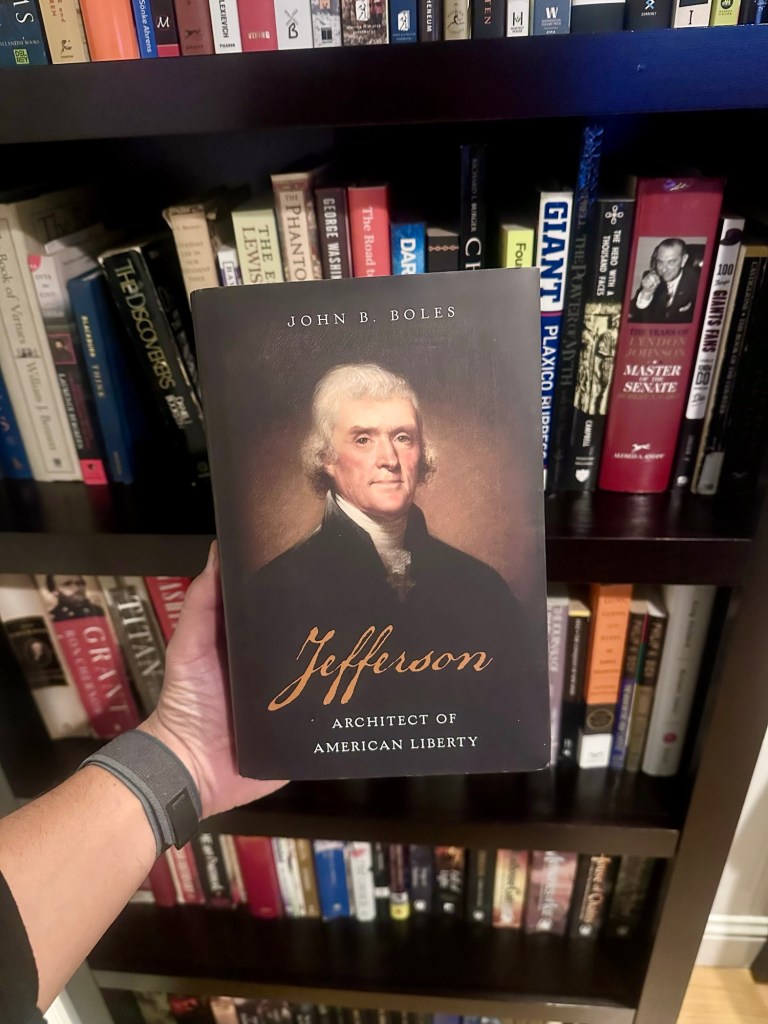
- Jefferson: Architect of American Liberty by John Boles
- Published: April 25, 2017
- Pages: 656
- Read: 9/19/2024 – 10/02/2024
- Rating: 5/5 Stars
Thomas Jefferson is a controversial figure in American history. He accomplished great things as a founding father and made sacrifices for the country he loved. Even though judgment should be withheld in certain aspects of history because they were a product of their time, other moments, like the holocaust and slavery, are never acceptable, regardless of the time period. With Jefferson, it becomes complicated because, like many of the other founding fathers, if he followed suit and never went against slavery, then he would be lumped in with everyone else as a product of their time. Unfortunately, Jefferson is looked at as a hypocrite because, on the one hand, he fought for abolition but continuously used slaves at Monticello. He eventually fathered multiple children with a slave named Sally Hemings but never took a fatherly role over them. Jefferson did treat his slaves well, and I think he believed that by keeping them under his service, he was giving them a better life until a better alternative was available. While this may be true, he should have allowed his slaves the freedom to choose for themselves.
John Boles does an excellent job writing about Jefferson in a positive light, and it gives us a different viewpoint on his complex life. As I read, I consistently went back and forth on my opinion, and by the end, I concluded that Jefferson was a good man with good intentions and clouded judgment. It’s a shame because if he had freed his slaves in his will, he could have redeemed his image, but I believe his financial troubles towards the end of his life kept him from doing that for fear of leaving his family in an even bigger financial crisis.
The Lessons Learned series is different than standard book reviews. There are hundreds of great book reviews on Thomas Jefferson, and I would be wasting your time creating another one. Instead, I strive to give you the lessons I was able to extract from the book to improve my life and yours.
Creating A Sect of Your Own
For most highly intellectual people, religion becomes a complicated topic because they think objectively. For things to make sense, they need facts and impartial proof. They tend to move past the church and community aspect of religion and focus on a personal relationship with God because that’s where they see the majority of its value.
Jefferson viewed himself as a disciple of Jesus’s doctrines. He then created his own modified version of the Bible, a pamphlet containing what he believed were its most important and valuable parts.
“Jefferson considered himself neither an atheist nor an enemy of Christianity but an authentic Christian, defined as a follower of Jesus, not the church.”
John Boles
I agree that going to church and praising God has an important community aspect, but it feels more like an entry point into religion. If you are new and not well-read, a community can help guide you. The more intellectual you become, the less you need church and the more time you spend focusing on your personal relationship with God. This can apply to any religion; we are just using Christianity since this is the religion Jefferson followed.
Just like you modify tools and systems to work for you as you become an expert in anything, you should do the same thing for religion. Create a sect of your own that works best with your intellectual level in order to bring yourself the most value from whatever religion you follow.
The Importance of Duty
One of the most shocking things I learned about the founding fathers is that many of them hated being in politics, and if it was up to them, they would retire to their homes peacefully, read books, and spend time with their families. Yet over and over again, duty called, and they served their country faithfully because they knew that’s what their young nation needed to survive.
This was especially true when George Washington was president, and he had to talk Jefferson out of quitting politics and retiring continuously. Some of the founding fathers, like John Adams, wanted to emulate the British government, and Jefferson feared that the country would fall back into a monarchy, the very thing they had fought so hard to win freedom from. Jefferson served as the first Secretary of State to George Washington’s presidency and two terms as United States President solely for the duty of it.
What duties do you have in your life that you neglect because they aren’t what you want to do? Showing up for your kids even when you are tired, being present and patient with your family after a long day at work, or being kind and generous to others even if you feel they don’t deserve it. These are examples of duties we must do even if we don’t feel like it. Just like the founding fathers sacrificed what they wanted to do for duty to their country, we can do the same in our own lives.
One of the best compliments one can get is one from one’s rival or enemy. Thomas Jefferson and Alexander Hamilton constantly clashed as political rivals, but when duty called, they put their differences aside and worked together. Alexander Hamilton went on to say that even though he didn’t agree with Jefferson’s political views, he acknowledged that Jefferson was an honorable man and was doing what he believed was best for his country.
Duty called, and Jefferson answered.
You Reap What You Sow As A Parent
Many parents are unpleasantly surprised when the relationship with their children fizzles out once they become adults and start their own lives. The children who maintain great relationships with their parents into old age are the ones who built the bond through childhood with parents who were present.
After the death of his wife, Jefferson dedicated his life to his daughters, his country, and his state. He spent many sleepless nights worried about the well-being of his daughters. While living in Paris, he gave his eldest daughter the best possible schooling to find a respectable husband and career once they moved back to America. When his youngest daughter tragically passed away while he was living abroad, he planned for his middle daughter to join them in France and vowed never to be away from them again. Into his old age, his main concern was the well-being of his children and grandchildren, which reaped its benefits when Jefferson was an old man, and his daughter ran Monticello for him and was by his side until his death. Many people sadly spend their final days alone with children and grandchildren, rarely visiting because the bond that is strengthened in childhood was never present. It’s not a guarantee, but if you want to raise great kids and have them in your life into your old age, then you must prioritize them and be present in their lives as Jefferson did with his daughters.
Deep Work Before Deep Work
One of my favorite insights when reading biographies is seeing great people in history practicing life hacks, efficiency strategies, and time management techniques that did not become mainstream and knowledgable to everyone until decades later. In the old days, these strategies were passed down through mentorship and trial and error. For example, Ralph Waldo Emerson would preach to anyone who listened about the importance of starting a commonplace book to jot down all your ideas and insights and not rely on memorization. Nowadays, the second brain movement on note-taking apps or programs is one of the primary tools in knowledge management. The other popularized term, “deep work,” comes from Cal Newport and emphasizes the importance of focusing on an individual task for long periods of time without distractions.
Thomas Jefferson was a proponent of deep work before deep work existed. He strongly believed that his study time should be undisturbed, and he had strict rules for his servants and family: If he was in his study, he would be undisturbed unless it was an emergency.
During his public life, Jefferson would find the need to retreat to an isolated location to do his deep thinking and to work through difficult decisions.
Jefferson’s daughter recalls her father finding solitude in locations outside of his everyday life for his deep work.
“He found such a place shortly beyond the Bois de Boulogne, where a community of lay brothers called the Hermites operated a boardinghouse for guests. Especially in 1787 and 1788, Jefferson frequently rented a room there for solitude to study and write. As his daughter recalled long afterward, ‘Whenever he had a press of business, he was in the habit of taking his papers and going to the hermitage, where he spent sometimes a week or more till he had finished his work.’”
John Boles
Cal Newport recommends finding a place away from the stresses of everyday life to get moments of peace and solitude to think deeply. This can be a spare bedroom away from distractions, a park bench, or a coffee house. Find your own spot that you can designate for intense concentration and critical thinking.
The Importance of Urgency and Ambition
There is nothing wrong with leisurely practicing activities you enjoy or want to improve at, but if you want to be great at something, you need a sense of urgency and a great amount of ambition. If your ambition is lacking, then it will be easy to put the required work off for later or not give the activity your full effort. From a young age, Jefferson knew that he wanted to amount to something, and this was displayed by his study habits and the sense of urgency he impressed on his fellow students.
“His fellow students remembered not his extravagance but his diligence in his studies. Classmate John Page envied his study habits, for he ‘could tear himself away from his dearest friends, and fly to his studies.’ Another student remembered, ‘Even when at school he used to be seen with his Greek Grammar in his hand while his comrades were enjoying relaxation in the interval of school hours.’ According to family members, he ‘habitually’ studied fifteen hours a day, taking a break at twilight to run for two miles before reading deep into the night. By all the evidence he placed high demands upon himself; he admitted in 1819, ‘I was a hard student.’”
John Boles
Like Theodore Roosevelt and John D. Roosevelt, these great intellectuals exhibited a strong work ethic from a young age. Early on, they understood the importance of urgency in their work and displayed high ambition in whatever they set their minds to.
Later, when mentoring aspiring law students, he continued to preach the importance of displaying great intensity and a strong work ethic in achieving one’s goals. This is displayed in the reading schedules he provided to law students who tried to emulate Jefferson’s study habits.
“In letters he wrote later to students aspiring to study law, Jefferson laid out his exhausting schedule: from dawn till 8:00 a.m., one should study science, religion, and ethics; from 8:00 till noon, one should read foundational books in law covering everything from origins to comparative studies to practical tomes; then from noon to 1:00 p.m., politics, with the balance of the afternoon devoted to history, ancient through modern; after dinner, one should spend a couple of hours reading various genre of literature.”
John Boles
This is a great reminder of an excerpt from “Roll the Dice,” a poem by the influential American poet Charles Bukowski.
“if you’re going to try, go all the
Charles Bukowski
way.
otherwise, don’t even start.”
If you want to be truly great at something, only do it if you are willing to go all the way. If you are going to give anything less than your full effort, then those resources are better distributed elsewhere, or be conscious that you are never going to be great at it. This may sound tough, but there is nothing wrong with accepting you won’t be great at something so that you won’t be disappointed in the end. There are plenty of other things to be great at; just be ready to fully commit to those things, or else be okay with mediocrity.
Having a Growth Mindset
One of the most challenging aspects of transitioning from a fixed mindset to a growth mindset is admitting when you are wrong. In a growth mindset, everything that happens is an opportunity to grow, and being wrong does not matter if you are still improving or learning from your mistakes. In a fixed mindset, you stand your ground and never admit defeat, even if it’s staring you right in the face.
Jefferson gracefully acknowledged when he was wrong, especially if he trusted the judgment of those on the other side. He displayed this when the Constitution was ratified, but he did not fully agree with many of the laws governing the presidency.
“When Jefferson finally learned that Virginia had ratified the Constitution, meaning the requisite nine states had voted in favor, he graciously sent Madison a note saying, ‘I sincerely rejoice at the acceptance of our new constitution by nine states. It is a good canvas, on which some strokes only want retouching,’ referring to the need for a bill of rights. He told Madison that since a majority had rejected his concern about the presidency, ‘I readily therefore suppose my opinion wrong.’ Jefferson sincerely believed in the judgment of the people, in this instance and most others. It was a bedrock principle of his political faith.”
John Boles
Purpose Through Pain
A common struggle for people is carrying on with life after tragedy strikes. A death in the family, a loss of a job, or an unfortunate diagnosis can send us downspiraling and put us in a lethargic state of “what the point” when trying to accomplish anything. Like holocaust survivor Viktor Frankl witnessed in the concentration camps when prisoners lost meaning or purpose in their lives, they would quickly die. Frankl found purpose in the concentration camps even when hope was at its bleakest, which kept him alive while many others died around him.
This is why we need to find purpose in our lives when going through difficult times. Jefferson faced constant death in his family combined with struggles in keeping the young nation on its feet. He went through bouts of depression and lethargy, finding his purpose always brought ambition and desire back into his work. He stepped away to recover for a short period in Philadelphia, which was exactly what he needed to get back in the right mindset.
“The dark spell of grief and even self-pity had been broken. He rediscovered what excited him about life, recovered the stoicism that had first served him well almost three decades before when his father died, found a true intellectual colleague in Madison (they lived in the same boardinghouse), and resolved to put aside the allures of premature retirement. Never frivolous, Jefferson found an even greater seriousness of purpose. It was as though he, now more mature and resilient, had been reborn to a life of learning and public service.”
John Boles
When life feels too difficult to continue, sometimes we need a change of scenery, a small getaway, or something that temporarily takes us away from the monotony of everyday life. This can give us that small space to breathe and guide us back to finding a purpose.
The Joy of Seeing Your Children Embrace Your Guidance
Books were an essential part of Jefferson’s life, and he credited them with bringing him the most joy. He preached the importance of books to colleagues, students he mentored, and especially his children and grandchildren. Just like the earlier section on reaping what you sow as a parent, Jefferson again capitalized on this when he delighted in his family’s love for reading.
“After dinner, when the family sat about the parlor reading by candlelight, Jefferson occasionally put down his book—likely a familiar Greek or Latin classic, which he loved reading in the original language—and, smiling contentedly, looked around the room at his whole family with their own books in their hands. Jefferson always loved nurturing younger minds or seeing them nurtured by others such as Martha.”
John Boles
Lead by example if you want others to follow in your footsteps. If you want your kids to partake in good habits, then you must practice those good habits, too, you can’t tell your kids to read more books if you sit on your phone or watch TV in your leisure time. Surround them with books and read books in front of them, and they will do the same.
Final Thoughts
Jeff Boles did an amazing job making this book a joy to read. We get an inside view of the difficulties of guiding a new nation that eventually became one of the greatest countries in the world. Those early years were filled with constant trials and tribulations that threatened to make the new nation succumb to European powerhouses. In the end, even with political disagreements, the founding fathers were able to guide us through the early years and give us the pathway to becoming the great nation we are today.
Jefferson was a flawed character, but he was a good man with good intentions. I strongly recommend this well-written biography for anyone interested in learning more about America as a young nation, the founding fathers, and Thomas Jefferson’s life.
If you enjoyed this content, please sign up for my newsletter below, share this post with a friend, or read some of my other blog posts. Thanks for stopping by.
Disclosure: Some of the links in this post are affiliate links. This means that, at zero cost to you, I will earn an affiliate commission if you click through the link and finalize a purchase.
 Book Ponder
Leave a comment