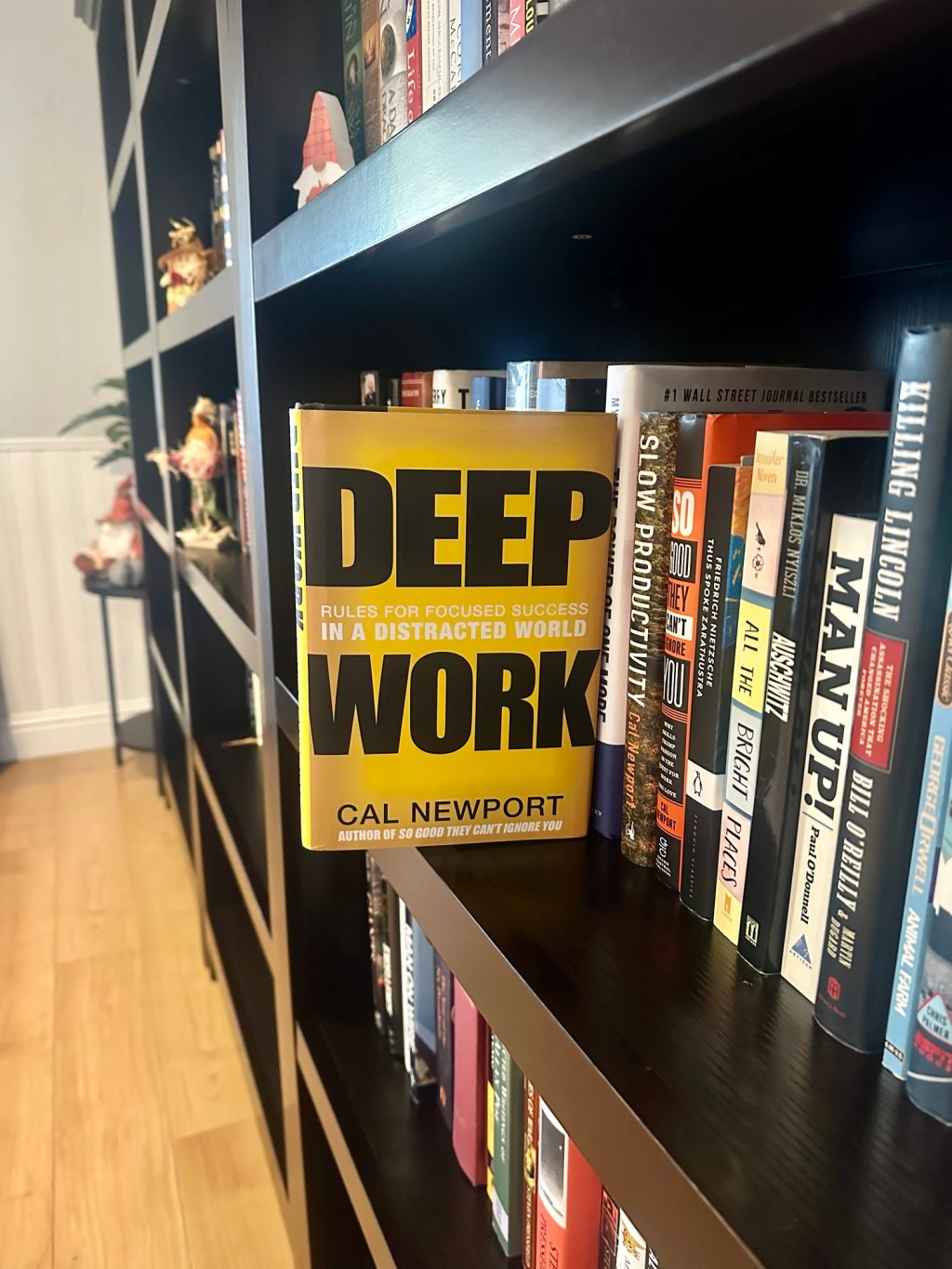
- Deep Work by Cal Newport
- Published: January 5, 2016
- Pages: 296
- Read: 09/20/2019 – 11/04/2019 | 08/19/2024 – 08/24/2024
- Rating 5/5 (Quake Book)

The Lessons Learned series is different than normal book reviews. There are hundreds of great book reviews for Deep Work and I would be wasting your time creating another one. Instead, I strive to give you the lessons I was able to extract from the book to improve my life and yours.
What Is Deep Work?
Do you ever find yourself trying to focus intently on one important task and your mind keeps tugging at you for a short distraction to get your mind off the difficult task? The basis of deep work is the ability to push through this and concentrate deeply on a task.
Cal Newport better defines it as, “Professional activities performed in a state of distraction-free concentration that push your cognitive capabilities to their limit. These efforts create new value, improve your skill, and are hard to replicate.”
With an entire industry focused on keeping you distracted with social media apps and games, the advantages of deep work are more valuable than ever. If you can practice deep work today, it will give you a huge advantage over your competition.
You Can’t Rely Solely on Willpower
Many individuals will read that something is good for them and try to apply it with no strategy, and rely solely on willpower. While this may be effective in the beginning, studies have shown that willpower is finite. To truly make a change you need a strategy and systems in place to help you achieve a change. Don’t forget that there are engineers out there whose sole purpose is to keep you distracted and doom scrolling on their apps.
“The key to developing a deep work habit is to move beyond good intentions and add routines and rituals to your working life designed to minimize the amount of your limited willpower necessary to transition into and maintain a state of unbroken concentration.”
Cal Newport
How to Get Better at Deep Work
There are many strategies out there to improve your ability to focus and it depends on what your main source of distraction is. For now, we will focus on the most common one: smartphones. Smartphones are an incredible tool if used correctly, but can also be the bane of your existence if allowed to run amok in your life.
The Digital Detox
The next book after Deep Work by Cal Newport is “Digital Minimalism.” It talks about a strategy of detoxing yourself from your smartphone addiction by removing all apps from your phone that make money off of your time. After the 30-day detox, you methodically allow some of these apps back onto your phone when they fulfill a useful purpose or have limits that can be followed. For example, your favorite game or the Netflix app can make its way back onto your phone if you have the correct systems and guidelines in place to only use these apps with intention and not every time you feel bored. An example of intention can be scheduling a 30-minute block every other day where you can watch Netflix or play your game guilt-free, but once that time is up you don’t use that app again. When boredom hits throughout the day you don’t allow these apps to work their way into your life as a distraction device.
Being Bored Is Okay
The next step to improve your ability to practice deep work is to regain the skill of being bored. A common theme in my writing is that boredom and the ability to focus are the same skill and if you never allow yourself to be bored, then you are losing the ability to focus. Have you ever tried to complete a difficult task if you can’t focus? It will either take much longer than intended or the quality will be lackluster. Cal Newport recommends implementing short sessions of boredom throughout your day with one longer session once a week. These short sessions can be waiting in line at the grocery store without reaching for a form of distraction or driving to work without anything on the radio. The longer weekly session can be going on a 30-minute walk without any devices. This leads to our next lesson and the incredible benefits of walking.
The Power of Walking
The more biographies I read the more I realize that many great individuals in history had many of the same habits. The three that are always recurring are the benefits of walking, writing things down, and surrounding yourself with the right people.
Many great artists, leaders, authors, and businessmen credit their ability to solve difficult problems or come up with new ideas to walking. As Nietzsche said, “It is only ideas gained from walking that have any worth.”
Productive Meditation
Long undistracted walks are a great way to regain your ability to focus, but if this feels like too much, you can try practicing a strategy that Newport introduces called “Productive Meditation”.
“The goal of productive meditation is to take a period in which you’re occupied physically but not mentally—walking, jogging, driving, showering—and focus your attention on a single well-defined professional problem. Depending on your profession, this problem might be outlining an article, writing a talk, making progress on a proof, or attempting to sharpen a business strategy. As in mindfulness meditation, you must continue to bring your attention back to the problem at hand when it wanders or stalls.”
Cal Newport
Implementing productive meditation into your “boredom sessions” can make them feel more productive and an easier transition from constantly being distracted to allowing yourself to practice complete boredom.
The next time you go on your weekly “boredom session” try bringing a problem you are trying to solve and keep your mind focused on that task during the entire session. Over time practicing these small boredom sessions every day and a longer productive meditation session throughout the week will give you a noticeable improvement in your ability to focus the next time you sit down to do meaningful work.
What Do You Focus On?
Let’s say you have regained your ability to focus for long periods and are ready to implement this skill back into your life. You may ask yourself, does every task require deep work? Do you implement deep work when mowing the lawn? The answer is to focus on your most important goals.
Deep Work Has Limits
The longer you practice deep work the longer you can do it, but even the most agile minds find that there is a limit to deep work. Cal Newport puts this number at 4 hours of pure deep work before your focus resources are depleted and for novices in deep work, perhaps only one hour of deep concentration seems to be the limit, if we were to implement deep work to everything, we would be toast by noon.
Not every task requires deep work, narrowing it down to a small number of extremely important goals and directing your deep work skills to those goals is ideal. Once you have chosen a task to perform deep work on, try your best to have a least a one-hour block for deep work, because any distraction that causes a context switch while trying to focus starts the process all over again as you have to ramp up that full focus mode again. It’s not just a switch we can turn on and off, concentrating on a task deeply requires build-up.
Doing Meaningful Work Brings Us Joy
What is all of this for? Why is this so important if life is just about happiness? Cal Newport says that studies have shown that human beings are most satisfied with life when immersed deeply in something challenging. How good does a well-deserved dopamine rush feel when you create something or complete a difficult task? Lounging around doing nothing may seem like it makes us happy, but being in the flow state doing meaningful work, brings us joy. That’s why it’s important to find some sort of fulfillment in whatever you are doing.
Give Whatever You Are Doing Your Full Attention
Once you have regained your ability to focus again and found something to work on that brings you fulfillment or joy, give whatever you are doing your full attention. Better yet, imitate the actions of one of the most decorated deep work advocates in history.
“Like Roosevelt at Harvard, attack the task with every free neuron until it gives way under your unwavering barrage of concentration.”
Cal Newport
Final Thoughts
Deep Work by Cal Newport is what I consider a “quake book”, a book that shook me to my core and changed the way I view the world. The first time I read it, I was struggling to balance returning to school for my Bachelor’s degree and working full-time, while being a husband and father. After implementing the strategies in the book and regaining my ability to focus I was able to easily pass the rest of my classes by practicing one hour of deep work on my days off to study. That’s all it took, you will be surprised how much more you can get done with one hour of deep work compared to hours of distracted work.
If you enjoyed this content, please sign up for my newsletter below, share this post with a friend, or read some of my other blog posts. Thanks for stopping by.
Disclosure: Some of the links in this post are affiliate links. This means that, at zero cost to you, I will earn an affiliate commission if you click through the link and finalize a purchase.

 Book Ponder
Leave a comment