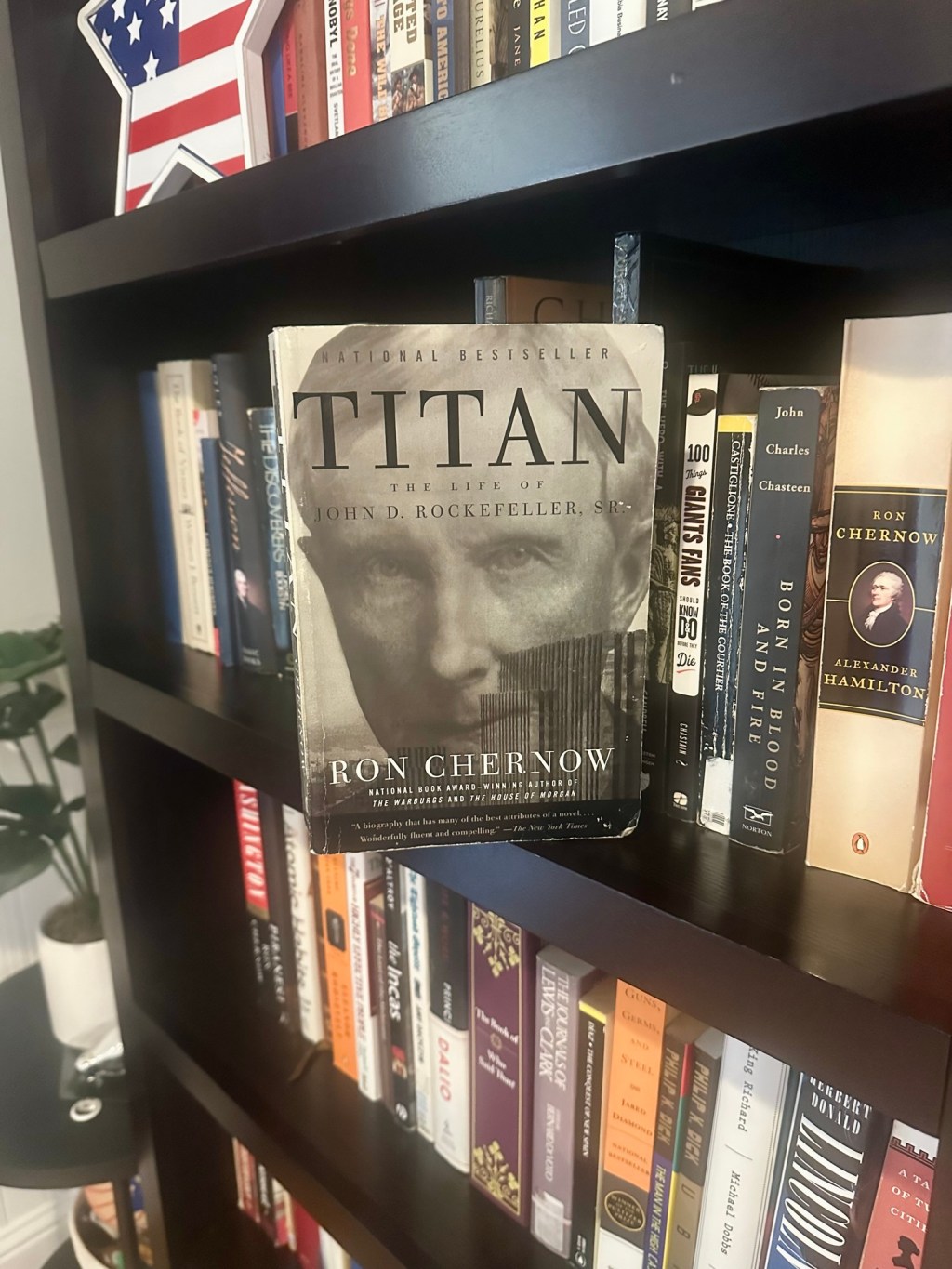
- Titan: The Life of John D. Rockefeller, Sr. by Ron Chernow
- Published: May 5, 1998
- Pages: 832
- Read: 7/13/2024 – 8/17/2024
- Rating: 5/5 Stars
The Lessons Learned series is different than normal book reviews. There are hundreds of great book reviews for Titan by Ron Chernow and I would be wasting your time creating another one. Instead, I strive to give you the lessons I was able to extract from the book to improve my life and yours.

Surround Yourself With What You Want to Be or Who You Want to Become
A common theme when reading about individuals who have become wildly successful is that they knew the importance of surrounding themselves with the right people, John D. Rockefeller was no exception. He credited a large portion of his success to being able to read people and finding out who was trustworthy or not. He surrounded himself with these people when starting his life as a businessman and it helped him build great partnerships and an advantage over his rivals. This theme can also be extended to large groups of people like the incorporated village of Owego where Rockefeller grew up.
“The incorporated village of Owego had an imposing courthouse, a well-stocked library, a renowned school, and other nascent hints of culture. For a country town of seventy-two hundred people, it also boasted a disproportionate number of resident writers and artists.”
Ron Chernow
Surrounding yourself with the right people, communities, and even towns can go a long way to improving your growth. Even if we are unaware of it, we subconsciously start having similar characteristics to the people we are around most. Be wary of who you associate with and always strive to be around like-minded people or individuals who are where you want to be.
Build Your Future With Relentless Effort and Determination
My favorite part of all biographies is the journey, how regular people like you and I found a way to do incredible things. Rockefeller was no exception to this and it shows in his journey to get his first job. This was our first glimpse into Rockefeller’s intense ambition and sense of urgency to get what he wanted. Following the constant abandonment of his father and his subsequent withdrawal from supporting John’s dream of going to college, he realized that he was going to have to become the man of the house and find a source of income.
Each morning Rockefeller would leave his home and 8 AM and make his rounds to Cleveland firms offering his services for bookkeeping work. In the middle of summer, he made this trek six days a week for six consecutive weeks. The thought of going back to the country and relying on his father for his livelihood gave him the strength to carry on. As described in this biography, failure was never an option and he would restart his trek from the beginning over and over again when all businesses had turned him down.
“When he exhausted his list, he simply started over from the top and visited several firms two or three times. Another boy might have been crestfallen, but Rockefeller was the sort of stubborn person who only grew more determined with rejection.”
Ron Chernow
Rockefeller’s perseverance finally paid off as he got a bookkeeping job at the firm Hewitt and Tuttle, and this started the rollercoaster journey to becoming the wealthiest man alive. The importance of this day was never forgotten and Rockefeller cherished “Job Day” as the most important day of his life.
“For the rest of his life, he would honor September 26 as ‘Job Day’ and celebrate it with more genuine brio than his birthday. One is tempted to say that his real life began on that day.”
Ron Chernow
Imagine if Rockefeller had just given up and admitted defeat. We need to have the same passion and determination that Rockefeller implemented when we are pursuing our dreams.
Write Things Down
Like Abraham Lincoln, Teddy Roosevelt, and Ralph Waldo Emerson before him, Rockefeller had the habit of writing things down in a commonplace book or what he called “Ledger A”.
“In his pocket, he carried a little red notebook in which he jotted suggestions for improvements and always followed up on them.”
Ron Chernow
Ledger A was the most sacred relic in Rockefeller’s life and he cherished it for the rest of his life. It shows his passion for numbers as he kept a meticulous log of all his expenditures even into old age in future versions of his ledger.
“For the remainder of his life, Rockefeller treated Ledger A as his most sacred relic. Producing it before Bible classes more than fifty years later, he became almost tearful and trembled as he thumbed its pages, so potent were the emotions it evoked.”
Ron Chernow
It may seem strange or dramatic for us when someone has this type of reaction to just a notebook, but many people in history gave credit to their commonplace books as the main reason for their success. The commonplace book was there to externalize great ideas, remember important information, and a resource to clear the mind. They are all used differently by all users but they share the same benefit of getting important things off your mind to free up resources to generate new ideas.
If you haven’t started your commonplace book, don’t wait any longer to start. It can be on a notes app, a fancy bullet journal, or just a basic notepad, the important part is externalizing the things that cross your mind throughout the day.
Never Judge a Book by Its Cover
How often do you judge someone before getting to know them, perhaps by the way they dress or their demeanor? There’s nothing wrong with following your intuition but you should work on holding off passing judgment on others until you have gotten to know them. I would have missed out on many great friendships in my life if I had judged people by my first impression. This leads to a comical story in Titan when a young Rockefeller starts seeing a woman but is turned away by her parents because they don’t think he is good enough for their daughter.
“In one of the less prophetic judgments in parent history, they argued that they didn’t want their daughter to throw herself away on a young man with such poor prospects.”
Ron Chernow
These parents judged Rockefeller without getting to know him and believed that the eventual wealthiest man in the world had poor prospects. To add insult to injury, Rockefeller went on to become an even better father and husband than a businessman.
The Power of Walking
How often do you go on walks? Better yet how often do you go on walks without distractions? On top of all the excellent health benefits of walking, it’s also an incredible idea generator. Combining walking with writing things down is a guaranteed way to think through difficult problems and generate new ideas. Being bored without reaching for a source of distraction goes hand in hand with the ability to focus on a difficult task for long periods, but many people have a hard time implementing “boredom” sessions throughout their day as it feels like a huge waste of time. A better alternative is going on undistracted walks, this means no phone, no music, no podcasts, just your thoughts. At first, the desire to reach for a distraction will be unbearable but over time you can slowly begin to retrain your brain to be okay without constant dopamine hits. Over time you will look forward to these moments as they will become stress relieving and a great way to think through things.
Rockefeller credited much of his success to walking for his business partner Henry Flagler and himself.
“We met and walked to the office together, walked home to luncheon, back after luncheon, and home again at night. On these walks, when we were away from the office interruptions, we did our thinking, talking, and planning together.”
John D. Rockefeller, Sr.
Aside from the benefits of going on walks alone, walking as a social interaction is also a great activity and I can credit it to some of the best conversations I’ve had with my family when we’ve gone on device-free walks after dinner.
Learn From Your Mistakes Instead of Repeating Them
How often do you see kids go through traumatic childhoods and then put their own families through the same things when they grow up? You would think that if you went through something you hated you would never put your own family through the same thing, but this dilemma is more common than you think. We learn by example, even if it’s negative.
Every so often we get individuals who learn from their mistakes and go above and beyond to never repeat the mistakes of their parents. This was the case for Rockefeller. As he began to raise his own family he was always conscious of the shortcomings of his father and made great efforts to not follow in the same footsteps. The most admiral trait that I learned from reading this biography is that even though Rockefeller was considered to be the greatest businessman of his time, he was an even better father and husband. This is the true redemption story, when your childhood sets you up for failure but you become great at the thing everyone expected you to fail at. His father was a terrible role model, yet Rockefeller used this as a lesson on what not to do instead of following his father’s footsteps.
The greatest compliment Rockefeller could receive was from his biggest critic Ida Tardbell who almost single-handedly dismantled the Standard Oil empire. After working together with Rockefeller Jr. she went on to say that even though she disdained Rockefeller’s business practices, no one can question his excellence in parenting.
This goes to show you, that just because life dealt you a bad hand, doesn’t mean you can’t learn from those mistakes and not repeat them.
The Importance of Concentration
With the rise of technology, the skill to focus on a single task for long periods is becoming less common and more valuable. Being able to focus almost seems like a superpower now. Always ahead of his time, Rockefeller knew how valuable this skill was and was always using it to his advantage.
“He once asked rhetorically, ‘Do not many of us who fail to achieve big things . . . fail because we lack concentration—the art of concentrating the mind on the thing to be done at the proper time and to the exclusion of everything else?’”
John D. Rockefeller, Sr.
Prioritize not relying on your phone as a constant source of distraction and pick up a book or write in your commonplace book when you have moments of downtime. This will benefit you when it’s time to sit down and focus on a difficult task. You won’t be constantly fighting the urge to check your phone as a source of distraction.
Focus on Your Strengths, Delegate Your Weaknesses
The most valuable part of your time is to spend the majority of your time doing the things you are good at and delegating the rest. If you are a great writer but a terrible website designer, don’t waste countless hours working on your website when it could be spent writing. Find which one of your skills has value and delegate the others if possible. Rockefeller used this same strategy when dealing with business, he knew what he thrived at and delegated the rest to others who thrived at those skills.
“I never felt the need of scientific knowledge, have never felt it. A young man who wants to succeed in business does not require chemistry or physics. He can always hire scientists.”
John D. Rockefeller, Sr.
Stay Accountable to Your Commitments
Being a good person is a fine balance and many of the greatest businessmen in history have terrible children who have been coddled or raised by nonpresent parents. Rockefeller’s greatest achievement was his parenting of Junior. Like mentioned before, when your biggest critic, compliments your parenting, you must be doing something right.
We can use this as a reminder that just because you are chasing your dreams, doesn’t mean that you can let your other responsibilities fall by the wayside.
Final Thoughts
Titan by Ron Chernow is one of my favorite biographies I have read in the last few years. Most of us have heard the story of the oil giant “Standard Oil” and the subsequent movement by the U.S. Government to put rules in place to control monopolies. Chernow does a great job of showing us who Rockefeller was as a human being, not just a businessman. I strongly recommend checking out this biography, don’t be intimidated by its size, like all Ron Chernow biographies, the flow is amazing and it’s an entertaining read.
If you enjoyed this content, please sign up for my newsletter below, share this post with a friend, or read some of my other blog posts. Thanks for stopping by.
Disclosure: Some of the links in this post are affiliate links. This means that, at zero cost to you, I will earn an affiliate commission if you click through the link and finalize a purchase.
 Book Ponder
Leave a comment