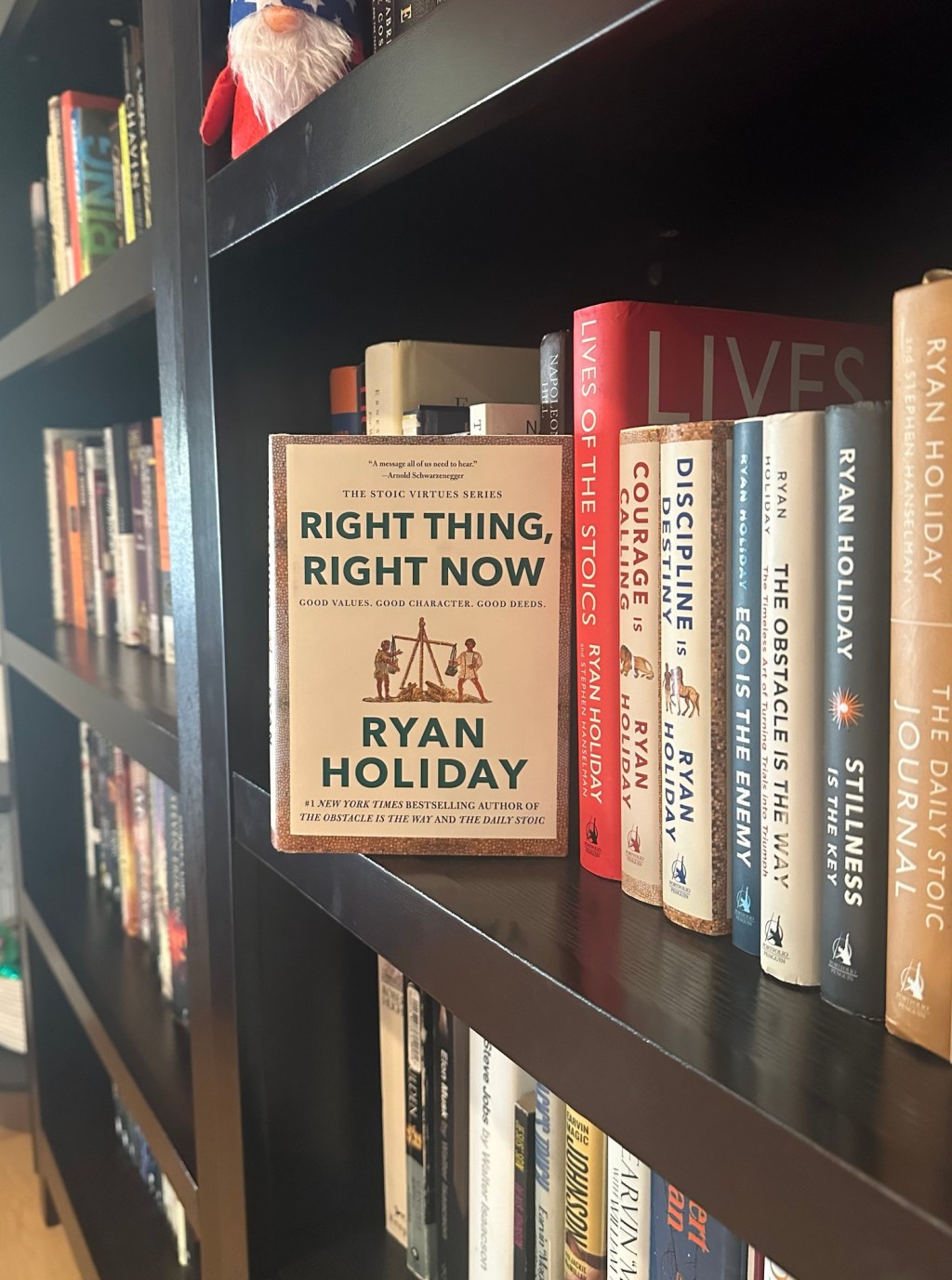
- Right Thing, Right Now by Ryan Holiday
- Published: June 11, 2024
- Pages: 365
- Rating: 4/5 Stars
- Read: 6/14/2024 – 6/24/2024

Right Thing, Right Now by Ryan Holiday is the third book in “The Stoic Virtue Series” preceded by Discipline is Destiny and Courage is Calling. It focuses on “justice” and how it goes hand in hand with discipline which focuses on being good internally while justice focuses on being good externally.
“We keep our word to ourselves— that’s discipline.
We keep our word to others because it’s justice.”
Ryan Holiday
The Lessons Learned series is different than normal book reviews. There are many great book reviews for Right Thing, Right Now and I believe I would be wasting your time creating another one. Instead, I strive to give you the lessons I was able to extract from the book to improve my life and perhaps yours.
Be Good, Even When Nobody Is Watching
It’s easier to do good when it benefits us. Putting in that extra effort at work is easy when our boss is watching and can benefit us in getting that promotion in the future. It’s easy to help an elderly person in need or give up your seat for a pregnant woman when your kids are watching. It shows them a good example of what being a good human being looks like. But what about when no one is watching? That is the true test of character. Ryan Holiday emphasizes the importance of doing what’s right even when it may cost you.
“Care about others.
Treat them as you would wish to be treated.
Not just when it’s convenient or recognized, but especially when it isn’t.
Even when it’s not returned. Even when it costs you.”
A good practice to improve this habit is by using a tool that many religious individuals practice. It says to always act as if God is watching over your shoulder, if you aren’t religious, you can replace God with anyone important to you. Always act as if your kids are watching, or always act as if your parents are watching. This will help give you pause to think and become aware if you are making a bad decision.
Being good when nobody is watching goes hand in hand with being good when the going gets tough. It’s easy to do the right thing when the right thing is easy, and circumstances are perfect. But what about when the going gets tough? What about when the stakes are high, or you don’t feel well? This is when the importance of discipline kicks in and not relying on how you feel to do the right thing. A good practice to improve at this is to take a step back and ask ourselves, “What decision would I make right now if the circumstances weren’t difficult, and I felt great?” The right thing must be done all the time, not just when it’s convenient.
Acting as if the world is watching in everything you do, will impose justice into every aspect of your life. If you act as if your spouse is watching, you won’t step outside of your marriage. If you act as if your friend is watching, you won’t gossip behind their back. Ryan Holiday says that if we are inclined to hide something and would dread for it to become public then it’s probably not the right thing to do.
“Meanwhile, how many of our marriages would survive our spouse looking at our phone? Or our boss seeing what’s in our email? How many reputations would survive a lawsuit that made it to discovery?
If we’re inclined to hide it, we probably shouldn’t do it. If we dread the publicity, maybe we’re not living or doing right.”
Use the Past to Guide Your Future
A common theme you see when reading history and biographies are atrocities people committed because it was a product of that time or back then it was the standard. While we should show leniency to our ancestors in certain areas because it was a product of the time, other actions like slavery or the holocaust are irreprehensible, regardless of the period they were committed in. This leads to a lesson you can apply to your actions. Act with the mindset of, “What will the future think of this decision?” Some things that are a gray area today, will be crystal clear to our grandkids in the future. 100 years ago, people were unsure whether they should support the abolition of slavery, in the moment it was a tough decision with immense financial repercussions, but those who chose not to do the right thing are looked at negatively today. In whatever you support or believe in, try putting yourself in the shoes of people who are directly affected and think of what the history books will say about it in the future. If you are always doing the right thing, you are future-proofing your reputation and will be someone future generations can look up to.
Don’t Become Desensitized to Bad Things
Ryan Holiday talks about how people become desensitized to horrific acts committed in history. Perhaps the first time everyone was horrified but once it became “normal” people became accustomed to acting this way.
“The first time we see it, we’re horrified. New sailors on slave ships reacted with horror. The same goes for executives touring a sweatshop. Or the prison guard. The first taste of illicit money. But the third or the fourth time? After a while on the job? It just becomes part of the job. Our conscience is dulled.”
Ryan Holiday
The first time we do something wrong is the hardest. It gets easier every time after that. Don’t let it get to that point, continue to let bad things make you feel bad by not letting it become a habit. Your conscious is the same as a friend trying to give you advice and they slowly stop because you never listen. That little voice in your head gets quieter and quieter the longer you ignore it until you catch yourself going too far and wishing you would have listened to that voice sooner. That’s what justice is about, not saying “Just this one time” or “It’s okay because no one will notice”, eventually someone will notice and one time will lead to two, that’s why we never put off doing the right thing.

A Life of Integrity Will Cost You
So far, the theme of justice has been doing the right thing regardless of the circumstances. One of the toughest challenges of this mantra is doing the right thing while others are succeeding while doing the wrong thing. In these moments where it’s tough to see the good in doing the right, it’s important to look long-term and at the big picture.
“When we see others pull ahead of us because they have acted without it, when we see them bending the rules or taking bribes, we must remember where that road ultimately ends.”
Ryan Holiday
That road will lead to losing your integrity, and no amount of success can offset it. We see some of the most successful people in the world lose their integrity, their reputation never recovers regardless of all the assets they have. How you feel about yourself when no one is watching is something money can’t buy. When you are sitting alone with your thoughts you know who you truly are and someone who maintains their integrity can feel good about themselves and that goes a long way to being happy rather than having success with no integrity. It’s tough seeing others succeed by taking shortcuts, but there’s a price to pay in the end. Some individuals pay it after their death, when their atrocities come to light, and their descendants have to deal with the fallout.
Virtue Is Practiced Everyday
Doing the right thing is something that is never put off for later. It’s a lifestyle, not something we do when it’s convenient. Ryan Holiday advises us to take Aristotle’s view of virtue and make it a part of our daily habits.
“I’ll do it later. I’ll do it when I’m more secure. I’ll do it when it will really count.
But this violates Aristotle’s view of virtue. It wasn’t a thing you arrived at, it was a daily practice— it was a habit. And in this daily practice, we become who we are.”
To help implement this lesson into your life think of yourself as being a virtuous person which allows you to do the right thing all the time because that’s who you are, not an action that you are trying to accomplish whenever it’s convenient.
Do Not Excuse Your Actions
The easiest way to let wrongdoing run amuck is to stay in your bubble. You tell yourself that it’s not your business or you say it’s someone else’s problem, but that’s what allowed many of the worse moments in history to carry on for much longer than they should have. Too many people turning a blind eye because it didn’t affect them, or acting oblivious because it would be an inconvenience, it’s cowardice if you ask me. Perhaps you aren’t going to save the world but at the bare minimum, you have the power to make yourself a good person.
“The problem is that it’s so easy to stay in our bubbles. To not see what we don’t want to see. We don’t do the math— on what it would be like to live on such a wage, on where all these raw materials are coming from, on where our money is going. We ignore the smell . . . or let people cover it up for us.”
Ryan Holiday
As I mentioned before, put yourself in the shoes of the affected person and then decide what you would do.
The book talked of the famous poem by Martin Niemöller on the effects of showing indifference to suffering until it affects you.
“First they came for the socialists, and I did not speak out—
Because I was not a socialist.
Then they came for the trade unionists, and I did not speak out—
Because I was not a trade unionist.
Then they came for the Jews, and I did not speak out—
Because I was not a Jew.
Then they came for me—and there was no one left to speak for me.”
If you weren’t there in someone else’s time of need then no one will be there in yours. Everyone’s time comes. Step out of your comfort zone and do the right thing. If you read a lot of history, you will understand that life on earth is a big cycle, history consistently repeats itself, and you must look to the past to not make the same mistake again when your time comes.
Another excuse people make is that they don’t want to start small, they try to hit a home run when they’ve never taken a swing before, they want to save the day or do nothing at all. If you want to make a change in any aspect of your life you must start small. No change is possible without that first tiny step, if you are looking to make a change in society start with your local politics instead of running for president.
Blaming the system is an excuse to do nothing. Ryan Holiday talks about how acting like an “outsider” is cool and how blaming the whole system being corrupt excuses you from taking action, but this is another form of cowardice. Perhaps the whole system is corrupt, but that doesn’t excuse you from working on what’s right.
“You can resign in protest. You can call them all bastards. You can damn the whole world as corrupt and broken. Just know that, in so doing, you may put yourself out of the running to be of service to anything but your sense of superiority.”
Ryan Holiday
In the end, it’s all an act to stay in your comfort zone and not do what’s right because it’s difficult. You are just watching from the sidelines and letting everyone else do the work.
Stop making excuses to not do the right thing.
Generosity Everyone Can Afford
You blame your lack of generosity on not having enough money to help. Yet some of the best forms of generosity exist outside of financial assistance. Ryan Holiday talks about kindness being a form of generosity we can always afford.
“It doesn’t matter how much money you have, how much power you have (or how little), nothing is stopping you from being generous in some form or some way. How are you doing? Do you need anything? Great job. I appreciate you. These are expressions of generosity that don’t cost a thing.”
Sometimes you can’t afford to be generous financially, but many types of generosity are free and sometimes just asking someone “how they’re doing” is all the kindness they need. If you feel like you can’t be generous financially, then ask someone if there’s any other way you can be of assistance that isn’t financial. You will be surprised by how helpful you can be to someone without spending a penny.
The 7 Blunders of Humanity
The final lesson isn’t directly from Ryan Holiday but from his excerpt of the great ethicist Mahatma Gandhi. These seven blunders of humanity were passed on to his grandson while Gandhi lay on his deathbed.
“Wealth without work.
Pleasure without conscience.
Knowledge without character.
Commerce without morality.
Science without humanity.
Religion without sacrifice.
Politics without principle.”
If you feel that it’s too difficult to navigate through all the self-help advice out there, simplify it by not committing any of Ghandhi’s seven blunders.
Right Thing, Right Now was another great addition to Ryan Holiday’s stoicism-based self-improvement books. Judgment is an area we certainly lack as most of the self-improvement is based on “self”, and we forget that a big chunk of being a good person is how we deal with others. I would recommend this book and look forward to Ryan’s final installment of his stoic virtue series.
If you enjoyed this content, please sign up for our newsletter below, share this post with a friend, or read some of our other blog posts. Thanks for stopping by.
Disclosure: Some of the links in this post are affiliate links. This means that, at zero cost to you, I will earn an affiliate commission if you click through the link and finalize a purchase.
 Book Ponder
Leave a comment