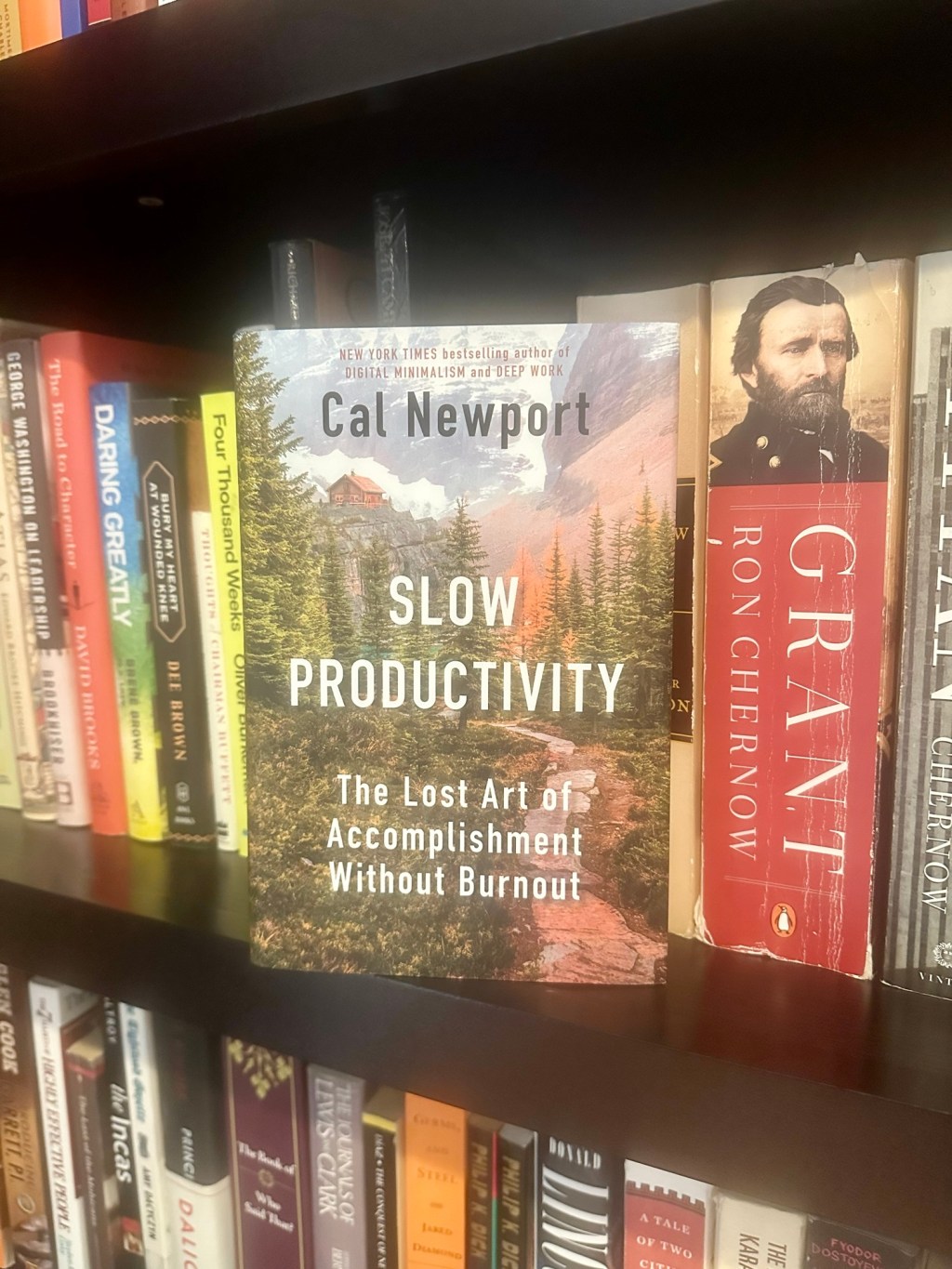
- Slow Productivity by Cal Newport
- Published: March 5, 2024
- Pages: 256
- Rating: 4/5 Stars
- Read: 3/5/2024 – 3/27/2024
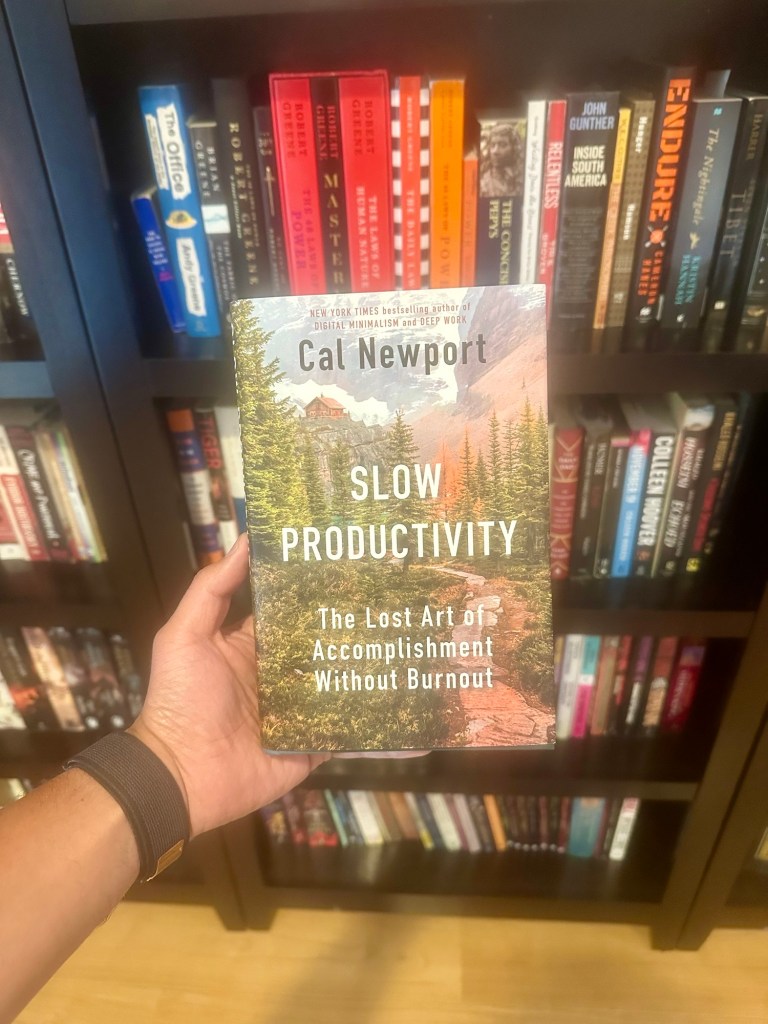
Slow Productivity is the newest book from Cal Newport, it delves into the world of productivity and how we have lost our way on what the main goal of productivity is. The goal of accomplishing quality work has been lost in short-term tasks that make us feel busy but do not produce quality work and end up causing burnout. Slow productivity encourages focused work at a sustainable pace for long-term goals.
The Lessons Learned series is different than normal book reviews. There are dozens of great book reviews for Slow Productivity, and I feel like I would be wasting your time creating another one. Instead, I strive to give you the lessons I was able to extract from the book to improve my life and perhaps yours.
What is Productivity?
For as long as I can remember, productivity always meant working on a given task in order to create a quality product or service. For the most part, our customers or boss would expect a given result in a set amount of time, and it would require us to be productive in order to complete it. Over the years as technology evolved more and more tasks were added to our agenda without any real way of knowing if accomplishing these things made us productive. Now the parameters of productivity have been lost and workers have turned to working as long and as hard as possible to be considered productive without any clear metric in sight. This can cause valuable hours to be lost doing “pseudo-productive tasks” that may feel like we are being productive but actually aren’t moving us any closer to our goals.
Cal Newport defines pseudo-productivity as “The use of visible activity as the primary means of approximating actual productive effort.” In short, it looks like we are doing a lot of work instead of doing a lot of work. The lost art of real productivity has created a generation of workers doing unproductive work in order to look busy and impress their bosses. This leads to companies going through waves of hiring and layoffs once they realize that the problem wasn’t a lack of workforce, it was that the workforce was unproductive. It is a problem that has yet to be solved but Cal Newport’s books emphasize the point of giving workers time to do undistracted focused work to create quality instead of piling on administrative work that doesn’t use the valuable skills they were hired for.
Implementing Slow Productivity
Whether it be in your career or personal life, consistency over a long period will produce greater results. Cal Newport believes you can reach these results by doing fewer things, working at a natural pace, and obsessing over quality. The term slow and productivity seem to be opposites but slowing down allows you to have clarity to be productive on the things that matter.
The first step of slow productivity is to do fewer things, to accomplish this you need to know what tasks bring value to your company or projects. Once these tasks are isolated you need to work on them at a natural pace that is sustainable for long periods to avoid stress and burnout. Both steps contribute to step three which is obsessing over quality. The only way to stand out is to create quality work and that’s impossible if we lack clarity on what tasks are important and are burned out to have the energy and mindset to create quality work.
This sometimes means that the best-paying job isn’t always the best job for your goals. If you lack passion, you will never be dedicated to applying slow productivity to your job or career. Sometimes your passion isn’t your job but what your job allows you to do. Using myself as an example, I have a blue-collar job that is the opposite of my writing career, but the job allows me to listen to audiobooks most of the day which frees up my off time to work on my writing. I may not be passionate about my job, but I am passionate about the opportunity it gives me. The best career allows you to do a job you are passionate about or gives you enough balance and compensation to pursue your passion.
Mastery is the Best Leverage
Many aspiring creators I talk to want to know the secret to success. Anywhere from the perfect system, the right social media strategy, or the best template for a website, but at the end of the day it just comes down to quality. If you create something great, you will be found. That’s why I believe gaining mastery should be your main goal in anything you want to pursue, that’s the only way you will have leverage to implement slow productivity in whatever you desire. The book shares a great story about the artist Jewel and her realization that to control her schedule and to create the music she wanted; she would have to have abilities that could grant her leverage. She became good enough that music labels were willing to work with her demands in order to be associated with her. If you want that kind of autonomy, you need to gain mastery over your skillset.
Don’t Quit Your Day Job Yet
Follow your passion. We hear it all the time. It might be some of the most common advice given, but in the theme of slow productivity, don’t quit your day job until your side hustle can stand on its own two feet. This is especially true if the risks you take affect more than just yourself. It’s important to find a balance between risk-taking and playing it safe. Cal Newport believes in having a balanced strategy in first finding out if people will pay for whatever product or service you provide. Secondly, whatever you had success with, is replicable. If your first project did well, make sure you can replicate it, and it wasn’t just a one-hit wonder. If these two prerequisites can be met, then your side hustle may be ready to be your main thing.
Final Thoughts
Slow Productivity has great advice on long-term sustainability with productivity. Compared to his previous books, “Deep Work” and “Digital Minimalism”, the lessons from “Slow Productivity” felt directed at a more niche knowledge worker audience, instead of the former two which had lessons that could be applied to everyone. Combined with the fact that Cal now has a great podcast that has already covered many of the topics in this book, I would say it is the weaker of the three but still a great read for knowledge workers who aren’t familiar with all of Cal’s podcast episodes. I am looking forward to Cal’s next book centered around the deep life.
If you enjoyed this content, please sign up for our newsletter below, share this post with a friend, or read some of our other blog posts. Thanks for stopping by.
Disclosure: Some of the links in this post are affiliate links. This means that, at zero cost to you, I will earn an affiliate commission if you click through the link and finalize a purchase.
 Book Ponder
Leave a comment