
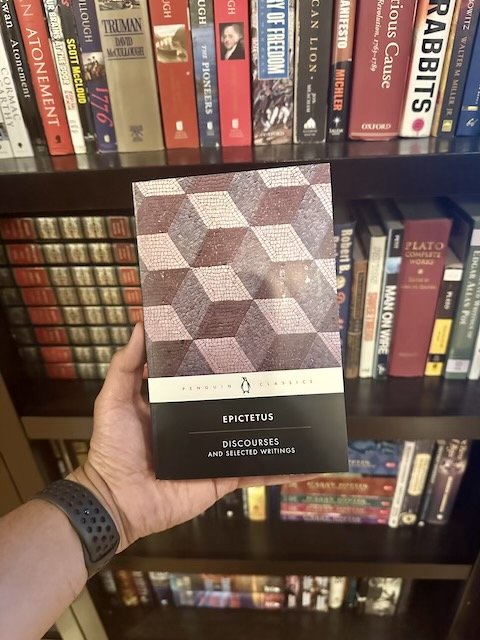
- Discourses and Selected Writings by Epictetus
- Pages: 276
- Published: AD 108
- Read: May 30, 2022 – June 27, 2022 | January 8, 2024 – January 31, 2024
- Rating: 5/5 Stars
You Have the Power to Fix Your Problems
One of the first lessons Epictetus introduces in his Discourses is the amount of control and resources you possess to solve your problems, instead of complaining or asking for help. His first quote on the downside of complaining is one of my favorites in the entire book,
[33] ‘But my nose is running!’ What do you have hands for, idiot, if not to wipe it? [31] ‘But how is it right that there be running noses in the first place?’ [32] Instead of thinking up protests, wouldn’t it be easier just to wipe your nose?
Epictetus
Epictetus shows you that something as menial as wiping your nose will find reason for complaints from people, when a simple tissue (resource) would fix the problem, don’t use every minor inconvenience as a reason to complain, instead fix the problem and move on with your life, you will be much happier.
[3] ‘Who’s my “master”?’ Whoever controls what you desire or dislike. [4] So in life our first job is this, to divide and distinguish things into two categories: externals I cannot control, but the choices I make with regard to them I do control.
Epictetus
Acknowledging that you have the resources to fix a minor inconvenience can lead to the realization that you have tools at your disposal to solve most of life’s problems. Instead of praying for a solution, use the tools already given to you, to solve the problem.
Now that you know all this, come and appreciate the resources you have, and when that is done, say, ‘Bring on whatever difficulties you like, Zeus; I have resources and a constitution that you gave me by means of which I can do myself credit whatever happens.’
Epictetus
Once the seed has been planted in you that you can face challenges with the resources at your disposal you begin to face life with a different perspective. Instead of being fearful of any inconvenience that comes your way, you face your challenges directly, knowing that you have the tools to face them. Sometimes it takes one small victory or realization like using a tissue to wipe your nose, to understand that you have the resources to face your challenges.
Epictetus follows up this with a motivating quote, challenging his readers to bring him his problems and he will show them they have the resources to overcome them.
I am prepared to show you that you have resources and a character naturally strong and resilient; show me in return what grounds you have for being peevish and malcontent.
Epictetus
Realistically, there are things out of your control and no matter what resources you have, you can’t fix them. This is when the lesson of control comes in. Epictetus emphasizes the point that if something is out of your control, you still have control over how you react to it.
[32] You should thank the gods for making you strong enough to survive what you cannot control, and only responsible for what you can. [33] The gods have released you from accountability for your parents, your siblings, your body, your possessions–for death and for life itself. [34] They made you responsible only for what is in your power–the proper use of impressions. [35] So why take on the burden of matters which you cannot answer for? You are only making unnecessary problems for yourself.
Epictetus
If outside circumstances constantly dictate how you feel and act, then they have ownership over you, ask yourself, “Who is my master?” Do you want to be the master of your domain or let others be masters over yours?
[3] ‘Who’s my “master”?’ Whoever controls what you desire or dislike. [4] So in life our first job is this, to divide and distinguish things into two categories: externals I cannot control, but the choices I make with regard to them I do control.
Epictetus
Once you can distinguish between the things you can and cannot control, you start to become the master of yourself. With the knowledge of control at our disposal you begin to view challenges differently and instead of complaining over every one of them, you become smarter and find the right resource to overcome them. Epictetus reminds us that for anything you are facing, God has given you the resources to overcome it, the real challenge is in finding the right resource.
For every challenge, remember the resources you have within you to cope with it. Provoked by the sight of a handsome man or a beautiful woman, you will discover within you the contrary power of self-restraint. Faced with pain, you will discover the power of endurance. If you are insulted, you will discover patience. In time, you will grow to be confident that there is not a single impression that you will not have the moral means to tolerate.
Epictetus
Only worry about the circumstances you can control, and the ones you can’t just be thankful you have the strength to survive them. If you didn’t you wouldn’t be here to talk about it anyway. Book II of the Discourses was filled with great lessons on control, my main takeaway is that as long as you do the right thing in all things that are under your control, by finding the proper resources to overcome it, then whatever else happens is irrelevant, and you just need to control how you react to it.
Seek Your Own Approval
Now worse than ever, people are doing things for other’s approval instead of their own. From the way they talk and dress, they do things they don’t enjoy, only to gain other’s approval. While fitting into society is important, you shouldn’t give up your own approval to accomplish it, most likely you are just hanging around the wrong people. Epictetus tells us that it’s a sign we are properly grounded in life when we stop looking for other’s approval.
When someone is properly grounded in life, they shouldn’t have to look outside themselves for approval.
Epictetus
Epictetus takes it a level further and believes that seeking others’ approval goes against your character as a philosopher while compromising your integrity in the process. It seems harsh but doing things for others and not you is the gateway to a large number of ugly habits like envy, jealousy, and hate.
If you are ever tempted to look for outside approval, realize that you have compromised your integrity. So be satisfied just being a philosopher, and if you need a witness in addition, be your own; and you will be all the witness you could desire.
Epictetus
While seeking the approval of others opens the gateway to envy and temptation, it also allows you to develop the ugly habit of desiring things that others have. Epictetus says that if you begin to care and desire things that aren’t yours, you begin to surrender what is yours in the process. Protect what belongs to you and don’t desire what belongs to others.
‘Protect what belongs to you at all costs; don’t desire what belongs to another.’ Trustworthiness is your own, decency and a sense of shame; no one can take them from you or prevent you from using these qualities except yourself–which you do the moment you begin to care about what isn’t yours, surrendering what is yours in the process.
Epictetus
Be proud of what you have accomplished, sometimes all it takes is a step back to enjoy the things you have attained through your hard work and not desire what others have. This also requires a balance because if you are too prideful in what you have, you tend to flaunt it and make others desire what you have. While you shouldn’t desire what others have, you also shouldn’t tempt others to desire what you have, perhaps they are also on the journey like you are and you should be respectful of that process.
As Epictetus explains,
Look at it this way. You have beautiful clothes and your neighbour does not. You have a window and want to give them an airing. The neighbour does not know what man’s good consists in, but imagines it means having beautiful clothes–the opinion you happen to share. [14] It’s a foregone conclusion that he’s going to try and steal them. I mean, when starving people see you gobbling down food all by yourself, you know one of them will make a grab at it. So don’t provoke them–don’t air your clothes at the window!
Epictetus
There is Nothing to Fear but Fear Itself
The FDR quote about fear is popular because people can relate to it. You live your life in constant fear of things that most likely will never come true, and if they did, you would have lived through it twice. Epictetus has the same mindset in his views of fearing death.
[7] When death appears an evil, we should have ready the fact that it is a duty to avoid evil things, whereas death is necessary and cannot be avoided. [8] I mean, where am I going to go to get away from it? Maybe I am not Sarpedon, the son of Zeus, so that I can say in the same grand manner, ‘I will go, and either win the prize for valour myself, or give another the opportunity to gain it.’45 The former may be beyond us, but at least the latter is within our reach. [9] And where can I go to escape death in any case? Tell me the country, give me the name of the people who are safe from death, where I can get asylum; provide me with the magic charm. No, I cannot escape death, [10] but at least I can escape the fear of it–or do I have to die moaning and groaning too?
Epictetus
You fear death, but it’s something inevitable. Why not conquer our fear of death instead? It’s easier said than done but even if death is the end of your life, you must realize that it happens to everyone, no one in history has been able to avoid death, so why should you fear it? Only worry about the things you can control, and if you can’t control it, worry about how you react to it. With death, we can go as far as not even giving it that much consideration because once it happens, we won’t even have the opportunity to react to it. The real culprit in all of this is the fear of things, our greatest fears are pain and death, but Epictetus tells us the only thing we should fear is not facing these things with bravery.
Death and pain are not frightening, it’s the fear of pain and death we need to fear. Which is why we praise the poet who wrote, ‘Death is not fearful, but dying like a coward is.’
Epictetus
Make Use of What You’ve Learned
Epictetus said,
Step forward and make use of what you’ve learned. [56] It isn’t more logic chopping that is needed–our Stoic texts are full of that. What we need now are people to apply their learning and bear witness to their learning in their actions. [57] Please, be the one to take on this character, I am tired in my teaching of invoking examples from the past, I want to be able to hold up an example from my own time.
Epictetus
Make use of what you’ve learned. If you do nothing with your knowledge, then you are nothing but a hoarder of information. There are already resources that can do a much better job at that than we can, leave it to the computers and dictionaries. Take action and do something with what you’ve learned.
The problem with being hoarders of information is that you feel like you are wise and productive because you consume information, but Epictetus tells us that in knowledge and life, you need to form your own opinion or else what was the point of learning, if you are only going to have the same opinion as everyone else.
[11] In literature, too, it is no great achievement to memorize what you have read while not formulating an opinion of your own. In ethics, we do the same thing, only it’s much worse.
Epictetus
This leads to gaining mastery in skills you value, while the first step for learning something new may be to pick up a book on the subject, you eventually need to take action to become better. As Epictetus emphasizes, a runner can’t become a good runner without running. This is relatable to any habit or skill you want to improve.
[1] Every habit and faculty is formed or strengthened by the corresponding act–walking makes you walk better, running makes you a better runner. [2] If you want to be literate, read, if you want to be a painter, paint. Go a month without reading, occupied with something else, and you’ll see what the result is. [3] And if you’re laid up a mere ten days, when you get up and try to walk any distance you’ll find your legs barely able to support you. [4] So if you like doing something, do it regularly; if you don’t like doing something, make a habit of doing something different.
Epictetus
People label themselves as hard-working just because they studied for something, but at some point, you need to do the work to show results. If we are always preparing for something and never acting, then you can’t call yourself hard-working.
[41] I cannot call somebody ‘hard-working’ knowing only that they read and write. Even if ‘all night long’ is added, I cannot say it–not until I know the focus of all this energy. You don’t call someone ‘hard-working’ who stays up nights with their girlfriend. No more do I. [42] If the goal is glory, I call them ambitious; if it’s money, I call them avaricious. [43] If, however, their efforts aim at improving the mind, then–and only then–do I call them hard-working.
Epictetus
Epictetus ends this lesson with yet another challenge, if you aren’t going to put into practice everything you have learned then you might as well pack your bags and go home because you are taking away resources from someone willing to make use of what they’ve learned. There is no room for self-pity and becoming the victim, either you are willing to put in the work or not.
But anyone whose sole passion is reading books, and who does little else besides, having moved here for this–my advice for them is to go back home immediately and attend to business there, [23] because they left home for nothing.
Epictetus
Be Humble on the Path to Mastery
I see this in my workplace and even catch myself doing it at times, you pretend to know more than you do to not look ignorant to your peers or vice versa, you brag about how good you are at something or how much you know about a given subject, to impress others. Both extremes are extremely harmful in the path to developing mastery and character.
[3] It is good to be clear about the level of your talent and training. That way, when unfamiliar topics arise, you will know enough to keep still, and not be put out if there are students more advanced than you. [4] You will show your own superiority in logic; and if others are disconcerted over that, mollify them by saying, ‘Well, I had a good teacher.’ [5] The same applies to subjects that require some practical training; don’t pretend you have a particular skill if you don’t yet; yield to whoever has the requisite experience; and for your own part take satisfaction in an awareness that your persistence is helping you become expert in the subject yourself.
Epictetus
If you fear what people think and lie about your skill level, you will never learn how to improve. Eventually, we will be exposed, and that will be more embarrassing than just admitting ignorance and asking for help.
Be Clear in What You Want
Clarity is power, if you are clear in what you want then you can plan accordingly to reach your goal. When I ask someone what their goal in life is and they say, “I just want to be successful”, the lack of clarity gives me no room to advise them. What do they want to be successful at? If they want to be in the best shape of their life, then we can make a detailed workout and diet plan for their goals. If they want to become a great writer, we can set up a curriculum with the proper books and writing workshops to allow them to reach their goal. You must have clarity in whatever you want, the more detailed the better, because then you can make a plan that has a higher chance of success for your given circumstance.
[1] First, tell yourself what you want to be, then act your part accordingly. This, after all, is what we find to be the rule in just about every other field. [2] Athletes decide first what they want to be, then proceed to do what is necessary. If they decide to be a distance runner, it means one particular diet, racecourse, workout and mode of physical therapy. If they want to be sprinters, those factors are different. And if it’s a pentathlete they want to be, they vary again. [3] You will find the same thing true of the crafts. If you want to be a carpenter, you will have one kind of training, if you want to be a sculptor, quite another. All our efforts must be directed towards an end, or we will act in vain. If it is not the right end, we will fail utterly.
Epictetus
Develop Stillness
Throughout the Discourses, Epictetus emphasizes having control over your actions, or your reaction to actions that are outside of your control. The longer you practice this skill the more peace and stillness you gain in your life. You can gauge how far into the philosopher’s path you are by how easily your peace can be disturbed.
What kind of peace is this that is so easily shattered–not by the emperor or even by a friend of the emperor, but by a crow, a street musician, a cold, or a thousand other annoyances? True peace is characterized by nothing so much as steadiness and imperturbability.
Epictetus
If you easily get annoyed by a car cutting you off, someone interrupting you, or your baseball game getting rained out, then others are in control of how you feel. Giving up control of your peace is a dangerous game, and you should strive to constantly work at being the only one in control of how you feel. Outside circumstances out of your control should be irrelevant to how you feel. You should seek perfect stillness.
Persist and Resist
Ten years ago, when I took my first steps down the philosopher’s path, a quote that resonated with me greatly and still does to this day was “Persist and Resist”.
According to Favorinus, Epictetus would also say that there were two vices much blacker and more serious than the rest: lack of persistence and lack of self-control. The former means we cannot bear or endure hardships that we have to endure, the latter means that we cannot resist pleasures or other things we ought to resist. ‘Two words,’ he says, ‘should be committed to memory and obeyed by alternately exhorting and restraining ourselves, words that will ensure we lead a mainly blameless and untroubled life.’ These two words, he used to say, were ‘persist and resist’.
Epictetus
The lack of persistence and the lack of self-control are vices far more serious than others. If you have persistence, you will continue working at whatever your goal is regardless of how difficult it becomes, and having self-control will always leave you in control of how you feel and allow you to be the master of yourself. On the opposite end, not having any persistence will make you give up when the going gets tough on any endeavor you attempt to accomplish. Lacking self-control will leave you vulnerable to others being in control of how you feel and act. These two vices are the center of living a good life and you should be prioritizing them every day. Persist and resist, that quote will be the light that will guide you through hard times on your journey to becoming the best version of yourself.
Final Thoughts
If you are a reader of my content, you will know how important quake books are to me. If you are new to the term, quake books are books that fundamentally shake you to your core in some way, perhaps they completely change the way you view the world or give you advice that changes your life. Quake books never get old and give you something new every time you return to them. Discourses by Epictetus is a quake book to me, one I return to every year, and it brings me new insights every time I revisit it. I strongly recommend it to anyone wanting to make a positive change in their life.


If you enjoyed this content, please sign up for our newsletter below, share this post with a friend, or read some of our other blog posts. Thanks for stopping by.
Disclosure: Some of the links in this post are affiliate links. This means that, at zero cost to you, I will earn an affiliate commission if you click through the link and finalize a purchase.
 Book Ponder
Leave a comment