
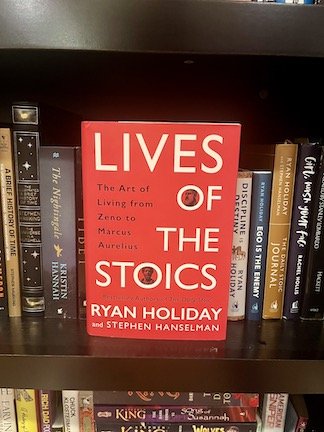
· Lives of the Stoics by Ryan Holiday
· Published: September 29, 2020
· Pages: 352
· Rating: 5/5 Stars
· Read: 9/29/2020 – 10/26/2020. 1/3/2023 – 1/22/2023
Studying While Your Friends Are Partying
“While other young men in his position partied and enjoyed their wealth (and lack of parental supervision), Cicero studied like a man with something to prove.”
Ryan Holiday
The fear of missing out is real, especially in our younger years when our social status is important. We fear that staying in and studying or working on our goals will cause us to miss out on great experiences and friendships. That can be true but there is also another side to being like Cicero and working your ass off while everyone else is worried about the next great party or their next dating partner, you can use it as an opportunity to distance yourself from the competition. Your group of friends from college or work is the same group you will be competing against in life and if you have a fear of missing out on friendships, being this way will open you up to meeting people with the same ambition as you and will help you build stronger relationships. If that’s not enough to convince you, remember that you are the average of the five people you are around most, do you want those five people to be the ones that are wasting their life away partying and doing the bare minimum?
The Wicked Thing Will Stay With You Forever
“This might be difficult, it might be exhausting, he said, but soon enough we forget about the hard labor. The results of doing well, though, “will not disappear as long as you live,” he said. And conversely, even though taking a shortcut or doing something bad may bring a few seconds of relief, “the pleasure will quickly disappear, but the wicked thing will stay with you forever.” ”
Cato the Younger
Doing the right thing can be very difficult, especially when doing the wrong thing is much easier. Many times, the wrong thing will give us instant gratification while the hard labor will go unnoticed, these are the times when what we think about ourselves is what matters. What do you think about yourself when you are alone and no one else is around?
You Will Know When You Are Free From All Desires
Living a deep life and being a good person with no vices is a lifelong project that we constantly must work on, we will have relapses and times that we think we have lost, but we must keep fighting. Marcus Aurelius explains that when we are close to being our best selves, we will start asking God for things we are not ashamed of. Our prayers can be said out loud because we have no shame in the problems, we want help with.
““You will know you’ve been freed from all desires when you’ve reached the place where you will pray to God for nothing but things, you’d ask for openly,” he would say. “Live among men as if God watching and speak with God as if men were listening.””
Marcus Aurelius
There Should Be No Hesitation in Doing the Right Thing
How often do we find ourselves making excuses over a decision we are going to make? The small little voice in the back of our heads is piping up telling us what we should be doing but we always ignore it. Eventually, we make the wrong choice and live with regret. The right choice is easy, and we know it right away, it’s the excuses we make for ourselves that make the decision difficult. Epictetus explains that we should have no hesitation in making the right decision, there are no other options.
“To Agrippinus, there should be no hemming and hawing about the right thing. There should be no weighing of options. ”
Epictetus
Balance Life’s Books Each Day
“One of the most common themes in Seneca’s letters and essays from this period is death. For a man whose tuberculosis loomed over him from an early age-at one point driving him to consider suicide-he could not help but constantly think and write about the final act of life. ‘Let us prepare our minds as if we’d come to the very end of life,’ He reminded himself. ‘Let us postpone nothing. Let us balance life’s books each day. … The one who puts the finishing touches on their life each day is never short of time.’”
Seneca
We put things off for later…constantly. We make promises to return phone calls or reach out to family members we haven’t talked to in months. Suddenly grandpa had a heart attack, and we wish we would have answered the last ten missed calls we had with him or swung by to visit him when he said he missed us. These are scenarios that are happening to people every day and that’s why they say to live each day as if it’s your last. In reality, no one can live that way for long, but we can do as Seneca says, “Balance life’s books each day”. By this, he means to leave all your to-do lists completed and stop putting things that could have been completed today for tomorrow.
Persist and Resist
“[Epictetus] used to say that there were two faults which were by far the worst and most disgusting of all, lack of endurance and lack of self-restraint when we cannot put up with or bear the wrongs which we ought to endure or cannot restrain ourselves from actions or pleasures from which we ought to refrain. ‘Therefore, ‘he said, ‘if anyone would take these two words to heart and use them for his own guidance and regulation, he will be almost without sin and will lead a very peaceful life. These two words, ’he said, ‘are avéxov (persist) and àñéxov (resist).’
Persist and Resist.
The ingredients of freedom, whatever one’s condition”
Epictetus
After studying stoicism for the past decade, persist and resist has been the quote that has impacted me the greatest. Epictetus believed that after analyzing all our faults there were two that stood above all else. The lack of endurance to any sort of adversity and the lack of self-restraint from actions and pleasures we should refrain from. The reason why these two are the worse is that they are completely under our control and require no outside influence to do them or not, and if we give into them, we have no one to blame but ourselves.
Do It for Yourself
Deciding to make a change in your life is great and always encouraged, but sometimes people find themselves doing it for the wrong reasons. They post on social media how they are going to change their lives around and get healthy, and friends and family will encourage them by giving them praise which makes accomplishing the goal harder. Our brains process this praise as if we have already achieved the goal and puts us at ease. This is a huge mistake and when you are about to commence major changes in your life you should keep it personal or tell a few close individuals that will hold you accountable, not give you praise before you have even started. Plus, the compliments or praise you receive after you have accomplished a goal that no one even knows you were working on feel much better and well deserved compared to the ones that you get before you even get started.
“When you have accustomed your body to a frugal regime,’ he said, ‘don’t put on airs about it, and if you only drink water, don’t broadcast the fact all the time. And if you ever want to go in for endurance training, do it for yourself and not for the world to see.’
Progress is wonderful. Self-improvement is a worthy endeavor. But it should be done for its own sake-not for congratulations or recognition.”
Marcus Aurelius
It’s Fortunate That This Happened to Me
“It’s unfortunate that this has happened. No. It’s fortunate that this has happened and I’ve remained unharmed by it—not shattered by the present or frightened of the future. It could have happened to anyone. But not everyone could have remained unharmed by it.”
Marcus Aurelius
This was a hard philosophy to adapt to my life but once I was able to act as if everything that has happened to me is my fault and I must face it regardless of how I feel about the situation, I was able to move forward through life and not try to place blame on everything little thing that happened to me. This is not to be confused with negative self-talk, rather it means to be okay with what has happened to me because I am prepared and can deal with it, when it could have broken a less prepared soul. I have studied and prepared for this moment and will not let it harm me.
Don’t Talk About It, Be About It
I want to end this post with the most important question I can ask, how much longer are you going to wait? How many more motivational videos are you going to watch? How many more people are you going to tell about the person you want to become? At some point, you must stop talking about it and just be about it. Epictetus emphasized this same concept.
“Forget everything but action. Don’t talk about it, be about it.
‘Don’t explain your philosophy,’ Epictetus said, ‘embody it.’
‘Waste no more time talking about what a good man is like. Be one.’”
Epictetus
Further Reading
If you enjoyed this content, you could help me out by signing up for the newsletter below, sharing with a friend, reading some of my other blog posts, or purchasing any of the books mentioned through our affiliate links. Thanks for stopping by.
 Book Ponder
Leave a comment