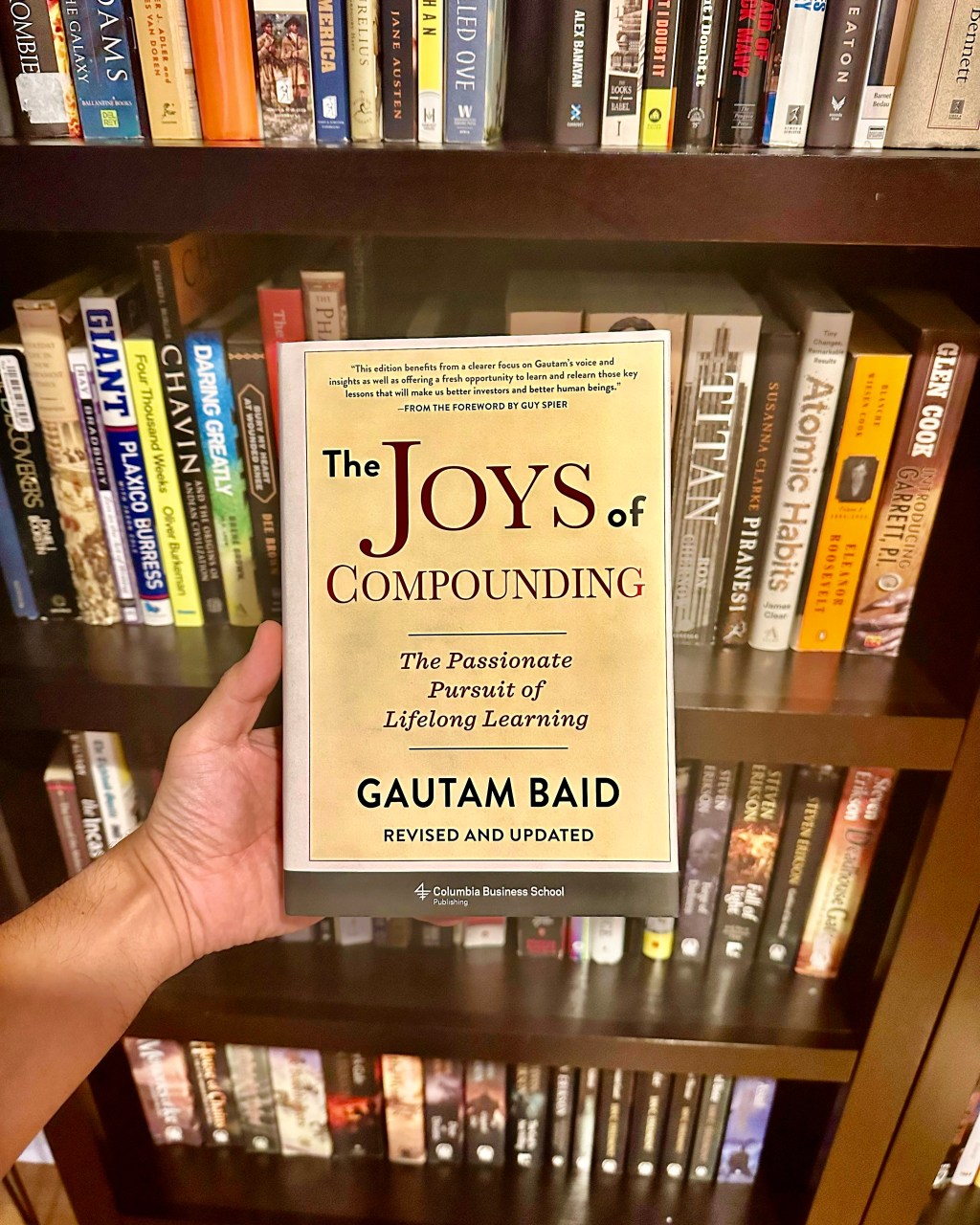
- The Joys of Compounding by Gautam Baid
- Published: January 1, 2019
- Pages: 534
- Read: June 12, 2023 – June 25, 2023
- Rating: 4/5 Stars

The Joys of Compounding: The Passionate Pursuit of Lifelong Learning by Gautam Baid caught my interest from the moment I saw it at the bookstore. I am passionate about lifelong learning, and I believe it is one of the most important pursuits a human being can have. Education only begins once your formal schooling years are over, except now you can pick what you want to learn and choose in which way you will learn it instead of a teacher or curriculum telling you what to learn.
Always Be Learning
If you don’t believe me that lifelong learning is the most important pursuit a human being can have, at least believe me that all successful people know the importance of lifelong learning. As Zig Ziglar says,
“Rich people have small TVs and big libraries. Poor people have small libraries and big TVs.”
What you see when you walk into someone’s home tells you a lot about the person. An individual with a large home library most likely promotes reading and learning to their family and understands the value of education. Having many books in your home puts you in an atmosphere of learning that encourages time spent reading instead of watching TV. If the desire for the TV outweighs the books, guess which one you will end up doing?
“If you’re glued together and honorable and get up every morning and keep learning every day and you’re willing to go in for a lot of deferred gratification all your life, you’re going to succeed.”
Charlie Munger
The reward of being a lifelong learner is delayed, we do not get the instant dopamine hit we receive from watching TikTok videos. The gratification from reading a book comes slowly but the effect lasts a lifetime. The laugh or mood swings you receive from a short video only last a few seconds and makes your brain hungry for that next dopamine hit, when we delay that dopamine hit our brain becomes wired to earn it and it is a much more satisfying experience rather than constantly being rewarded for no work. If we receive free gratification for too long our brains lose the capacity to concentrate or work on difficult tasks. In his book Deep Work, Cal Newport talks about people losing the ability to be bored, and being bored is the same skill as being able to concentrate on one task for long periods. When we cannot sit in silence with our thoughts for longer than a few minutes without grabbing for a distraction on our smartphone then we are slowly losing the ability to be bored and concentrate. When the time comes for our brain to focus on a difficult task, we will be constantly bombarded with cravings to take out our phones and watch one more video. It’s an addiction. While Charlie Munger’s advice may be directed at investing, it also applies to everyday life, if we delay our gratification, we will live happier and more financially stable lives.
Isaac Disraeli once said,
“The wisdom of the wise, and the experience of ages, may be preserved by quotations.”
There is a great importance in having mentors in your life, but what happens when we do not have access to mentors? Not everyone has that luxury. In those cases, we can turn to books to be our mentors, they may not be as good as the real thing, but they can still fill in the gaps in our learning. For any issue or problem that you are facing, odds are that someone at some point in history has dealt with that same issue you are facing and overcame it, some of them even wrote about it. What took someone a lifetime to learn can be consumed in a few hours, what better mentor than that?
“The best way to learn something is to try to do it, but the next best way to learn is from someone who has already done it. This is the importance of reading and vicarious learning.”
Gautam Baid
While Baid pushes us to be lifelong learners and educate ourselves our entire lives, there comes a point where we must implement what we learn to get better. If we never act on our knowledge, then we are just hoarders of information. Reading will only get us so far but at some point, we must go out there and do what we have learned to get better, we cannot always stand by on the sidelines or else we will become stagnant.
Ditch the Ego and Ask Questions
Charlie Munger said,
“Acknowledging what you don’t know is the dawning of wisdom.”
Through personal experience, I’ve missed out on many great learning opportunities because I couldn’t ditch my ego. I was embarrassed that I didn’t know something at work so instead of saying no when someone offered to teach me something I would lie and say I already knew how to do it. It made my job twice as hard as I scrambled to learn something that I was already supposed to know, I could have easily ditched the ego and responded with “I don’t know that yet, but I would love it if you could teach me.” In Tom Bilyeu’s podcast Impact Theory, he frequently talks about not being the smartest person in the room, even if you look dumb, it is worth it if you are learning something you didn’t know before.
Gautam Baid talks about how idiotic it is to have access to an answer but not receive it over the fear of what others think and that we need to not be afraid to show our ignorance.
“Raise questions. If you want to deepen your understanding, you need to raise questions. Do not be afraid to show your ignorance. If you do not understand, ask. The great philosopher Socrates would challenge his students, friends, and even enemies to make new discoveries by asking them uncomfortable, core questions, which often led to new insights.”
Gautam Baid
Not being afraid to show our ignorance goes hand in hand with not allowing ourselves to take risks and be challenged. When we can be comfortable in our skin and realize that everything, we don’t know is a learning opportunity then we will be open to questioning everything. This leads to a lesser-known quote by Albert Einstein:
“Ego = 1 / Knowledge. More the knowledge lesser the ego, lesser the knowledge more the ego.”
We must be self-aware that it is human nature for the wiser we become the more we believe that we know everything. This means that the smarter we get the larger our ego becomes, stunting our growth. We must stay humble and always act as if we know nothing.
Helping Others Learn
We are constantly encouraged to not become hoarders of knowledge and apply what we learn to our everyday lives. Another fulfilling way we can implement our knowledge is by helping others learn. As Charlie Munger says, “The best thing a human being can do is to help another human being know more.” Not everyone has the luxury of being born in a country with the freedom or resources to study and learn whatever your heart desires. These are the moments when we need to step up and help those in need.
It’s Good to Have a Large TBR
Spending a lot of time around readers and autodidacts I run into a problem almost everyone has. They believe their TBR (to be read) list continues to grow at a much faster rate than their read list, and that they won’t ever be able to read every book they add to it in their lifetime. Gautam Baid explains that a large to-be-read list is a good thing because that means our curiosity is continuing to grow as we read more books.
“Thus, paradoxically, as you read more books, your pile of unread books will get larger, not smaller. That’s because your curiosity will grow with every great ready. This is the path of the lifelong learner.”
Gautam Baid
Finishing our TBR list is something that we do not want, finishing it would mean that we have stopped being curious about new topics and genres, and our desire for learning new things has diminished. An ever-growing list is a good thing and if it does give you anxiety watching that list grow too fast try the cleanup method that I use. About once a year I’ll go through my TBR and remove many books that do not suit my interest anymore, perhaps five years ago I was really into the Civil War, but after having read a few books on it I feel my thirst for this topic quenched. Perhaps later down the road, I may be interested in that topic again but for now, it can come off the TBR. It’s also a great way to see how your interests change as you grow as a person.
Building a Second Brain
A new concept that has recently become popularized by Tiago Forte and his “Building a Second Brain” book and courses is that we shouldn’t be trying to memorize everything we read and use the useful technology we have nowadays to store all this knowledge for us and we can use all of our brain’s resources doing harder things like deep work and creativity. With a second brain at our side, we can focus on applying its contents.
“Research published in the Journal of American Academy of Neurology has shown that people who engage in mentally stimulating activities like reading experience slower memory decline than those who do not. Reading is also linked with higher emotional intelligence, reduced stress, a wider vocabulary, and improved comprehension. If you think of your mind as a library, three things should concern you: 1. The accuracy and relevance of the information you store. 2. Your ability to find or retrieve that information on demand. 3. Your ability to put that information to use when you need it—that is, your ability to apply it. Having a repository of knowledge in your mind is pointless if you can’t find and apply its contents.”
Gautam Baid
There are many great tools online for building a second brain, my best advice is not to try to find the perfect app for it, just pick one and go. If you want the best, I would pick the one that gives you the least amount of friction and requires you to spend the least amount of time on it so you can go back to your reading and creative work. The best system is one that you will use.
Trust Your Judgment
Baid quotes a quote by Benjamin Graham in The Intelligent Investor that caught my attention:
“Have the courage of your knowledge and experience. If you have formed a conclusion from the facts and if you know your judgment is sound, act on it—even though others may hesitate or differ. You are neither right nor wrong because the crowd disagrees with you. You are right because your data and reasoning are right [emphasis added].”
Benjamin Graham
With the 24-hour news cycle and the constant fighting between people on social media and online forums, it can be hard to know what is true or what to believe. It’s in moments like these when we must look internally to trust our judgment and not be influenced by outsiders. The key to this is that we must have done the work so that our judgment is morally right. If we grew up constantly making bad decisions and have not learned from our mistakes, then trusting our judgment might not be the right decision. We need to work on ourselves first so that our judgment is pure and reliable for when we need it.
The Hedonic Treadmill
My final lesson learned from The Joys of Compounding and my favorite, is the hedonic treadmill. Baid describes it best:
“It’s called the “hedonic treadmill,” and its function is to continually move the goalpost of your financial dreams, completely extinguishing the joy you thought you would get from having more money, once you attain it. People are constantly running on the hedonic treadmill; as they make more money, their expectations and desires rise in tandem, which results in no permanent gain in happiness.”
Gautam Baid
Once I read this section, I looked inwardly at my own life to see how true this is. When I first got married my wife and I made 1/3rd of what we make and yet we had much more financial freedom in those days. Now we have so many financial commitments that we feel limited on what we can do, and our employers have “golden handcuffs” on us where they pay us just enough so they know we won’t leave and go somewhere else because that would require our lifestyle to change. Sometimes you do not realize that you are on the hedonic treadmill because it can be a subtle change that is often mistaken by just improving your quality of life, but you can notice you are on it if you take time to step back and gain some clarity. We begin to realize that many of our wants aren’t things we need. We don’t need the fanciest new car, we used to be perfectly content with the used older model. We don’t need the third camera on the new iPhone, for years we were perfectly content with one. William James Dawson, Seneca, Epictetus, and Morgan Housel’s quotes describe it best:
“I saw that it was the artificial needs of life that made me a slave; the real needs of life were few.”
William James Dawson
“Self-sufficiency is the greatest of all wealth. Wealth consists not in having great possessions, but in having few wants.”
Epictetus
“Wealth, in fact, is what you don’t see. It’s the cars not purchased. The diamonds not bought. The renovations postponed, the clothes forgone, and the first-class upgrade declined. It’s assets in the bank that haven’t yet been converted into the stuff you see.”
Morgan Housel
The key lesson here and one of the best I learned in this book was:
“The things you don’t do also form wealth.”
I hope you enjoyed my lessons learned from The Joys of Compounding by Gautam Baid. I would strongly recommend it.
Disclosure: Some of the links in this post are affiliate links. This means that, at zero cost to you, I will earn an affiliate commission if you click through the link and finalize a purchase.
 Book Ponder
Leave a comment