
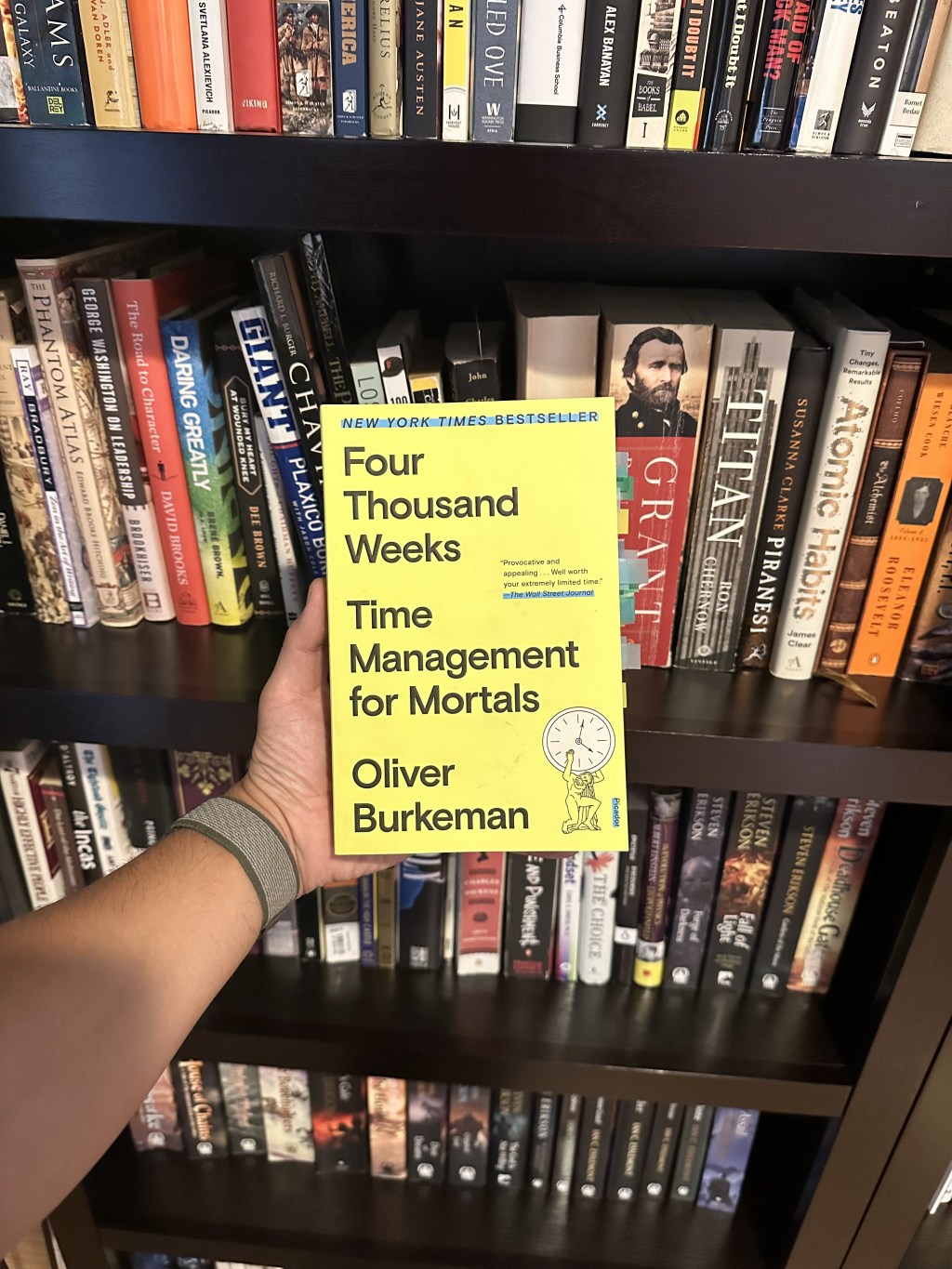
- Four Thousand Weeks by Oliver Burkeman
- Published: August 10, 2021
- Pages: 273
- Read: August 3, 2023 – August 10, 2023
- Rating: 4 / 5 Stars
Four Thousand Weeks by Oliver Burkeman made me weary the first few pages because I thought it was going to be another self-help book, full of fluff, that could have been a blog post, but the longer I read, the more I realized that Burkeman was setting us up to view time management differently. Instead of promoting today’s “hustle culture”, Burkeman encourages us to find balance in our productivity and be realistic about what we can accomplish. Putting unrealistic goals and unachievable expectations will set us up for failure and stress which will make us less productive.
The Efficiency Trap
Joe Rogan has a great point that he often makes on his podcast. He says that whatever happens to you is the worst thing in the world because that’s all you know. If the worst thing that has ever happened to you is breaking your arm, then that will feel like the worst thing in the world even though there are much greater harms happening to others in the world. This can also be applied to finances, career, and time management. Burkeman explains this dilemma,
“Research shows that this feeling arises on every rung of the economic ladder. If you’re working two minimum-wage jobs to put food in your children’s stomachs, there’s a good chance you’ll feel overstretched. But if you’re better off, you’ll find yourself feeling overstretched for reasons that seem, to you, no less compelling: because you have a nicer house with higher mortgage payments, or because the demands of your (interesting, well-paid) job conflict with your longing to spend time with your aging parents, or to be more involved in your children’s lives, or to dedicate your life to fighting climate change. As the law professor Daniel Markovits has shown, even the winners in our achievement-obsessed culture—the ones who make it to the elite universities, then reap the highest salaries—find that their reward is the unending pressure to work with “crushing intensity” in order to maintain the income and status that have come to seem like prerequisites for the lives they want to lead.”
Oliver Burkeman
So, what do people do when they feel overwhelmed? They try harder and this causes the imaginary conveyor belt they are running on to just speed up. Burkeman quotes anthropologist Edward T. Hall,
“In the modern world, the American anthropologist Edward T. Hall once pointed out, time feels like an unstoppable conveyor belt, bringing us new tasks as fast as we can dispatch the old ones; and becoming “more productive” just seems to cause the belt to speed up.”
“The general principle in operation is one you might call the ‘efficiency trap.’ Rendering yourself more efficient—either by implementing various productivity techniques or by driving yourself harder—won’t generally result in the feeling of having ‘enough time,’ because all else being equal, the demands will increase to offset any benefits. Far from getting things done, you’ll be creating new things to do.”
At this point, we must realize that we must work on setting realistic goals and expectations for our lives instead of constantly wanting the next great thing. It is good to be ambitious, but we also need to reap some of the benefits that come with our hard work.
Pay Yourself First
“If you try to find time for your most valued activities by first dealing with all the other important demands on your time, in the hope that there’ll be some left over at the end, you’ll be disappointed. So if a certain activity really matters to you—a creative project, say, though it could just as easily be nurturing a relationship, or activism in the service of some cause—the only way to be sure it will happen is to do some of it today, no matter how little, and no matter how many other genuinely big rocks may be begging for your attention.”
Oliver Burkeman
Many financial self-help books advise you to pay yourself first or else you will never have the needed pressure to grow. If you constantly pay your bills first and hope that you find a way to have leftover money at the end of the month to invest in yourself, then you will always find yourself short at the end of the month. If you spend that money first, then you will have the sense of urgency to work harder or find more ways to make money to make ends meet because you paid yourself first. The same concept applies to your time, if you constantly hope you will have time at the end of your day to work on your passion project or start the side business you always talk about, then it will never get done. If you pay yourself first and work on those tasks before anything else, you will have the required sense of urgency to grow and work harder to make the time to finish the rest of your responsibilities.
“If you plan to spend some of your four thousand weeks doing what matters most to you, then at some point you’re just going to have to start doing it.”
Oliver Burkeman
There will always be an excuse not to start something. Diets or workout routines are the biggest culprits for delaying a start time. We say that we’ll start the diet on Monday, or the 1st of the month, or in the New Year but if Four Thousand Weeks teaches you anything, it will teach you that if you want to do something you need to start now.
Don’t Give in to Complacency
There are traps everywhere that will convince us that it’s okay to be unproductive or lazy at any given moment. Burkeman writes about a passage in the journalist Arnold Bennett’s book “How to Live on 24 Hours a Day” and his thoughts on people not doing things because they thought they weren’t supposed to.
“His blunt diagnosis was that most people wasted several hours each day, especially in the evenings; they told themselves they were tired when they could just as easily pull up their socks and get on with all the life-enriching activities they claimed they never had time for. ‘What I suggest,’ wrote Bennett, ‘is that at six o’clock you look facts in the face and admit that you are not tired (because you are not, you know).’”
Arnold Bennett
We are all accustomed to coming home from a long day at work and just relaxing until it’s time to go to bed, we may skip a workout or a deep leisure activity because you deserve to be lazy after a long day. While it may be true that a break is earned, that isn’t the type of person you are striving to be, you are a go-getter who wants to accomplish big things and that requires us to have the willpower to do more than the average person does. The average person gives in to this trap that they are supposed to be doing nothing, but a high achiever knows these are the moments that will differentiate you from others, and these small wins every day will compound over time to make a big difference. Imagine the difference that years and decades of doing a little bit extra will do.
Get Help
There’s always that one person who can quit a bad habit or change their life around out of sheer will and not need any help, but for the rest of us, there’s nothing wrong with using available tools and assistance to achieve our goals. Tristan Harris has a great quote about relying on willpower alone,
“each time you open a social media app, there are “a thousand people on the other side of the screen” paid to keep you there—and so it’s unrealistic to expect users to resist the assault on their time and attention by means of willpower alone.”
Occasionally we are too hard on ourselves when we give in to bad habits, we promised ourselves we would quit, but sometimes we must realize that these apps are designed by hundreds of highly skilled individuals whose sole purpose is to make you addicted to their product. So be easier on yourself if sheer willpower alone is not enough and start using strategies and tools at your disposal to overcome these addictions. Just like an alcoholic or drug addict uses services uniquely designed to help them beat their addiction, we also need to take this hard stance on our addictions to activities that keep us from reaching our goals.
Hofstater’s Law
As I was reading the book I came across the concept of “Hofstater’s Law”. Burkeman describes it,
“The cognitive scientist Douglas Hofstadter is famous, among other reasons, for coining “Hofstadter’s law,” which states that any task you’re planning to tackle will always take longer than you expect, “even when you take into account Hofstadter’s Law.” In other words, even if you know that a given project is likely to overrun, and you adjust your schedule accordingly, it’ll just overrun your new estimated finishing time, too. It follows from this that the standard advice about planning—to give yourself twice as long as you think you’ll need—could actually make matters worse.”
Does Hofstater’s Law resonate with you? For myself, I’ve noticed it happens more often in longer, complex tasks. Mowing the lawn usually takes just as long as I planned, but preparing a blog post always takes longer than I planned. In most cases, we would just readjust our schedule for the next time we do this activity but that’s setting us up for even more failure. We should just leave the allotted time it should realistically take to complete the given task as is instead of giving ourselves more and more time to do it because we will still find time to use up all the newly allocated time and still want more.
Be In the Moment
One of my greatest pet peeves is watching people miss out on great moments because they are trying to capture the moment. You spend your hard-earned savings to go on a great family vacation but you spend more time trying to get the perfect picture instead of cherishing the moment. Your favorite band finally comes into town, but you are more occupied with posting live updates of the entire concert on your Instagram story instead of enjoying the great music. The book had a story about the psychologist Steve Taylor noticing this phenomenon when visiting a British Museum,
“In his book Back to Sanity, the psychologist Steve Taylor recalls watching tourists at the British Museum in London who weren’t really looking at the Rosetta Stone, the ancient Egyptian artifact on display in front of them, so much as preparing to look at it later, by recording images and videos of it on their phones. So intently were they focused on using their time for a future benefit—for the ability to revisit or share the experience later on—that they were barely experiencing the exhibition itself at all. (And who ever watches most of those videos anyway?)”
This same behavior will seep into our family lives too, we are so focused on taking pictures and videos that we miss the moment by trying to capture the moment. The next time you are doing something entertaining, try to be present and enjoy the moment instead of trying to save it for later. Later will have its moments, enjoy the now.
Don’t Be Afraid of Leisure
Leisure is not the enemy; leisure time is good if used responsibly. Planning to watch a couple of episodes of your favorite show with your spouse a couple of nights a week is quality leisure. Binging 8 hours of Netflix on your day off is not quality leisure. Feeling guilty about relaxing and enjoying yourself occasionally, will make you less productive because those mental breaks are necessary to be all in, in the hours you are being productive. You need to be intentional in your busy time and leisure time. Burkeman addresses the issue of feeling wasteful about your leisure time, “The truth, then, is that spending at least some of your leisure time “wastefully,” focused solely on the pleasure of the experience, is the only way not to waste it—to be truly at leisure, rather than covertly engaged in future-focused self-improvement. In order to most fully inhabit the only life you ever get, you have to refrain from using every spare hour for personal growth. From this perspective, idleness isn’t merely forgivable; it’s practically an obligation.” I want to emphasize the point of idleness being an obligation. No one is telling you not to go hard, but you are going to burn out if you do not let your mind and body rest. If the thought of doing anything unproductive makes you uncomfortable then think of leisure time making your busy hours even more productive, also schedule your leisure time to be deliberate. For myself, I try to pair it with family or social obligations. Do leisure activities together with your friends or family so you can still spend time with them and recharge your batteries.
Use Dedicated Devices
This final lesson is probably the most expensive but if you can find a way to afford it, it will go a long way for your productivity. Have dedicated electronic devices for each different task. For example, my setup goes like this:
- Reading Non-Physical Books – Kindle E-Reader
- Reading Saved Articles and Magazines – iPad
- Writing/Blogging/Research – Desktop Computer
These dedicated devices only do what they are designated to do. My iPad can’t receive messages, go on social media, check email, or play games. It is strictly for reading articles and magazines. My Kindle is perfect for when I am not reading physical books, I can highlight and take notes while the e-ink technology is the same as if I was reading a real book. No notifications, no distractions. My desktop computer is my dedicated workspace for writing and research, I don’t have any games or entertainment apps on it. While this may seem extreme, it is one of the most valuable strategies I have implemented to live a more productive life and avoid distraction.
Finding Balance
The main takeaway I received from Four Thousand Weeks is to find balance. We see individuals who spend too much time on uncontrolled leisure time and others who feel guilty about being productive. Once you can find the right balance for you then work on being intentional in everything you do. If it’s time to work, then give your work all your focus and constantly strive to do your best. If it’s time for leisure, then be intentional about it and enjoy the moment, instead of overthinking the time you are wasting. If you are intentional, everything you do will bring you some sort of value. I would recommend Four Thousand Weeks and I enjoyed the way Burkeman gave us a different view of time management. Most self-help books advise us to go as hard as possible for as long as possible, but Burkeman does a great job of being realistic with the reader and telling us that you need to find balance in your life to be your most productive self.
I would love to hear stories from your time management experiences and if this book had a positive impact in your life.
If you enjoyed this content, please sign up for our newsletter below, share this post with a friend, or read some of our other blog posts. Thanks for stopping by!
Disclosure: Some of the links in this post are affiliate links. This means that, at zero cost to you, I will earn an affiliate commission if you click through the link and finalize a purchase.
 Book Ponder
Leave a comment