

I recently finished Zen in the Art of Writing by Ray Bradbury and it is the best book I have read to make you a better writer. It’s not going to teach you grammar or how to write the perfect book. But it will teach you how to love and gain mastery over writing.
Write Your First Draft on Fire
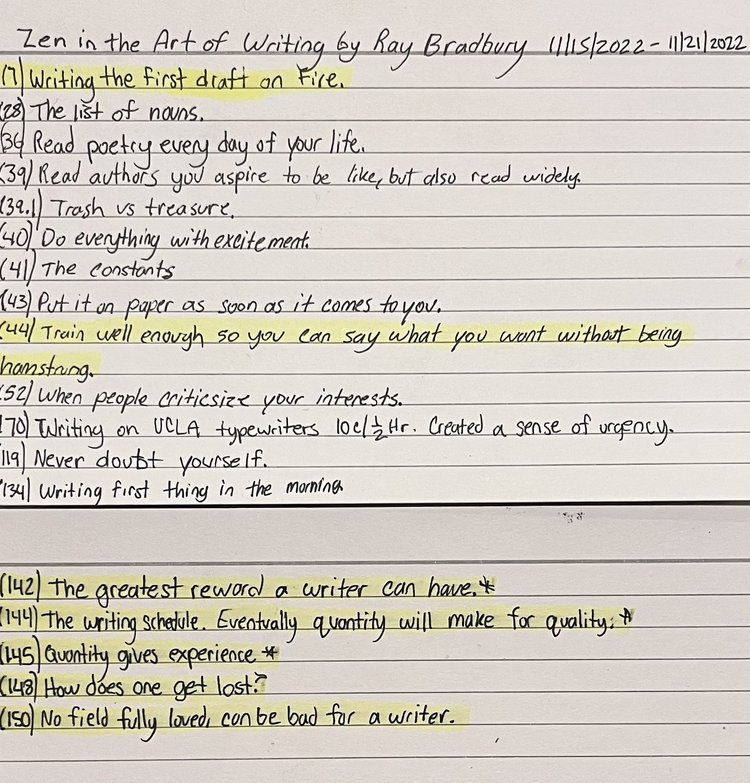
Writing is hard and the amount of time that is spent editing turns off many aspiring writers. There’s no way around it, you must edit your work, but does that mean you can’t have fun before that? Bradbury talks about writing the first draft on fire, “The history of each story, then, should read almost like a weather report: Hot today, cool tomorrow. This afternoon, burn down the house. Tomorrow, pour cold critical water upon the simmering coals. Time enough to think and cut and rewrite tomorrow. But today explode-fly apart-disintegrate! The other six or seven drafts are going to be pure torture. So why not enjoy the first draft, in the hope that your joy will seek and find others in the world who, reading your story, will catch fire, too?”
Enjoy that first draft, and don’t worry about editing, the first draft is supposed to be garbage. You will have plenty of time to go over and over to edit, cherish that first draft, and pour your heart and soul into it.
Stop Caring What Others Think
Ray Bradbury was once bullied by his classmates because he loved to collect Buck Rogers comic strips. He went home in a rage and destroyed all his comic strips, after about a week or so he realized he was miserable and missed one of his favorite things in life. He ran back to Buck Rogers and never let anyone else dictate what content he would enjoy. As Bradbury would say about individuals that criticize your interests: “I went back to collecting Buck Rogers. My life has been happy ever since. For that was the beginning of my writing science fiction. Since then, I have never listened to anyone who criticized my taste in space travel, sideshows or gorillas. When this occurs, I pack up my dinosaurs and leave the room.”
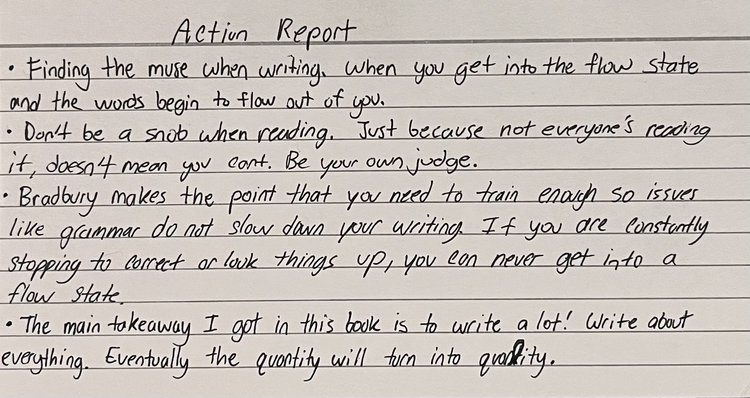
If someone criticizes your interests, pack it up and leave the room, but this also goes to respecting others’ interests. Just because a group of people thinks a book sucks, don’t be a snob about it, and find out for yourself. As Bradbury would advise, to read deeply, but also widely,
“Read those authors who write the way you hope to write, those who think the way you would like to think. But also read those who do not think as you think or write as you want to write, and so be stimulated in directions you might not take for many years.
“Here again, don’t let the snobbery of others prevent you from reading Kipling, say, while no one else is reading him. Ours is a culture and a time immensely rich in trash as it is in treasures. Sometimes it is a little hard to tell the trash from the treasure, so we hold back, afraid to declare ourselves. But since we are out to give ourselves texture, to collect truths on many levels, and in many ways, to test ourselves against life, and the truths of others, offered us in comic strips, TV shows, books, magazines, newspapers, plays, and films, we should not fear to be seen in strange companies.”
Don’t Let the Basics Hamstring You
If you want to gain mastery over something you need to train enough so that you can be in a flow state while doing it. If you are getting in the zone while working out, you can’t stop constantly to look up how to do an exercise correctly. In writing, you can’t have a great writing session if you are constantly checking your grammar or looking up how to spell certain words. These skills are important, but they put a damper on our flow state, the more we practice the craft, the easier it is to master the entry-level skills so that they do not hinder us. Work on your craft enough so that when you start making great progress, you aren’t constantly interrupted by the basics.
Quantity Produces Quality
Bradbury emphasizes that people are worried they are not producing quality work, so they stop producing. We should go in the other direction, produce as much as we can, get all the junk out of you, and eventually, enough quantity will produce something of quality. It may seem counterproductive but all the quantity you are producing is also experience you are producing, and experience will make you better at whatever skill you want to master.
Bradbury says, “Quantity gives experience. From experience alone can quality come. All arts, big and small, are the elimination of waste motion. The artist learns what to leave out. The surgeon knows how to go directly to the source of trouble, how to avoid wasted time and complications. The athlete learns how to conserve power and apply it now here, now there, how to utilize this muscle, rather than that.
Is the writer different? I think not.”
Do It a Lot!
The main takeaway I got from this book was to find what you want to do and do it a lot! Consume content widely and do not let others’ opinions dictate what you want to enjoy or do. In the end, it is your life, and if you want to become a writer or pro gamer, do it because you love it, not because others told you it was cool. Ray Bradbury has been a tremendous influence on me going forward, and I plan on applying many of the lessons I learned from his book to my writing. I strongly recommend it to anyone that wants to master a skill because even though he is talking about writing, these strategies can be applied to any skill you want to master.
My Reading Notes
 Book Ponder
Leave a comment