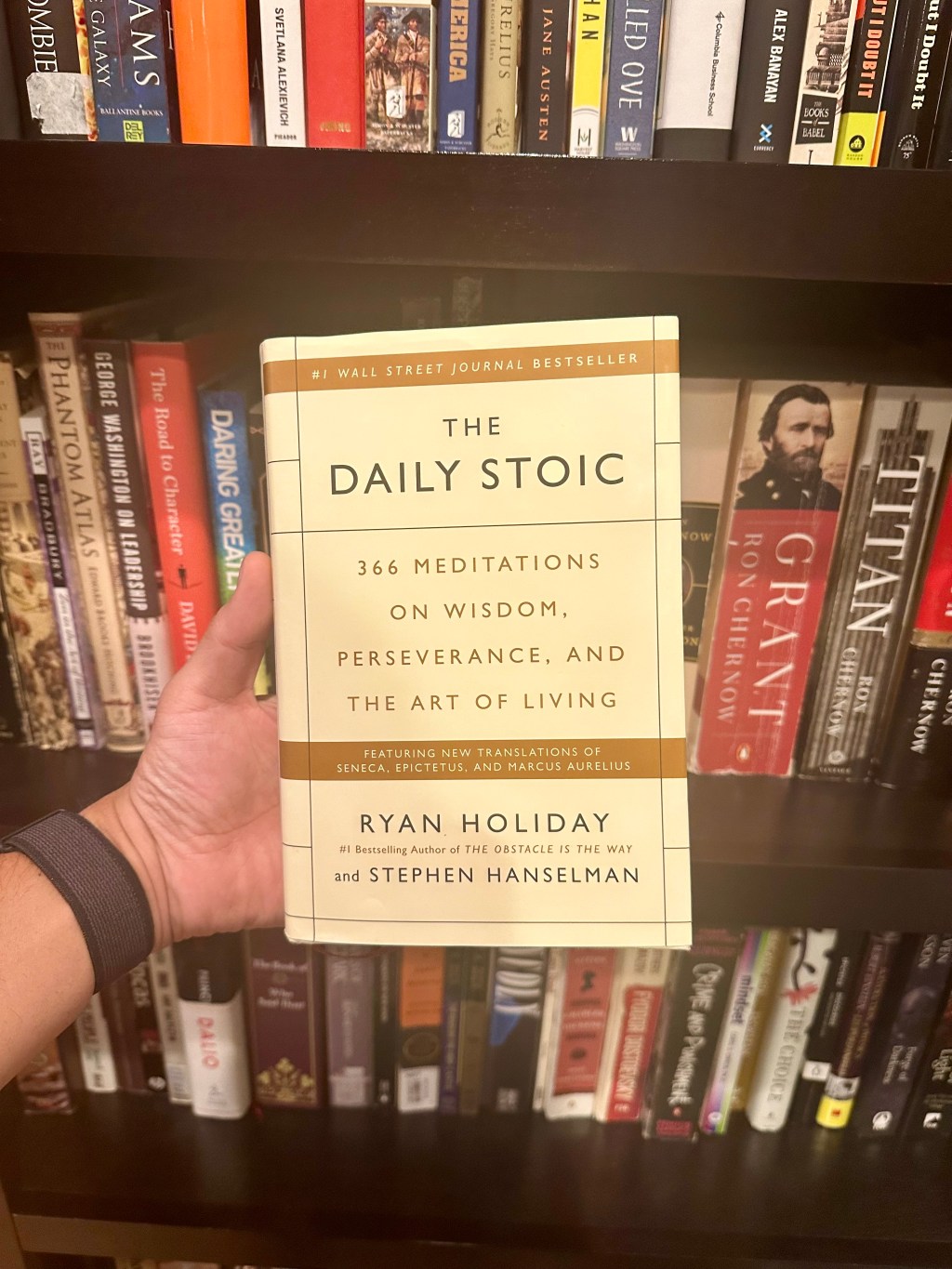
- The Daily Stoic by Ryan Holiday
- Published: October 18, 2016
- Pages: 416
- Read: December 19, 2022 – November 15, 2023
- Rating 5/5 Stars

The Daily Stoic is a daily devotional by Ryan Holiday that has a new piece of advice for life from the stoics everyday. Last year I read The Daily Laws by Robert Greene and in 2024 I plan to read The Daily Dad also by Ryan Holiday and The Daily Pressfield by Steven Pressfield. The best thing about daily devotional’s is that even though its usually one page a day, it helps facilitate the habit of reading everyday. Like the majority of Ryan Holiday’s works, the Daily Stoic was exceptional and I ended up highlighting 98 passages from it, one short from my record (Meditations by Marcus Aurelius has 99). Out of those 98 saved passages, these are the 22 lessons I learned from The Daily Stoic.
Stop Complaining
“We have a choice: Do we focus on the ways we have been wronged, or do we use what we’ve been given and get to work? Will we wait for someone to save us, or will we listen to Marcus Aurelius’s empowering call to ‘get active in your own rescue—if you care for yourself at all—and do it while you can.’” – Ryan Holiday
Take responsibility for everything that happens in your life, if you keep waiting around for someone to rescue you or come fix your problems then you will never move on with your life, you will sit in a vicious cycle of doing nothing because you feel like the world owes you something.
“‘Character,’ Joan Didion would write in one of her best essays, ‘the willingness to accept responsibility for one’s own life—is the source from which self-respect springs.’ Marcus is urging us not to waste time complaining about what we haven’t got or how things have worked out. We have to quit monkeying around and be the owners of our own lives. Character can be developed, and when it is, self-respect will ensue. But that means starting and getting serious about it. Not later, not after certain questions have been answered or distractions dealt with, but now. Right now. Taking responsibility is the first step.” – Ryan Holiday
A big theme in Ryan’s writing is to stop waiting around for things to be perfect or we will wait forever. Regardless of the circumstances you have been given, you need to start now!
“Don’t allow yourself to be heard any longer griping about public life, not even with your own ears!”—MARCUS AURELIUS, MEDITATIONS, 8.9
If you want to change from a person that is constantly complaining to someone that accepts the circumstances of life then stop complaining even to yourself. Step one should be to not be heard complaining in front of others, but our brains are smart enough to detect that we are still thinking those negative thoughts internally. Step two is to take it a step further and stop complaining even to yourself, if you can’t do anything about the problem then move on. You will be amazed how greatly your quality of life improves when you remove complaining from the equation. This isn’t an overnight change, it takes work, but isn’t working for something the point? If it was easy everybody would do it.
Do All That Can Be Done Each Day
“Let us therefore set out whole-heartedly, leaving aside our many distractions and exert ourselves in this single purpose, before we realize too late the swift and unstoppable flight of time and are left behind. As each day arises, welcome it as the very best day of all, and make it your own possession. We must seize what flees.”—SENECA, MORAL LETTERS, 108.27b–28a
“You will only get one shot at today. You have only twenty-four hours with which to take it. And then it is gone and lost forever. Will you fully inhabit all of today? Will you call out, “I’ve got this,” and do your very best to be your very best? What will you manage to make of today before it slips from your fingers and becomes the past? When someone asks you what you did yesterday, do you really want the answer to be “nothing”?” – Ryan Holiday
“We can’t do this life thing halfheartedly. There’s no time off. There aren’t even weekends. We are always preparing for what life might throw at us—and when it does, we’re ready and don’t stop until we’ve handled it.” – Ryan Holiday
“Let us prepare our minds as if we’d come to the very end of life. Let us postpone nothing. Let us balance life’s books each day. . . . The one who puts the finishing touches on their life each day is never short of time.”—SENECA, MORAL LETTERS, 101.7b–8a
If we have the luxury of leaving this life peacefully and have time to reflect on our lives, I bet you will wish you had done more with your time. That sense of urgency needs to be there because life is only long when you look at it on a day to day basis. If we step back and look at the big picture of life its actually not that long, don’t be that guy on your death bed wishing you had done more, how great would it be to leave this world knowing you did all that you could possibly do?
“Whatever humble art you practice: Are you sure you’re making time for it? Are you loving what you do enough to make the time? Can you trust that if you put in the effort, the rest will take care of itself? Because it will. Love the craft, be a craftsman.” – Ryan Holiday
What is your thing? It can be anything you feel passionate about, just commit to it. Stop half heartedly doing things, you will be pleasantly surprised at the difference in the results when you give something your full effort.
“The answer to the question “Why did you do the right thing?” should always be “Because it was the right thing to do.” After all, when you hear or see another person do that—especially when they might have endured some hardship or difficulty as a consequence for doing that right thing—do you not think, There, that is a human being at their finest? So why on earth do you need thanks or recognition for having done the right thing? It’s your job.” – Ryan Holiday
How often do we find ourselves doing the right thing only to but upset that we didn’t get any recognition for it? If thats the case then we are doing the right thing for the wrong reasons, we should be doing the right thing because its the right thing to do, even if no one in the world ever finds out, it doesn’t matter, because we will know we did the right thing. Isn’t what we think about ourselves when no one else is around what truly matters?
“Let each thing you would do, say or intend be like that of a dying person.”—MARCUS AURELIUS, MEDITATIONS, 2.11.1
“Don’t behave as if you are destined to live forever. What’s fated hangs over you. As long as you live and while you can, become good now.”—MARCUS AURELIUS, MEDITATIONS, 4.17
Nothing gives people a bigger sense of urgency than a terminal illness, but we are already born with a terminal illness. Death comes for us all, so why not do everything that we can do each day?
Anger Isn’t Manly
“Keep this thought handy when you feel a fit of rage coming on—it isn’t manly to be enraged. Rather, gentleness and civility are more human, and therefore manlier. A real man doesn’t give way to anger and discontent, and such a person has strength, courage, and endurance—unlike the angry and complaining. The nearer a man comes to a calm mind, the closer he is to strength.” —MARCUS AURELIUS, MEDITATIONS, 11.18.5b
In the moment, being angry and yelling may feel like a masculine trait but the real masculine trait is when you can handle stressful, aggravating, and insulting things and still manage to keep your cool. Those are the real men that receive respect from others, when words can’t get under their skin.
“Who then is invincible? The one who cannot be upset by anything outside their reasoned choice.” —EPICTETUS, DISCOURSES, 1.18.21
True invincibility is that no matter what happens to us physically, nothing can reach our minds. This is the mindset that got people like the concentration camp survivor Viktor Frankl through some of his hardest moments, knowing that the enemy can never touch your mind is true invincibility.
“He knew, as the former emperor of Rome knew, that it’s easy to fight back. It’s tempting to give them a piece of your mind. But you almost always end up with regret. You almost always wish you hadn’t sent the letter. Think of the last time you flew off the handle. What was the outcome? Was there any benefit?” – Ryan Holiday
I can’t remember a single time in my life when I lashed out with emotion and fury and didn’t regret it later. Even if my anger was justified and the other person was at fault, I always felt embarassed by the way I acted and ashamed at giving someone else the satisfaction that they could illicit that kind of reaction from me. Don’t ever make any decision when feeling strong emotions, even if you have to put it off for 5 minutes, its still better than acting in the moment.
How Many Fresh Starts Do You Need?
“We almost always know what the right thing is. We know we should not get upset, that we shouldn’t take this personally, that we should walk to the health food store instead of swinging by the drive-through, that we need to sit down and focus for an hour. The tougher part is deciding to do it in a given moment. What stops us? The author Steven Pressfield calls this force The Resistance. As he put it in The War of Art, “We don’t tell ourselves, ‘I’m never going to write my symphony.’ Instead we say, ‘I’m going to write my symphony; I’m just going to start tomorrow.’” Today, not tomorrow, is the day that we can start to be good.” – Ryan Holiday
“Pragmatism has no such hang-ups. It’ll take what it can get. That’s what Epictetus is reminding us. We’re never going to be perfect—if there is even such a thing. We’re human, after all. Our pursuits should be aimed at progress, however little that it’s possible for us to make.” – Ryan Holiday
Many times when we make one mistake in our day we chalk it up as a loss and decide that we will start fresh tomorrow. We spend the rest of that day making bad decisions and doing things that aren’t moving us towards our goals. Look back and think how many times you’ve put things off until the next day, or the next Monday morning, or the next first of the month, or even until the new year to start making changes in your life. If you make one mistake in your day just decide in that very next moment, to be good, don’t put everything off for later. We will always make mistakes or have relapses but if every time we do that we wait for another “fresh start” then we will never get to where we want to to be. We should attempt to make progress everyday. If we wait for perfection we will never start anything.
Be Ambitious but Also Be Content
There is nothing wrong with working hard and wanting to better yourself but when you cross the line and become obsessed with keeping up with others, then you will never reap any of the rewards from your hard work. Sometimes you have to take a step back and enjoy the fruits of your labor.
“We regularly covet what other people have. We desperately try to keep up with the Joneses, all the while the Joneses are miserable trying to keep up with us. It would be funny if it weren’t so sad. So today, stop trying to get what other people have. Fight your urge to gather and hoard. That’s not the right way to live and act. Appreciate and take advantage of what you already do have, and let that attitude guide your actions.” – Ryan Holiday
“Nothing can satisfy greed, but even a small measure satisfies nature. So it is that the poverty of an exile brings no misfortune, for no place of exile is so barren as not to produce ample support for a person.”—SENECA, ON CONSOLATION TO HELVIA, 10.11b
Look back 10 to 15 years and compare your quality of life to what you have today. This exercise may not be beneficial for everyone, but for the majority of people you most likely are making more money, have accomplished more things, and live a higher quality of life. Yet we still feel like it’s never enough and if we just had one more thing then it would be enough. Let me tell you, that one more thing will never come, you will always find another, instead, reflect back to what your former self would think if they could travel in time to spend a day in your life right now. Would they tell you to stop complaining and enjoy the fruits of your labor? On the other side of this argument, if you are a young person or someone who is struggling in life right now, use this scenario to make it a goal for for you to look back with pride in 10 to 15 years at everything you accomplished.
Practice Deep Leisure
“Leisure without study is death—a tomb for the living person.”—SENECA, MORAL LETTERS, 82.4
The down time we have shouldn’t be used to sit around and do nothing. Our brains need to be working and learning so it doesn’t atrophy just like muscles do when they aren’t being used. Our time off from work and responsibilities should be spent doing leisure activities that continue to help us grow. We shouldn’t waste our time sitting on the couch watching TV or doom scrolling social media, instead pickup a hobby or craft, read some books, or learn something new. Our brains want to continually be engaged in something. That’s why they always advise older people to solve puzzles and do activities to stay sharp and stave off dementia. If we want to spend time doing activities like watching Netflix or movies then we should at least schedule them for set times so we don’t waste hours away binging tv shows. Instead of wasting these hours away on our own we should take advantage of movies or tv and mix it in with family time. Perhaps movies will only be watched as a family, or tv shows with a spouse so it’s something you can do together.
Pray for the Strength Instead of the Result
“Try praying differently, and see what happens: Instead of asking for ‘a way to sleep with her,’ try asking for ‘a way to stop desiring to sleep with her.’ Instead of ‘a way to get rid of him,’ try asking for ‘a way to not crave his demise.’ Instead of ‘a way to not lose my child,’ try asking for ‘a way to lose my fear of it.’”—MARCUS AURELIUS, MEDITATIONS, 9.40.(6)
We are always praying for things to happen for us but why don’t we pray for the strength to accomplish or quit whatever the thing we are praying for is? Why are we praying for the outcome instead of the ability to produce the outcome on our own? It’s a cop out to just ask for the result without putting in the work for it.
Examine Yourself Everyday
“To what are you committed? What cause, what mission, what purpose? What are you doing? And more important, why are you doing it? How does what you do every day reflect, in some way, the values you claim to care about? Are you acting in a way that’s consistent with something you value, or are you wandering, unmoored to anything other than your own ambition? When you examine these questions, you might be uncomfortable with the answers. That’s good. That means you’ve taken the first step to correcting your behavior—to being better than those wild creatures Marcus mentions. It also means you’re closer to discovering what your duty calls you to do in life. And once you discover it, you’ve moved a little bit closer to fulfilling it.” – Ryan Holiday
When I first read this quote it gave me the desire to start examining myself everyday. We often go through life doing our day to day activities but never slowing down enough to truly examine ourselves. Have we gone astray? Are our actions still moving us towards our goals? Sometimes a moment of self reflection can give us a deep insight in what kind of progress we are making and what changes we need to make to get back on track.
Keep the Streak Alive
“The comedian Jerry Seinfeld once gave a young comic named Brad Isaac some advice about how to write and create material. Keep a calendar, he told him, and each day that you write jokes, put an X. Soon enough, you get a chain going—and then your job is to simply not break the chain. Success becomes a matter of momentum. Once you get a little, it’s easier to keep it going. Whereas Seinfeld used the chain method to build a positive habit, Epictetus was saying that it can also be used to eliminate a negative one. It’s not all that different than taking sobriety “one day at a time.” Start with one day doing whatever it is, be it managing your temper or wandering eyes or procrastination. Then do the same the following day and the day after that. Build a chain and then work not to break it. Don’t ruin your streak.” – Ryan Hoilday
Starting a streak for a positive action that you want to turn into a habit can be a great tool to get you through the hard days when you dont feel like doing it. Just like discipline doesn’t require motivation, starting a streak for something will help you do it on the tough days so you don’t break the streak. When you have gone to the gym for 35 days in a row, the feeling of starting over from zero will outweigh the fatigue of only sleeping 4 hours the night before. It might even translate to you going to bed earlier the next day. Implementing good habits is hard work, use all the tools at your disposal to accomplish it.
Limit Your Attachments
“According to Anthony de Mello, “there is one thing and only one thing that causes unhappiness. The name of that thing is Attachment.” Attachments to an image you have of a person, attachments to wealth and status, attachments to a certain place or time, attachments to a job or to a lifestyle. All of those things are dangerous for one reason: they are outside of our reasoned choice. How long we keep them is not in our control.” – Ryan Holiday
Next time you are unhappy think of what is causing it, most likely it’s some sort of attachment. A responsible adult isn’t going to wake up one morning and get rid of all of their attachments, but we can begin to remove the ones that are truly causing us unhappiness. If there are attachments that we can’t get rid of then those are the ones we need to find ways to accommodate and make changes in so they do not sabotage us.
Prioritize Yourself
“I’m constantly amazed by how easily we love ourselves above all others, yet we put more stock in the opinions of others than in our own estimation of self. . . . How much credence we give to the opinions our peers have of us and how little to our very own!”—MARCUS AURELIUS, MEDITATIONS, 12.4
Why are we so obsessed with what others think about us to the point that we will do things that go against our beliefs or what is enjoyable to us in order to satisfy them? Shouldn’t we be the most important thing? Prioritize instead on what you feel is best, and how something will make you feel. At the end of the day you are the one who has to live with the choices you make in your life, so do the things you enjoy, wear the clothes you like, read the books you get satisfaction from, and stop doing things to impress others.
Stop Multitasking
“Winifred Gallagher, in her book Rapt, quotes David Meyer, a cognitive scientist at the University of Michigan: “Einstein didn’t invent the theory of relativity while he was multitasking at the Swiss patent office.” It came after, when he really had time to focus and study. Attention matters—and in an era in which our attention is being fought for by every new app, website, article, book, tweet, and post, its value has only gone up. Part of what Epictetus is saying here is that attention is a habit, and that letting your attention slip and wander builds bad habits and enables mistakes. You’ll never complete all your tasks if you allow yourself to be distracted with every tiny interruption. Your attention is one of your most critical resources. Don’t squander it!” – Ryan Holiday
Be skeptical of people who say they thrive while multitasking, most likely they aren’t doing great work or are multitasking on tasks that can be done passively. The important things need focus, leave the multitasking for activities that do not need any cognitive effort. A common rule of thumb for believers of deep work is that 1 hour of fully focused, undistracted work, is the equivalent to 4 hours of muiltitasking, distracted work. If it’s important give it all your attention.
Stop Talking About Yourself
“If that’s too heady, remember that as Epictetus points out, there is another reason not to tell stories about your past. It’s boring, annoying, and self-absorbed. It might make you feel good to dominate the conversation and make it all about you, but how do you think it is for everyone else? Do you think people are really enjoying the highlights of your high school football days? Is this really the time for another exaggerated tale of your sexual prowess? Try your best not to create this fantasy bubble—live in what’s real. Listen and connect with people, don’t perform for them.” – Ryan Holiday
It’s happened to all of us at some point, either you are the one who is excited about a story are are incredibly passionate about being the center of attention, in reality the story may be really interesting to you because you experienced it, but to others its not so exciting. On the other hand you’ve been in the opposite position where someone else is dominating the room with their awesome story and you can’t help from thinking, “this person really loves the sound of their own voice.” There is a balance when it comes to being self aware with your social skills.
Be Strict With Yourself and Patient With Others
Not everyone has the same advantages we did. At times it’s hard to fathom why certain people do the things that they do but you don’t know what situations they’ve been in or what their upbringing was. Who knows what our actions would be if we were in the same scenario as them. Be kind and have patience.
“Some people are sharp and others dull; some are raised in a better environment, others in worse, the latter, having inferior habits and nurture, will require more by way of proof and careful instruction to master these teachings and to be formed by them—in the same way that bodies in a bad state must be given a great deal of care when perfect health is sought.”—MUSONIUS RUFUS, LECTURES, 1.1.33–1.3.1–3.
“First practice not letting people know who you are—keep your philosophy to yourself for a bit. In just the manner that fruit is produced—the seed buried for a season, hidden, growing gradually so it may come to full maturity. But if the grain sprouts before the stalk is fully developed, it will never ripen. . . . That is the kind of plant you are, displaying fruit too soon, and the winter will kill you.”—EPICTETUS, DISCOURSES, 4.8.35b–37
Just buckle down and do the work instead of flaunting it to everyone. You need to be doing it for yourself not anyone else.
“When philosophy is wielded with arrogance and stubbornly, it is the cause for the ruin of many. Let philosophy scrape off your own faults, rather than be a way to rail against the faults of others.” – Ryan Holiday
Use what you learn from philosophy to better yourself, not to compare yourself to others. Leave people to their own faults, be their if they ask for help, but instead of knocking on doors showing off the new you, lead by example. Let others see the power of stoicism by the actions you take and the type of person you become.
Take Action
“For it’s disgraceful for an old person, or one in sight of old age, to have only the knowledge carried in their notebooks. Zeno said this . . . what do you say? Cleanthes said that . . . what do you say? How long will you be compelled by the claims of another? Take charge and stake your own claim—something posterity will carry in its notebook.”—SENECA, MORAL LETTERS,
“Stop wandering about! You aren’t likely to read your own notebooks, or ancient histories, or the anthologies you’ve collected to enjoy in your old age. Get busy with life’s purpose, toss aside empty hopes, get active in your own rescue—if you care for yourself at all—and do it while you can.”—MARCUS AURELIUS, MEDITATIONS, 3.14
All these great quotes you read were at some point someone’s original thoughts. Create your own original thoughts. Do something with all the knowledge you are collecting. Create your own thing or else you are just a collector of information. We have dictionaries and the internet for that and they do a much better job at it. Either create something, or apply what you learn to improve your life and help others.
Read for the Right Reasons
“From Rusticus . . . I learned to read carefully and not be satisfied with a rough understanding of the whole, and not to agree too quickly with those who have a lot to say about something.” —MARCUS AURELIUS, MEDITATIONS, 1.7.3
“What’s the point of having countless books and libraries, whose titles could hardly be read through in a lifetime. The learner is not taught, but burdened by the sheer volume, and it’s better to plant the seeds of a few authors than to be scattered about by many.”—SENECA, ON TRANQUILITY OF MIND, 9.4
We’re reading to gain lessons, not to check off a box or impress our teachers. Reading has slowly become something that makes you look cool or smart but people are forgetting the real reason why we started reading, because it helped us get better. We see speed reading fads or reading goals which are fine, if they encourage us to read more, but we shouldn’t lose sight of the real reason why reading is so important. You know when you have found a real reader who does it for the right reasons, because when you ask them how many books they’ve read or how they keep track, they say they have no clue, they just know they read a lot. Many great readers couldn’t care less if they finish the book or not, they may just read certain chapters that resonate with them or give them the lessons they are looking for and forget the rest. They know reading is a tool, not something to make you look cool.
Using Books as Mentors
“We are fortunate enough that some of the greatest men and women in history have recorded their wisdom (and folly) in books and journals. Many others have had their lives chronicled by a careful biographer—from Plutarch to Boswell to Robert Caro. The literature available at your average library amounts to millions of pages and thousands of years of knowledge, insight, and experience. Maybe your parents were poor role models, or you lacked a great mentor. Yet if we choose to, we can easily access the wisdom of those who came before us—those whom we aspire to be like. We not only owe it to ourselves to seek out this hard-won knowledge, we owe it to the people who took the time to record their experiences to try to carry on the traditions and follow their examples—to be the promising children of these noble parents.” – Ryan Holiday
A book contains knowledge that took someone a lifetime to acquire. It is packaged nicely for us to learn from and use as a guide in our careers. Every career in the world has a success story someone put into a book, use it as your mentor when no one else is around to guide you.
Walking Is a Superpower
“Throughout the ages, philosophers, writers, poets, and thinkers have found that walking offers an additional benefit—time and space for better work. As Nietzsche would later say: “It is only ideas gained from walking that have any worth.” Today, make sure you take a walk. And in the future, when you get stressed or overwhelmed, take a walk. When you have a tough problem to solve or a decision to make, take a walk. When you want to be creative, take a walk. When you need to get some air, take a walk. When you have a phone call to make, take a walk. When you need some exercise, take a long walk. When you have a meeting or a friend over, take a walk together. Nourish yourself and your mind and solve your problems along the way.” – Ryan Holiday
When is the last time you went on a walk fully disconnected from the world and allow yourself to be alone with your thoughts? Many people reap the health benefits of walking but they use it to listen to music, podcasts, or books. Theres nothing wrong with that, I get a lot of my knowledge from hours spent running, walking, and driving through audio, but every once in awhile its refreshing to do these activities without any distraction and let your mind wander. You will be surprised where your thoughts will go and the great ideas that will come to you when you let your mind wander without any clear direction.
We Are All Human Beings
“Marcus liked to point out that Alexander the Great—one of the most passionate and ambitious men who ever lived—was buried in the same ground as his mule driver. Eventually, all of us will pass away and slowly be forgotten. We should enjoy this brief time we have on earth—not be enslaved to emotions that make us miserable and dissatisfied.” – Ryan Holiday
The professional athletes or celebrities you look up to are very similar to us. They don’t have some special super power that we don’t have, they aren’t a different species, they’re bodies and brains generally work the same way that ours do, yet they were still able to be successful. Outside of extreme circumstances, nothing is stopping you from also being great at whatever you put your mind to.
We Are Slaves to Our Vices
“Show me someone who isn’t a slave! One is a slave to lust, another to greed, another to power, and all are slaves to fear. I could name a former Consul who is a slave to a little old woman, a millionaire who is the slave of the cleaning woman. . . . No servitude is more abject than the self-imposed.”—SENECA, MORAL LETTERS, 47.17
We are all slaves to something we are addicted to or things that affect how we act or feel. Find things you are dependent on and try to deprive yourself from them for a set amount of time. This will show you which things really have control over you, you will be surprised on how many things you are overly dependent on.
You Are the Average of Your Surroundings
“One of Goethe’s maxims captures it better: ‘Tell me with whom you consort and I will tell you who you are.’” – Ryan Holiday
“Consciously consider whom you allow into your life—not like some snobby elitist but like someone who is trying to cultivate the best life possible. Ask yourself about the people you meet and spend time with: Are they making me better? Do they encourage me to push forward and hold me accountable? Or do they drag me down to their level? Now, with this in mind, ask the most important question: Should I spend more or less time with these folks?” – Ryan Holiday
Once you have made a change in your life you can’t expect everyone else to have made that change to. They will also have their moment just as you had yours so you can’t look down and scoff at them because they aren’t on your level yet, it didn’t feel good when others did that to you, when you were still struggling to make a change.
Review Your Day
“I will keep constant watch over myself and—most usefully—will put each day up for review. For this is what makes us evil—that none of us looks back upon our own lives. We reflect upon only that which we are about to do. And yet our plans for the future descend from the past.” —SENECA, MORAL LETTERS, 83.2
It’s a good idea to periodically give yourself an examination. Audit the different areas of your life and find areas that require improvements. This is made easier by creating a habit of reviewing our day. When your winding down for bed, reflect on your day and find things that triggered negative emotions and positive emotions in you. Reviewing and documenting these triggers will help you continue to grow.
I am a big fan of daily devotionals and The Daily Stoic is a great introduction to a new Ryan Holiday reader, someone curious about stoicism, or a seasoned reader that wants a nugget of wisdom everyday.
 Book Ponder
Leave a comment